Joint dislocation
Displacement of bones in a joint
| Joint dislocation | |
|---|---|
| Ankledislocation.JPG | |
| A traumatic dislocation of the tibiotarsal joint of the ankle with distal fibular fracture. Open arrow marks the tibia and the closed arrow marks the talus. | |
| Synonyms | Latin: luxatio
|
| Specialty | Orthopedics, Emergency medicine |
| Symptoms | Pain, swelling, visible deformity, inability to move the joint, bruising |
| Complications | Nerve injury, vascular injury, fracture, joint instability, arthritis |
| Usual onset | Sudden (trauma-related) |
| Duration | Variable; may resolve with treatment or lead to chronic instability |
| Types | Shoulder, elbow, hip, knee, finger, ankle, etc. |
| Causes | Trauma, falls, sports injuries, congenital conditions, ligament laxity |
| Risk factors | Contact sports, previous dislocations, joint hypermobility, accidents |
| Diagnosis | Physical examination, X-ray, MRI |
| Differential diagnosis | Fracture, sprain, ligament tear |
| Prevention | Protective gear in sports, proper technique, muscle strengthening, avoid high-risk activities |
| Treatment | Joint reduction, immobilization, physical therapy, surgical repair in some cases |
| Medication | Analgesics, NSAIDs, muscle relaxants |
| Prognosis | Good with prompt treatment, though risk of recurrence exists |
| Frequency | Common in sports and trauma cases |
| Deaths | Rare; typically due to associated trauma (e.g., vascular compromise) |
Joint dislocation, also known as luxation, occurs when there is an abnormal separation in the joint where two or more bones meet. A dislocated joint is a condition that requires immediate medical attention to prevent further damage to the surrounding ligaments, tendons, muscles, and nerves.
Causes[edit]
Joint dislocations are typically caused by a sudden impact to the joint. This can occur during sports activities, falls, or trauma such as a motor vehicle accident. The force of the impact can push the bones out of their normal position.
Symptoms[edit]
The symptoms of a joint dislocation include:
- Intense pain at the joint
- Swelling or bruising
- Visible deformity of the joint
- Inability to move the joint
- Numbness or tingling sensation
Diagnosis[edit]
Diagnosis of a joint dislocation is typically made through a physical examination and confirmed with imaging studies such as X-rays or MRI scans. These tests help to determine the extent of the dislocation and any associated injuries.
Treatment[edit]
The primary treatment for a dislocated joint is to reposition the bones back into their normal alignment, a process known as reduction. This can be done manually by a healthcare professional. In some cases, surgery may be required to repair damaged structures or to stabilize the joint.
After reduction, the joint may be immobilized with a splint or cast to allow for healing. Physical therapy is often recommended to restore strength and range of motion.
Complications[edit]
Complications from joint dislocations can include:
- Damage to surrounding tissues
- Arthritis in the affected joint
- Recurrent dislocations
- Nerve damage
Prevention[edit]
Preventive measures for joint dislocations include:
- Using protective gear during sports
- Strengthening muscles around the joint
- Practicing proper techniques in physical activities
Gallery[edit]
-
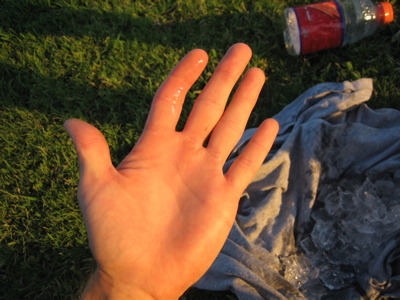 Dislocation of the left index finger
 -
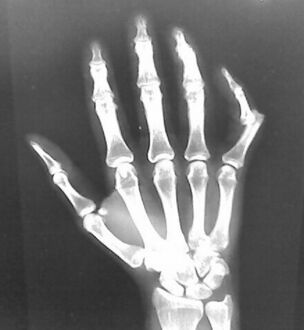 Radiograph of right fifth phalanx bone dislocation
 -
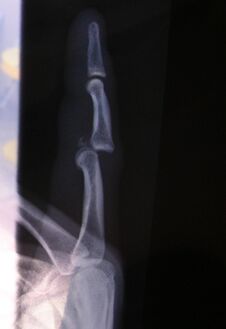 Radiograph of left index finger dislocation
 -
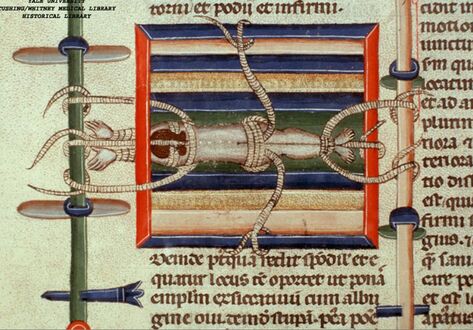 Depiction of reduction of a dislocated spine, ca. 1300
 -
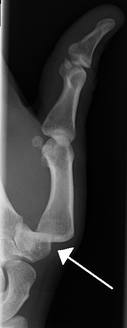 Dislocation of the carpo-metacarpal joint.
 -
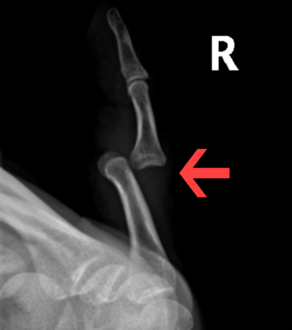 Radiograph of right fifth phalanx dislocation resulting from bicycle accident
 -
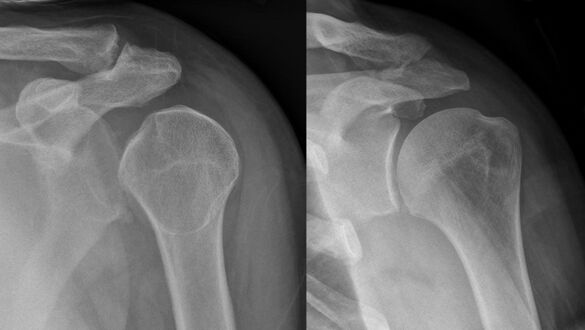 Shoulder dislocation before (left) and after (right) being reduced
 -
![X-ray of ventral dislocation of the radial head. There is calcification of annular ligament, which can be seen as early as 2 weeks after injury.[1]](/images/6/66/X-ray_of_ventral_dislocation_of_the_radial_head_with_calcification_of_annular_ligament.jpg)


![X-ray of ventral dislocation of the radial head. There is calcification of annular ligament, which can be seen as early as 2 weeks after injury.[1]](/wiki/File:X-ray_of_ventral_dislocation_of_the_radial_head_with_calcification_of_annular_ligament.jpg)
Related pages[edit]
External links[edit]
| Dislocations/subluxations, sprains and strains | ||||
|---|---|---|---|---|
|
| Trauma | ||||||||||||||||||||
|---|---|---|---|---|---|---|---|---|---|---|---|---|---|---|---|---|---|---|---|---|
|
- ↑ Earwaker J."Posttraumatic calcification of the annular ligament of the radius.".Skeletal Radiol.1992;21(3)
- 149–54.doi:10.1007/BF00242127.PMID:1604339.

Medical Disclaimer: WikiMD is for informational purposes only and is not a substitute for professional medical advice. Content may be inaccurate or outdated and should not be used for diagnosis or treatment. Always consult your healthcare provider for medical decisions. Verify information with trusted sources such as CDC.gov and NIH.gov. By using this site, you agree that WikiMD is not liable for any outcomes related to its content. See full disclaimer.
Credits:Most images are courtesy of Wikimedia commons, and templates, categories Wikipedia, licensed under CC BY SA or similar.
Translate page: - East Asian
中文,
日本,
한국어,
South Asian
हिन्दी,
தமிழ்,
తెలుగు,
Urdu,
ಕನ್ನಡ,
Southeast Asian
Indonesian,
Vietnamese,
Thai,
မြန်မာဘာသာ,
বাংলা
European
español,
Deutsch,
français,
Greek,
português do Brasil,
polski,
română,
русский,
Nederlands,
norsk,
svenska,
suomi,
Italian
Middle Eastern & African
عربى,
Turkish,
Persian,
Hebrew,
Afrikaans,
isiZulu,
Kiswahili,
Other
Bulgarian,
Hungarian,
Czech,
Swedish,
മലയാളം,
मराठी,
ਪੰਜਾਬੀ,
ગુજરાતી,
Portuguese,
Ukrainian

