Ayam masak merah
Ayam masak merah is a traditional Malaysian dish. The name translates to "chicken cooked red", which refers to the vibrant red color of the dish, achieved through the use of tomato sauce and chili paste. This dish is a staple in many Malaysian households and is often served during special occasions and festivities such as Eid al-Fitr and weddings.
Ingredients[edit]
The main ingredient in ayam masak merah is chicken, which is typically marinated in a mixture of spices and then fried until golden brown. The chicken is then simmered in a spicy tomato sauce until it is fully cooked and the flavors have melded together. Other key ingredients include garlic, onions, lemongrass, ginger, and turmeric. Some variations of the recipe also include coconut milk to add a creamy texture and balance out the spiciness of the dish.
Preparation[edit]
The preparation of ayam masak merah involves several steps. First, the chicken is marinated in a mixture of spices and left to sit for several hours, or overnight. The chicken is then fried until it is golden brown. Meanwhile, a paste is made from the garlic, onions, lemongrass, ginger, and turmeric. This paste is sautéed until fragrant, and then the tomato sauce and chili paste are added. The fried chicken is then added to the sauce and simmered until it is fully cooked and the flavors have melded together.
Cultural Significance[edit]
Ayam masak merah is a popular dish in Malaysia and is often served during special occasions and festivities. It is a common sight at Malay weddings, where it is often part of a larger feast. The dish is also commonly served during the Muslim holiday of Eid al-Fitr, which marks the end of Ramadan, the Islamic holy month of fasting.


-
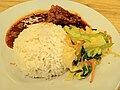 Nasi ayam masak merah
_at_Lotus%27s_Mutiara_Damansara_20231112_122914.jpg)
Ad. Transform your life with W8MD's
GLP-1 weight loss injections special from $29.99 with insurance
|
WikiMD Medical Encyclopedia |
Medical Disclaimer: WikiMD is for informational purposes only and is not a substitute for professional medical advice. Content may be inaccurate or outdated and should not be used for diagnosis or treatment. Always consult your healthcare provider for medical decisions. Verify information with trusted sources such as CDC.gov and NIH.gov. By using this site, you agree that WikiMD is not liable for any outcomes related to its content. See full disclaimer.
Credits:Most images are courtesy of Wikimedia commons, and templates, categories Wikipedia, licensed under CC BY SA or similar.
Translate this page: - East Asian
中文,
日本,
한국어,
South Asian
हिन्दी,
தமிழ்,
తెలుగు,
Urdu,
ಕನ್ನಡ,
Southeast Asian
Indonesian,
Vietnamese,
Thai,
မြန်မာဘာသာ,
বাংলা
European
español,
Deutsch,
français,
Greek,
português do Brasil,
polski,
română,
русский,
Nederlands,
norsk,
svenska,
suomi,
Italian
Middle Eastern & African
عربى,
Turkish,
Persian,
Hebrew,
Afrikaans,
isiZulu,
Kiswahili,
Other
Bulgarian,
Hungarian,
Czech,
Swedish,
മലയാളം,
मराठी,
ਪੰਜਾਬੀ,
ગુજરાતી,
Portuguese,
Ukrainian
