Acute lymphoblastic leukemia
Blood cancer characterised by overproduction of lymphoblasts
| Acute lymphoblastic leukemia | |
|---|---|

| |
| Synonyms | Acute lymphocytic leukemia, acute lymphoid leukemia |
| Pronounce | N/A |
| Field | Hematology, oncology |
| Symptoms | Feeling tired, pale color, fever, easy bleeding or bruising, bone pain, enlarged lymph nodes<ref name=NCI2017Pt/> |
| Complications | Infection, tumor lysis syndrome |
| Onset | 2–5 years old |
| Duration | |
| Types | B-cell ALL, T-cell ALL |
| Causes | Usually unknown<ref name=MDAnd2016/> |
| Risks | Identical twin with ALL, Down syndrome, Fanconi anemia, ataxia telangiectasia, Klinefelter syndrome, high birth weight, significant radiation exposure |
| Diagnosis | Blood tests and bone marrow examination |
| Differential diagnosis | Infectious mononucleosis, acute myeloid leukemia, lymphoblastic lymphoma, aplastic anemia |
| Prevention | |
| Treatment | Chemotherapy, stem cell transplantation, |
| Medication | |
| Prognosis | Children: 90% five-year survival rate> Adults: 35% five-year survival |
| Frequency | 1 in 1,750 children |
| Deaths | 111,000 (2015) |

Acute Lymphoblastic Leukemia (ALL) is a type of cancer that primarily affects the white blood cells known as lymphocytes. It is characterized by the rapid development of immature lymphocytes, which crowd out other healthy cells in the bone marrow.
Overview and Etiology
ALL is most prevalent in children, with a peak incidence between the ages of two and five years. However, it can also occur in adults, where it generally carries a poorer prognosis. The exact cause of ALL is unknown, although it is thought to be a combination of genetic and environmental factors.<ref>Belver, L.,
 The genetics and treatment of acute lymphoblastic leukaemia,
 Nature Reviews Cancer,
 2020,
 Vol. 20,
 pp. 227–246,
 DOI: 10.1038/s41568-019-0232-4,</ref>
Signs and Symptoms
Symptoms of ALL can vary but often include fatigue, fever, bleeding or bruising easily, frequent infections, bone or joint pain, and swollen lymph nodes.
Diagnosis
Diagnosis is typically made via blood tests and bone marrow examination. The presence of immature lymphocytes, or lymphoblasts, in the blood or bone marrow is characteristic of ALL. Molecular and genetic tests may also be used to further characterize the disease and guide treatment decisions.<ref>Campana, D.,
 Minimal residual disease in acute lymphoblastic leukemia,
 Hematology,
 2010,
 Vol. 2010,
 pp. 7–12,
 DOI: 10.1182/asheducation-2010.1.7,</ref>
Treatment
Treatment for ALL generally involves chemotherapy, which can be divided into several phases including induction, consolidation, and maintenance. Other treatments, such as radiation therapy or stem cell transplantation, may be utilized in certain cases. The specific treatment plan depends on various factors such as patient age, disease subtype, and genetic profile.<ref>Pui, C.H.,
 Acute lymphoblastic leukemia: Diagnosis and treatment,
 Mayo Clinic Proceedings,
 2016,
 Vol. 91,
 pp. 1645–1666,
 DOI: 10.1016/j.mayocp.2016.09.010,</ref>
Prognosis
The prognosis for ALL varies and depends on a multitude of factors. However, the survival rate in children is generally favorable, with about 90% achieving a long-term cure. In adults, the prognosis is less favorable but has improved significantly with advancements in treatment.
-
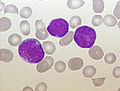 acute lymphoblastic leukemia (ALL), peripheral blood of a child, Pappenheim stain, magnification x100
 -
 bone marrow smear (large magnification) from a person with acute lymphoblastic leukemia
 -
 bone marrow smear from a person with acute lymphoblastic leukemia


References
<references />
 | |
|---|---|
 |
 |
| Arthritis in children | ||||||||||||||||||
|---|---|---|---|---|---|---|---|---|---|---|---|---|---|---|---|---|---|---|
|
| Chromosome abnormalities | ||||||||||||||||||||||||||
|---|---|---|---|---|---|---|---|---|---|---|---|---|---|---|---|---|---|---|---|---|---|---|---|---|---|---|
|
| Leukaemias, lymphomas and related disease | ||||
|---|---|---|---|---|
|
Ad. Transform your life with W8MD's
GLP-1 weight loss injections special from $29.99 with insurance
|
WikiMD Medical Encyclopedia |
Medical Disclaimer: WikiMD is for informational purposes only and is not a substitute for professional medical advice. Content may be inaccurate or outdated and should not be used for diagnosis or treatment. Always consult your healthcare provider for medical decisions. Verify information with trusted sources such as CDC.gov and NIH.gov. By using this site, you agree that WikiMD is not liable for any outcomes related to its content. See full disclaimer.
Credits:Most images are courtesy of Wikimedia commons, and templates, categories Wikipedia, licensed under CC BY SA or similar.
Translate this page: - East Asian
中文,
日本,
한국어,
South Asian
हिन्दी,
தமிழ்,
తెలుగు,
Urdu,
ಕನ್ನಡ,
Southeast Asian
Indonesian,
Vietnamese,
Thai,
မြန်မာဘာသာ,
বাংলা
European
español,
Deutsch,
français,
Greek,
português do Brasil,
polski,
română,
русский,
Nederlands,
norsk,
svenska,
suomi,
Italian
Middle Eastern & African
عربى,
Turkish,
Persian,
Hebrew,
Afrikaans,
isiZulu,
Kiswahili,
Other
Bulgarian,
Hungarian,
Czech,
Swedish,
മലയാളം,
मराठी,
ਪੰਜਾਬੀ,
ગુજરાતી,
Portuguese,
Ukrainian
