Nam phrik: Difference between revisions
CSV import |
CSV import |
||
| Line 26: | Line 26: | ||
{{Thai cuisine}} | {{Thai cuisine}} | ||
{{food-stub}} | {{food-stub}} | ||
<gallery> | |||
File:Nam_phrik_kapi_(cropped).JPG|Nam phrik kapi | |||
File:Nam_phrik_num.jpg|Nam phrik num | |||
File:Nam_phrik_pla_salat_ponน้ำพริกปลาสลาดป่น5323.jpg|Nam phrik pla salat pon | |||
File:Nam_phrik_long_ruea.jpg|Nam phrik long ruea | |||
File:Khao_phat_nam_phrik_narok.jpg|Khao phat nam phrik narok | |||
</gallery> | |||
Latest revision as of 11:20, 25 February 2025
Nam phrik is a type of Thai chili sauce that is commonly used as a condiment and ingredient in various dishes. The term "nam phrik" translates to "chili water" in English, which is a reference to its liquid consistency.
History[edit]
Nam phrik has been a staple in Thai cuisine for centuries. It is believed to have originated from the Ayutthaya Kingdom, which existed from 1351 to 1767. The sauce was traditionally made by pounding together chili peppers, garlic, shallots, and lime juice using a mortar and pestle.
Varieties[edit]
There are many different varieties of nam phrik, each with its own unique flavor profile. Some of the most popular types include:
- Nam phrik kapi: This version is made with fermented shrimp paste, and is one of the most common types of nam phrik.
- Nam phrik ong: This variety is similar to bolognese sauce, and is made with pork, tomatoes, and chili peppers.
- Nam phrik pla ra: This type is made with fermented fish, and has a strong, pungent flavor.
Preparation and Use[edit]
Nam phrik is typically prepared by pounding together the ingredients using a mortar and pestle. The sauce is then cooked over low heat until it reaches the desired consistency. Nam phrik is often served as a dip for raw or cooked vegetables, but it can also be used as a sauce for rice, noodles, and various types of meat.
Cultural Significance[edit]
Nam phrik is more than just a condiment in Thai cuisine; it is a symbol of Thai culture and tradition. The process of making nam phrik is often a communal activity, with family members and friends gathering together to prepare the sauce. The sauce is also a common offering at Buddhist temples, as it is believed to bring good luck and prosperity.
 Thai cuisine
 |
||||||||||
|---|---|---|---|---|---|---|---|---|---|---|
|

-
 Nam phrik kapi
 -
 Nam phrik num
 -
 Nam phrik pla salat pon
 -
 Nam phrik long ruea
 -
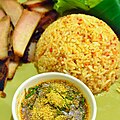 Khao phat nam phrik narok
.JPG)


