Immunity passport: Difference between revisions
CSV import |
CSV import |
||
| Line 26: | Line 26: | ||
[[Category:Public health]] | [[Category:Public health]] | ||
[[Category:COVID-19 pandemic]] | [[Category:COVID-19 pandemic]] | ||
<gallery> | |||
File:Italian_health_pass_1611.jpg|Immunity passport | |||
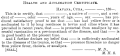
File:Health_and_Acclimation_Certificate_(cropped).gif|Immunity passport | |||
File:EU_Digital_COVID_Certificat_-_mobile.jpg|Immunity passport | |||
</gallery> | |||
Latest revision as of 04:11, 18 February 2025
Immunity passport or immunity certificate is a document that certifies a person has been infected and recovered from a disease, in this case, COVID-19. The concept is based on the assumption that recovery from COVID-19 might provide future immunity against the virus.
Concept[edit]
The concept of an immunity passport is based on the principle of herd immunity. Once a person recovers from a disease, they develop antibodies that can fight off the virus if it enters the body again. This is known as immunity. The immunity passport is a certification of this immunity, allowing the person to return to normal activities without the risk of spreading the virus.
Controversies[edit]
There are several controversies surrounding the concept of immunity passports. One of the main concerns is the lack of scientific evidence supporting the idea that people who have recovered from COVID-19 are immune to reinfection. The World Health Organization has warned against the use of immunity passports due to this uncertainty.
Another concern is the potential for discrimination and inequality. Immunity passports could create a two-tier society where those with immunity can return to normal life, while those without are still subject to restrictions.
Ethical considerations[edit]
The use of immunity passports raises several ethical issues. These include concerns about privacy, as the passports would require the collection and sharing of health data. There are also concerns about fairness, as access to testing and treatment for COVID-19 is not equally distributed.
See also[edit]
References[edit]
<references />

-
 Immunity passport
 -
 Immunity passport
 -
 Immunity passport

.gif)

