Agriculture: Difference between revisions
CSV import Tags: mobile edit mobile web edit |
|||
| Line 14: | Line 14: | ||
=== Importance and Challenges === | === Importance and Challenges === | ||
Agriculture is a vital industry that provides food and other materials for people around the world. It also plays an important role in the economy, providing jobs and income for millions of people. | Agriculture is a vital industry that provides food and other materials for people around the world. It also plays an important role in the economy, providing jobs and income for millions of people. | ||
== Glossary of | == Glossary of Agricultural Terms == | ||
* '''[[ | * '''[[Agrarian system]]''' – A dynamic set of economic and technological factors that shape [[agricultural]] practices within a given region. | ||
* '''[[ | * '''[[Agrarianism]]''' – A social and political philosophy that values rural society and the independent farmer over urban life and wage labor, emphasizing farming as a source of moral virtue and societal strength. | ||
* '''[[ | * '''[[Agribusiness]]''' – The business of agricultural production, including all activities and disciplines within modern food and fiber supply chains. | ||
* '''[[ | * '''[[Agricultural cooperative]]''' – Also called a ''farmers' co-op'' or simply a ''co-op''. An association where farmers pool resources to meet shared goals through a jointly owned enterprise. Divided into "service" and "production" types. | ||
* '''[[ | * '''[[Agricultural economics]]''' – A branch of [[economics]] that applies economic principles to optimize the production and distribution of agricultural products. | ||
* '''[[ | * '''[[Agricultural land]]''' – Land used for [[agriculture]], including [[cropland]], [[pasture]], and [[arable land]]. | ||
* '''[[ | * '''[[Agricultural productivity]]''' – A measurement of output (usually market value) relative to input (such as land, labor, or capital). | ||
* '''[[ | * '''[[Agriculture]]''' – The science and art of cultivating [[plants]], [[animals]], or other organisms for human use, especially for food, fiber, and fuel. | ||
* '''[[ | * '''[[Agrobiology]]''' – The study of [[plant nutrition]] and growth, often aimed at increasing [[crop yield]]. | ||
* '''[[ | * '''[[Agrology]]''' – A branch of [[soil science]] focusing on crop production. | ||
* '''[[ | * '''[[Agronomy]]''' – The science and technology of using [[plants]] for food, fuel, and land restoration. | ||
* '''[[ | * '''[[Algaculture]]''' – The [[aquaculture]] of [[algae]] for human uses, such as [[fertilizers]], dyes, or [[biofuels]]. | ||
* '''[[ | * '''[[Apiculture]]''' – Also known as [[beekeeping]], involving the management of [[bees]] for products like [[honey]] and pollination services. | ||
* '''[[ | * '''[[Aquaculture]]''' – The cultivation of aquatic organisms for human use, including [[pisciculture]], [[mariculture]], and [[algaculture]]. | ||
* '''[[ | * '''[[Artificial selection]]''' – The intentional breeding of organisms to promote desired traits, widely used in both [[plant breeding]] and [[animal husbandry]]. | ||
* '''[[ | * '''[[Biodynamic agriculture]]''' – An esoteric form of [[organic farming]] incorporating spiritual and holistic practices, regarded as a [[pseudoscience]]. | ||
* '''[[ | * '''[[Biofuel]]''' – Fuel produced from recently living [[biomass]], such as [[bioethanol]] or [[biodiesel]]. | ||
* '''[[ | * '''[[Bioturbation]]''' – The mixing of soil caused by organisms moving through it. | ||
* '''[[ | * '''[[Broadacre]]''' – Large-scale farmland, especially in Australian agriculture. | ||
* '''[[ | * '''[[Broadcast seeding]]''' – Scattering seed over a wide area by hand or machine, as opposed to [[row planting]]. | ||
* '''[[ | * '''[[Browsing]]''' – A form of herbivory involving feeding on woody plants, in contrast to [[grazing]]. | ||
* '''[[ | * '''[[Bumper crop]]''' – An unusually abundant [[harvest]]. | ||
* '''[[ | * '''[[Cash crop]]''' – A [[crop]] grown primarily for sale and profit rather than for personal use. | ||
* '''[[ | * '''[[Catch crop]]''' – A fast-growing [[crop]] planted between regular planting seasons to maintain soil health. | ||
* '''[[ | * '''[[Cereal]]''' – A grain-bearing [[grass]], such as [[wheat]] or [[rice]]. | ||
* '''[[ | * '''[[Chemigation]]''' – The application of chemicals through an [[irrigation]] system. | ||
* '''[[ | * '''[[Citriculture]]''' – The cultivation of [[citrus fruits]]. | ||
* '''[[ | * '''[[Collective farming]]''' – Joint agricultural production on shared land, practiced in [[cooperatives]] or [[state farms]]. | ||
* '''[[ | * '''[[Community Supported Agriculture (CSA)]]''' – A direct-to-consumer system where members receive regular shares of [[farm]] goods. | ||
* '''[[ | * '''[[Companion planting]]''' – Planting different [[crops]] together for mutual benefits such as [[pest control]] or improved [[pollination]]. | ||
* '''[[ | * '''[[Contract farming]]''' – A system where production and marketing are governed by a contract between producers and buyers. | ||
* '''[[ | * '''[[Cover crop]]''' – Crops planted primarily to protect and enrich the soil between harvests. | ||
* '''[[ | * '''[[Crop residue]]''' – Leftover organic material after harvesting, such as stalks and leaves. | ||
* '''[[Crop rotation]]''' – The practice of alternating [[crops]] seasonally to improve soil fertility and reduce [[pest]] buildup. | |||
* '''[[ | * '''[[Crop weed]]''' – A [[weed]] that grows among [[crop]] plants. | ||
* '''[[ | * '''[[Crop wild relative]]''' – A wild relative of a [[domesticated]] plant, useful in breeding programs. | ||
* '''[[ | * '''[[Crop-lien system]]''' – A credit system where a [[crop]] serves as collateral for loans during the [[growing season]]. | ||
* '''[[ | * '''[[Crop]]''' – Any cultivated plant, animal, or other organism harvested for profit or sustenance. | ||
* '''[[ | * '''[[Cultivation]]''' – The act of preparing land and growing [[crops]]. | ||
* '''[[ | * '''[[Dessert crop]]''' – A [[crop]] considered a luxury, such as [[coffee]], [[tea]], or [[cocoa]]. | ||
* '''[[ | * '''[[Drip irrigation]]''' – A water-conserving system applying water at the plant root zone. | ||
* '''[[ | * '''[[Dryland farming]]''' – [[Farming]] in areas with little rainfall, using techniques to conserve moisture. | ||
* '''[[ | * '''[[Ecology]]''' – The study of interactions between organisms and their [[environment]]. | ||
* '''[[ | * '''[[Energy crop]]''' – Crops grown specifically for [[biofuel]] production. | ||
* '''[[ | * '''[[Extensive agriculture]]''' – Agricultural systems with low input relative to land area, in contrast to [[intensive agriculture]]. | ||
* '''[[ | * '''[[Factory farming]]''' – See [[Intensive animal farming]]. | ||
* '''[[ | * '''[[Fallow]]''' – [[Arable land]] left unplanted to restore fertility. | ||
* '''[[ | * '''[[Farm crisis]]''' – An economic downturn affecting [[agriculture]], marked by low prices or income. | ||
* '''[[ | * '''[[Farm]]''' – Land used for producing [[crops]], [[livestock]], or other [[agricultural]] goods. | ||
* '''[[ | * '''[[Farmers' co-op]]''' – See [[Agricultural cooperative]]. | ||
* '''[[ | * '''[[Farmers' market]]''' – A venue for direct sale of [[agricultural]] goods from producers to consumers. | ||
* '''[[ | * '''[[Farmland]]''' – See [[Agricultural land]]. | ||
* '''[[ | * '''[[Feed grain]]''' – [[Cereal grains]] grown for [[livestock]] feed. | ||
* '''[[ | * '''[[Feedlot]]''' – A confined area for raising and fattening [[livestock]] prior to slaughter. | ||
* '''[[ | * '''[[Fertilizer]]''' – A material added to soil to enhance plant growth. | ||
* '''[[ | * '''[[Field]]''' – A plot of land used for [[cropping]] or [[grazing]]. | ||
* '''[[ | * '''[[Fish farming]]''' – See [[Pisciculture]]. | ||
* '''[[ | * '''[[Flood irrigation]]''' – A traditional method where fields are inundated with water. | ||
* '''[[ | * '''[[Floriculture]]''' – The cultivation of [[flowers]] and [[ornamental plants]]. | ||
* '''[[ | * '''[[Fodder]]''' – Food provided to [[livestock]], as opposed to that which they [[forage]]. | ||
* '''[[ | * '''[[Food miles]]''' – The distance food travels from production to consumption. | ||
* '''[[Food-feed system]]''' – A system in which crop byproducts are used to feed [[livestock]]. | |||
* '''[[ | * '''[[Foodshed]]''' – A geographic region from which a population derives its food. | ||
* '''[[ | * '''[[Forage]]''' – Plant material consumed by [[grazing]] animals. | ||
* '''[[ | * '''[[Forest farming]]''' – The production of specialty crops under a managed [[forest canopy]]. | ||
* '''[[ | * '''[[Free range]]''' – [[Animal husbandry]] where animals roam outdoors freely. | ||
* '''[[Free-range]]''' – See [[Free range]]. | |||
* '''[[Fungiculture]]''' – The [[cultivation]] of [[fungi]] for food or medicine. | |||
* '''[[Furrow irrigation]]''' – An irrigation method using trenches between crop rows. | |||
* '''[[Genetically Modified Organism (GMO)]]''' – Organisms whose genetic material has been altered for desired traits. | |||
* '''[[Gleaning]]''' – Collecting leftover crops from fields or unused goods from food systems. | |||
* '''[[Good agricultural practice]] (GAP)''' – Principles that ensure safe, sustainable, and quality food production. | |||
* '''[[Grain]]''' – Small, hard seeds harvested for food or feed, including [[cereals]] and [[pseudocereals]]. | |||
* '''[[Grass-fed]]''' – [[Livestock]] raised on pasture rather than grain. | |||
* '''[[Green manure]]''' – [[Crop residue]] left in the field to enrich the soil. | |||
* '''[[Growing season]]''' – The period during which weather conditions support plant growth. | |||
* '''[[Harrow]]''' – A tool used to smooth and break up soil. | |||
* '''[[Harvesting]]''' – The process of collecting ripe [[crops]]. | |||
* '''[[Hay]]''' – Dried [[grasses]] or [[legumes]] used as [[fodder]]. | |||
* '''[[Haylage]]''' – [[Silage]] made from high-moisture [[hay]]. | |||
* '''[[Hill farming]]''' – Extensive [[livestock]] farming in hilly terrain. | |||
* '''[[Honey wagon]]''' – See [[Manure spreader]]. | |||
* '''[[Intensive agriculture]]''' – High-input, high-yield farming systems. | |||
* '''[[Intercropping]]''' – Growing multiple [[crops]] together to optimize space and yield. | |||
* '''[[Irrigation]]''' – Controlled water application to [[crops]]. | |||
* '''[[Livestock]]''' – Domesticated animals raised for food, fiber, or labor. | |||
* '''[[Locavore]]''' – A person who prefers locally sourced food. | |||
* '''[[Mariculture]]''' – A form of [[aquaculture]] focused on marine species. | |||
* '''[[Mechanized agriculture]]''' – Agriculture using [[machinery]] to increase efficiency. | |||
* '''[[Mill]]''' – A device for grinding or processing agricultural products. | |||
* '''[[Minimum tillage]]''' – A [[conservation tillage]] practice minimizing soil disturbance. | |||
* '''[[Monoculture]]''' – Growing a single crop or [[livestock]] type in an area. | |||
* '''[[Multiple cropping]]''' – Planting more than one [[crop]] in the same area in a season. | |||
* '''[[Natural]]''' – A term for products that are minimally processed and free of artificial ingredients. | |||
* '''[[No-till farming]]''' – Farming without turning the soil to reduce erosion. | |||
* '''[[Orchard]]''' – A planned area of [[fruit]] or [[nut]] trees. | |||
* '''[[Organic]]''' – Agricultural products grown without synthetic chemicals or [[GMOs]]. | |||
* '''[[Pasture]]''' – Grazing land for [[livestock]]. | |||
* '''[[Permanent crop]]''' – A [[crop]] from a [[perennial]] plant, producing over several years. | |||
* '''[[Pharming]]''' – Genetic modification of plants or animals to produce pharmaceuticals. | |||
* '''[[Pisciculture]]''' – See [[Fish farming]]. | |||
* '''[[Polyculture]]''' – Growing multiple species together, mimicking [[biodiversity]]. | |||
* '''[[Postharvest]]''' – Activities after [[harvest]], such as [[sorting]], [[cooling]], and [[packing]]. | |||
* '''[[Precision agriculture]]''' – The use of technology to manage variability in [[crop]] production. | |||
* '''[[Produce]]''' – Fresh [[fruits]], [[vegetables]], and [[crops]] sold in a raw, unprocessed state. | |||
* '''[[Pruning]]''' – Cutting back plant parts to enhance health, yield, or appearance. | |||
* '''[[Rangeland]]''' – Natural grazing land, typically unfertilized or unirrigated. | |||
* '''[[Ratooning]]''' – Cutting a plant to ground level to encourage regrowth. | |||
* '''[[Row crop]]''' – A [[crop]] planted in spaced rows, often for mechanical cultivation. | |||
* '''[[Seedbed]]''' – Prepared soil where [[seeds]] are sown. | |||
* '''[[Sericulture]]''' – The production of [[silk]] from [[silkworms]]. | |||
* '''[[Sharecropping]]''' – A system where a [[tenant]] shares a portion of the [[harvest]] with the landowner. | |||
* '''[[Shifting cultivation]]''' – Temporary use of land for farming before moving to a new plot. | |||
* '''[[Site-specific crop management]]''' – See [[Precision agriculture]]. | |||
* '''[[Soil amendment]]''' – A product added to [[soil]] to improve its properties. | |||
* '''[[Sowing]]''' – Planting [[seeds]] by hand or machine. | |||
* '''[[Staple food]]''' – A food eaten regularly and in large amounts, forming the basis of a diet. | |||
* '''[[Stubble-mulching]]''' – Leaving [[crop residue]] in the field to protect soil. | |||
* '''[[Threshing]]''' – Separating [[grain]] from [[chaff]]. | |||
* '''[[Tillage]]''' – Mechanical soil preparation for [[planting]]. | |||
* '''[[Trap crop]]''' – A plant used to attract pests away from the main [[crop]]. | |||
* '''[[Value-added product]]''' – Raw agricultural goods processed for greater value, like jams or salsa. | |||
* '''[[Viticulture]]''' – The cultivation of [[grapes]] for [[wine]]. | |||
* '''[[Volunteer]]''' – An unplanted but desirable plant growing on its own. | |||
* '''[[Weed of cultivation]]''' – A plant adapted to grow among [[cultivated crops]]. | |||
* '''[[Xeriscaping]]''' – Landscaping designed to reduce the need for [[irrigation]]. | |||
* '''[[Yield]]''' – The total [[agricultural output]] per unit area. | |||
== Also see == | == Also see == | ||
* '''[[Glossary of agriculture]] | * '''[[Glossary of agriculture]] | ||
Latest revision as of 03:48, 26 March 2025

The practice of cultivating land, growing food, and raising livestock. Agriculture is the practice of cultivating crops, raising animals, and other related activities that are used to produce food, fiber, and other materials. It is a key component of human civilization and has been practiced for thousands of years.
History[edit]
Agriculture is believed to have originated in several different parts of the world, including the Fertile Crescent in the Middle East and the Yangtze River Valley in China. Early agricultural practices involved planting and harvesting crops by hand, as well as raising animals for food and other materials. Over time, agricultural practices became more specialized and advanced, with the development of new technologies like irrigation systems, plows, and fertilizers. Today, agriculture is a highly specialized industry that is used to produce a wide range of crops and products.
Types of Agriculture[edit]
There are many different types of agriculture, each with its own unique characteristics and practices. Some of the most common types of agriculture include: Traditional agriculture, which involves manual labor and basic farming tools Industrial agriculture, which involves the use of heavy machinery and advanced technologies Organic agriculture, which emphasizes sustainable and environmentally friendly farming practices Aquaculture, which involves the farming of fish and other aquatic organisms Agroforestry, which combines agriculture with the cultivation of trees and other plants Urban agriculture, which involves the cultivation of crops and the raising of animals in urban areas
Importance and Challenges[edit]
Agriculture is a vital industry that provides food and other materials for people around the world. It also plays an important role in the economy, providing jobs and income for millions of people.
Glossary of Agricultural Terms[edit]
- Agrarian system – A dynamic set of economic and technological factors that shape agricultural practices within a given region.
- Agrarianism – A social and political philosophy that values rural society and the independent farmer over urban life and wage labor, emphasizing farming as a source of moral virtue and societal strength.
- Agribusiness – The business of agricultural production, including all activities and disciplines within modern food and fiber supply chains.
- Agricultural cooperative – Also called a farmers' co-op or simply a co-op. An association where farmers pool resources to meet shared goals through a jointly owned enterprise. Divided into "service" and "production" types.
- Agricultural economics – A branch of economics that applies economic principles to optimize the production and distribution of agricultural products.
- Agricultural land – Land used for agriculture, including cropland, pasture, and arable land.
- Agricultural productivity – A measurement of output (usually market value) relative to input (such as land, labor, or capital).
- Agriculture – The science and art of cultivating plants, animals, or other organisms for human use, especially for food, fiber, and fuel.
- Agrobiology – The study of plant nutrition and growth, often aimed at increasing crop yield.
- Agrology – A branch of soil science focusing on crop production.
- Agronomy – The science and technology of using plants for food, fuel, and land restoration.
- Algaculture – The aquaculture of algae for human uses, such as fertilizers, dyes, or biofuels.
- Apiculture – Also known as beekeeping, involving the management of bees for products like honey and pollination services.
- Aquaculture – The cultivation of aquatic organisms for human use, including pisciculture, mariculture, and algaculture.
- Artificial selection – The intentional breeding of organisms to promote desired traits, widely used in both plant breeding and animal husbandry.
- Biodynamic agriculture – An esoteric form of organic farming incorporating spiritual and holistic practices, regarded as a pseudoscience.
- Biofuel – Fuel produced from recently living biomass, such as bioethanol or biodiesel.
- Bioturbation – The mixing of soil caused by organisms moving through it.
- Broadacre – Large-scale farmland, especially in Australian agriculture.
- Broadcast seeding – Scattering seed over a wide area by hand or machine, as opposed to row planting.
- Browsing – A form of herbivory involving feeding on woody plants, in contrast to grazing.
- Bumper crop – An unusually abundant harvest.
- Cash crop – A crop grown primarily for sale and profit rather than for personal use.
- Catch crop – A fast-growing crop planted between regular planting seasons to maintain soil health.
- Cereal – A grain-bearing grass, such as wheat or rice.
- Chemigation – The application of chemicals through an irrigation system.
- Citriculture – The cultivation of citrus fruits.
- Collective farming – Joint agricultural production on shared land, practiced in cooperatives or state farms.
- Community Supported Agriculture (CSA) – A direct-to-consumer system where members receive regular shares of farm goods.
- Companion planting – Planting different crops together for mutual benefits such as pest control or improved pollination.
- Contract farming – A system where production and marketing are governed by a contract between producers and buyers.
- Cover crop – Crops planted primarily to protect and enrich the soil between harvests.
- Crop residue – Leftover organic material after harvesting, such as stalks and leaves.
- Crop rotation – The practice of alternating crops seasonally to improve soil fertility and reduce pest buildup.
- Crop weed – A weed that grows among crop plants.
- Crop wild relative – A wild relative of a domesticated plant, useful in breeding programs.
- Crop-lien system – A credit system where a crop serves as collateral for loans during the growing season.
- Crop – Any cultivated plant, animal, or other organism harvested for profit or sustenance.
- Cultivation – The act of preparing land and growing crops.
- Dessert crop – A crop considered a luxury, such as coffee, tea, or cocoa.
- Drip irrigation – A water-conserving system applying water at the plant root zone.
- Dryland farming – Farming in areas with little rainfall, using techniques to conserve moisture.
- Ecology – The study of interactions between organisms and their environment.
- Energy crop – Crops grown specifically for biofuel production.
- Extensive agriculture – Agricultural systems with low input relative to land area, in contrast to intensive agriculture.
- Factory farming – See Intensive animal farming.
- Fallow – Arable land left unplanted to restore fertility.
- Farm crisis – An economic downturn affecting agriculture, marked by low prices or income.
- Farm – Land used for producing crops, livestock, or other agricultural goods.
- Farmers' co-op – See Agricultural cooperative.
- Farmers' market – A venue for direct sale of agricultural goods from producers to consumers.
- Farmland – See Agricultural land.
- Feed grain – Cereal grains grown for livestock feed.
- Feedlot – A confined area for raising and fattening livestock prior to slaughter.
- Fertilizer – A material added to soil to enhance plant growth.
- Field – A plot of land used for cropping or grazing.
- Fish farming – See Pisciculture.
- Flood irrigation – A traditional method where fields are inundated with water.
- Floriculture – The cultivation of flowers and ornamental plants.
- Fodder – Food provided to livestock, as opposed to that which they forage.
- Food miles – The distance food travels from production to consumption.
- Food-feed system – A system in which crop byproducts are used to feed livestock.
- Foodshed – A geographic region from which a population derives its food.
- Forage – Plant material consumed by grazing animals.
- Forest farming – The production of specialty crops under a managed forest canopy.
- Free range – Animal husbandry where animals roam outdoors freely.
- Free-range – See Free range.
- Fungiculture – The cultivation of fungi for food or medicine.
- Furrow irrigation – An irrigation method using trenches between crop rows.
- Genetically Modified Organism (GMO) – Organisms whose genetic material has been altered for desired traits.
- Gleaning – Collecting leftover crops from fields or unused goods from food systems.
- Good agricultural practice (GAP) – Principles that ensure safe, sustainable, and quality food production.
- Grain – Small, hard seeds harvested for food or feed, including cereals and pseudocereals.
- Grass-fed – Livestock raised on pasture rather than grain.
- Green manure – Crop residue left in the field to enrich the soil.
- Growing season – The period during which weather conditions support plant growth.
- Harrow – A tool used to smooth and break up soil.
- Harvesting – The process of collecting ripe crops.
- Hay – Dried grasses or legumes used as fodder.
- Haylage – Silage made from high-moisture hay.
- Hill farming – Extensive livestock farming in hilly terrain.
- Honey wagon – See Manure spreader.
- Intensive agriculture – High-input, high-yield farming systems.
- Intercropping – Growing multiple crops together to optimize space and yield.
- Irrigation – Controlled water application to crops.
- Livestock – Domesticated animals raised for food, fiber, or labor.
- Locavore – A person who prefers locally sourced food.
- Mariculture – A form of aquaculture focused on marine species.
- Mechanized agriculture – Agriculture using machinery to increase efficiency.
- Mill – A device for grinding or processing agricultural products.
- Minimum tillage – A conservation tillage practice minimizing soil disturbance.
- Monoculture – Growing a single crop or livestock type in an area.
- Multiple cropping – Planting more than one crop in the same area in a season.
- Natural – A term for products that are minimally processed and free of artificial ingredients.
- No-till farming – Farming without turning the soil to reduce erosion.
- Orchard – A planned area of fruit or nut trees.
- Organic – Agricultural products grown without synthetic chemicals or GMOs.
- Pasture – Grazing land for livestock.
- Permanent crop – A crop from a perennial plant, producing over several years.
- Pharming – Genetic modification of plants or animals to produce pharmaceuticals.
- Pisciculture – See Fish farming.
- Polyculture – Growing multiple species together, mimicking biodiversity.
- Postharvest – Activities after harvest, such as sorting, cooling, and packing.
- Precision agriculture – The use of technology to manage variability in crop production.
- Produce – Fresh fruits, vegetables, and crops sold in a raw, unprocessed state.
- Pruning – Cutting back plant parts to enhance health, yield, or appearance.
- Rangeland – Natural grazing land, typically unfertilized or unirrigated.
- Ratooning – Cutting a plant to ground level to encourage regrowth.
- Row crop – A crop planted in spaced rows, often for mechanical cultivation.
- Seedbed – Prepared soil where seeds are sown.
- Sericulture – The production of silk from silkworms.
- Sharecropping – A system where a tenant shares a portion of the harvest with the landowner.
- Shifting cultivation – Temporary use of land for farming before moving to a new plot.
- Site-specific crop management – See Precision agriculture.
- Soil amendment – A product added to soil to improve its properties.
- Sowing – Planting seeds by hand or machine.
- Staple food – A food eaten regularly and in large amounts, forming the basis of a diet.
- Stubble-mulching – Leaving crop residue in the field to protect soil.
- Threshing – Separating grain from chaff.
- Tillage – Mechanical soil preparation for planting.
- Trap crop – A plant used to attract pests away from the main crop.
- Value-added product – Raw agricultural goods processed for greater value, like jams or salsa.
- Viticulture – The cultivation of grapes for wine.
- Volunteer – An unplanted but desirable plant growing on its own.
- Weed of cultivation – A plant adapted to grow among cultivated crops.
- Xeriscaping – Landscaping designed to reduce the need for irrigation.
- Yield – The total agricultural output per unit area.
Also see[edit]
- Glossary of agriculture
- Glossary of agriculture insurance
- Farming
- Sustainable agriculture
- Food security
- Irrigation
- Livestock farming
Agriculture[edit]
-
 Pivot With Drops
 -
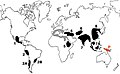 Vavilov Centers Updated
 -
 Centres of Origin and Spread of Agriculture
 -
 Tomb of Nakht
 -
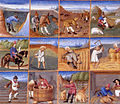 Crescenzi Calendar
 -
 Reindeer Herding
 -
 Unload Wheat by the Combine Claas Lexion 584
 -
 Manuring a Vegetable Garden


.jpg)


