Agroforestry
(2).jpg)
Agroforestry is a land management system that integrates trees and shrubs into agricultural landscapes to enhance productivity, biodiversity, and sustainability. This practice combines agriculture and forestry technologies to create more diverse, productive, profitable, healthy, and sustainable land-use systems.
Principles of Agroforestry[edit]
Agroforestry systems are based on the principles of ecology and sustainability. They aim to optimize the positive interactions between trees, crops, and livestock. The main principles include:
- Diversity: Incorporating a variety of plant species to enhance biodiversity and ecosystem services.
- Integration: Combining trees with crops and/or livestock to create a more resilient system.
- Sustainability: Enhancing soil fertility, water retention, and carbon sequestration.
- Productivity: Increasing overall land productivity by utilizing different layers of the ecosystem.
Types of Agroforestry Systems[edit]
Agroforestry systems can be classified into several types based on their structure and function:
Alley Cropping[edit]

Alley cropping involves planting rows of trees at wide spacings with crops grown in the alleys between the rows. This system can improve soil fertility and provide additional income from tree products.
Silvopasture[edit]
Silvopasture integrates trees with livestock grazing. This system provides shade and shelter for animals, improves pasture quality, and can enhance biodiversity.
Riparian Buffers[edit]

Riparian buffers are strips of vegetation planted along waterways. They help reduce soil erosion, improve water quality, and provide habitat for wildlife.
Forest Farming[edit]
Forest farming involves the cultivation of high-value crops under the canopy of an existing forest. This system can include the production of mushrooms, herbs, and other non-timber forest products.
Homegardens[edit]
Homegardens are small-scale agroforestry systems that combine trees, shrubs, and crops around a household. They provide food, fuel, and income for families.
Benefits of Agroforestry[edit]
Agroforestry offers numerous benefits, including:
- Environmental: Enhances biodiversity, improves soil health, and increases carbon sequestration.
- Economic: Diversifies income sources and reduces risk by producing multiple products.
- Social: Supports food security and provides employment opportunities.
Challenges of Agroforestry[edit]
Despite its benefits, agroforestry faces several challenges:
- Knowledge and Training: Requires specialized knowledge and skills for effective implementation.
- Policy and Incentives: Often lacks supportive policies and incentives for adoption.
- Market Access: Limited access to markets for agroforestry products can hinder profitability.
Related Pages[edit]
Gallery[edit]
-
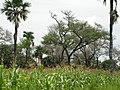 Faidherbia albida tree
 -
 Contour planting in agroforestry
 -
 Coffee under shade
 -
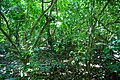 Coffee plantation with shade trees
 -
 Syntropic garden in Dordogne
 -
 Inga flowers
 -
 Jhum cultivation
 -
 Agrosylviculture in Australia


-
 Agroforestry


Medical Disclaimer: WikiMD is for informational purposes only and is not a substitute for professional medical advice. Content may be inaccurate or outdated and should not be used for diagnosis or treatment. Always consult your healthcare provider for medical decisions. Verify information with trusted sources such as CDC.gov and NIH.gov. By using this site, you agree that WikiMD is not liable for any outcomes related to its content. See full disclaimer.
Credits:Most images are courtesy of Wikimedia commons, and templates, categories Wikipedia, licensed under CC BY SA or similar.
Translate page: - East Asian
中文,
日本,
한국어,
South Asian
हिन्दी,
தமிழ்,
తెలుగు,
Urdu,
ಕನ್ನಡ,
Southeast Asian
Indonesian,
Vietnamese,
Thai,
မြန်မာဘာသာ,
বাংলা
European
español,
Deutsch,
français,
Greek,
português do Brasil,
polski,
română,
русский,
Nederlands,
norsk,
svenska,
suomi,
Italian
Middle Eastern & African
عربى,
Turkish,
Persian,
Hebrew,
Afrikaans,
isiZulu,
Kiswahili,
Other
Bulgarian,
Hungarian,
Czech,
Swedish,
മലയാളം,
मराठी,
ਪੰਜਾਬੀ,
ગુજરાતી,
Portuguese,
Ukrainian

