Parvocellular cell
Parvocellular cells, also known as P-cells, are a type of neuron located in the lateral geniculate nucleus (LGN) of the thalamus. These cells are part of the visual processing pathway and play a crucial role in the perception of color and fine detail.
Structure[edit]
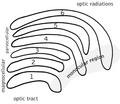
Parvocellular cells are characterized by their small cell bodies, which is reflected in their name, as "parvo" means "small" in Latin. They are found in the four dorsal layers of the lateral geniculate nucleus, which is a relay center in the thalamus for the visual pathway. The LGN receives input from the retina and sends output to the primary visual cortex in the occipital lobe.
Function[edit]
Parvocellular cells are primarily responsible for processing high-resolution visual information. They are sensitive to color and are involved in the detection of fine details and textures. These cells have a slower conduction velocity compared to magnocellular cells, which are another type of neuron in the LGN that process motion and broad outlines.
The parvocellular pathway is crucial for tasks that require detailed visual analysis, such as reading and recognizing faces. This pathway is also involved in the perception of color, as it receives input from the cone cells in the retina, which are responsible for color vision.
Visual Pathway[edit]
The visual information processed by parvocellular cells is transmitted from the retina to the LGN and then to the primary visual cortex. In the retina, the ganglion cells that project to the parvocellular layers of the LGN are known as P-ganglion cells. These cells receive input from the cone cells and are responsible for transmitting color and fine detail information.
Once the information reaches the primary visual cortex, it is further processed and integrated with other visual information to form a complete visual perception. The parvocellular pathway is part of the "what" pathway, which is involved in object recognition and identification.
Related Pages[edit]
-
 Lateral Geniculate Nucleus


Medical Disclaimer: WikiMD is for informational purposes only and is not a substitute for professional medical advice. Content may be inaccurate or outdated and should not be used for diagnosis or treatment. Always consult your healthcare provider for medical decisions. Verify information with trusted sources such as CDC.gov and NIH.gov. By using this site, you agree that WikiMD is not liable for any outcomes related to its content. See full disclaimer.
Credits:Most images are courtesy of Wikimedia commons, and templates, categories Wikipedia, licensed under CC BY SA or similar.
Translate page: - East Asian
中文,
日本,
한국어,
South Asian
हिन्दी,
தமிழ்,
తెలుగు,
Urdu,
ಕನ್ನಡ,
Southeast Asian
Indonesian,
Vietnamese,
Thai,
မြန်မာဘာသာ,
বাংলা
European
español,
Deutsch,
français,
Greek,
português do Brasil,
polski,
română,
русский,
Nederlands,
norsk,
svenska,
suomi,
Italian
Middle Eastern & African
عربى,
Turkish,
Persian,
Hebrew,
Afrikaans,
isiZulu,
Kiswahili,
Other
Bulgarian,
Hungarian,
Czech,
Swedish,
മലയാളം,
मराठी,
ਪੰਜਾਬੀ,
ગુજરાતી,
Portuguese,
Ukrainian

