General visceral efferent fiber: Difference between revisions
CSV import Tag: Removed redirect |
CSV import |
||
| Line 41: | Line 41: | ||
[[Category:Neuroanatomy]] | [[Category:Neuroanatomy]] | ||
[[Category:Autonomic nervous system]] | [[Category:Autonomic nervous system]] | ||
== General_visceral_efferent_fiber == | |||
<gallery> | |||
File:Gray799.svg|Gray799 | |||
File:Gray840.png|Gray840 | |||
File:Gray839.png|Gray839 | |||
File:1503_Connections_of_the_Parasympathetic_Nervous_System.jpg|1503 Connections of the Parasympathetic Nervous System | |||
</gallery> | |||
Latest revision as of 23:59, 24 February 2025
General Visceral Efferent Fiber[edit]
The general visceral efferent fibers (GVE fibers) are a type of nerve fiber that are part of the autonomic nervous system. These fibers are responsible for conveying motor impulses to the smooth muscles, cardiac muscles, and glands. They play a crucial role in the involuntary control of bodily functions such as heart rate, digestion, and respiratory rate.
Structure[edit]
General visceral efferent fibers originate from the central nervous system (CNS) and are part of the efferent division of the peripheral nervous system. These fibers are typically associated with the autonomic ganglia, where they synapse with postganglionic neurons that extend to the target organs.
The GVE fibers are divided into two main components based on their origin and function:
- **Sympathetic nervous system fibers**: These fibers originate from the thoracolumbar region of the spinal cord (T1 to L2) and are involved in the "fight or flight" response. They prepare the body for stressful situations by increasing heart rate, dilating airways, and inhibiting digestion.
- **Parasympathetic nervous system fibers**: These fibers originate from the brainstem and the sacral spinal cord (S2 to S4) and are involved in the "rest and digest" response. They promote relaxation and recovery by decreasing heart rate, constricting airways, and stimulating digestion.
Function[edit]
The primary function of general visceral efferent fibers is to regulate the activity of the visceral organs. They achieve this by:
- **Modulating cardiac function**: GVE fibers can increase or decrease the heart rate and force of contraction, depending on whether they are part of the sympathetic or parasympathetic system.
- **Controlling smooth muscle activity**: These fibers regulate the contraction and relaxation of smooth muscles in the gastrointestinal tract, respiratory system, and urogenital system.
- **Regulating glandular secretion**: GVE fibers influence the secretion of various glands, including salivary glands, sweat glands, and digestive glands.
Clinical Significance[edit]
Dysfunction of general visceral efferent fibers can lead to a variety of clinical conditions. For example, damage to the sympathetic fibers can result in Horner's syndrome, characterized by ptosis, miosis, and anhidrosis. On the other hand, parasympathetic dysfunction can lead to issues such as bradycardia or digestive disorders.
Understanding the role of GVE fibers is crucial in diagnosing and treating autonomic nervous system disorders. Medical interventions may include pharmacological agents that target specific receptors on the effector organs to modulate their activity.
Related Pages[edit]
- Autonomic nervous system
- Sympathetic nervous system
- Parasympathetic nervous system
- Efferent nerve fiber
- Visceral organ
General_visceral_efferent_fiber[edit]
-
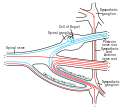 Gray799
 -
 Gray840
 -
 Gray839
 -
 1503 Connections of the Parasympathetic Nervous System


