Tryptophan hydroxylase
-
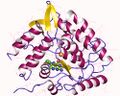 Tryptophan hydroxylase structure
 -
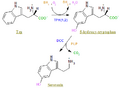 Serotonin synthesis pathway
 -
 Tryptophan to serotonin pathway


Tryptophan Hydroxylase[edit]
Tryptophan hydroxylase (TPH) is an enzyme that plays a crucial role in the biosynthesis of the neurotransmitter serotonin. It is the rate-limiting enzyme in the conversion of the amino acid tryptophan to 5-hydroxytryptophan (5-HTP), which is subsequently decarboxylated to form serotonin. Tryptophan hydroxylase is a member of the aromatic amino acid hydroxylase family, which also includes tyrosine hydroxylase and phenylalanine hydroxylase.
Structure[edit]
Tryptophan hydroxylase is a monomeric enzyme that requires a cofactor, tetrahydrobiopterin (BH4), for its activity. The enzyme also requires molecular oxygen and iron as a cofactor. The active site of tryptophan hydroxylase contains a non-heme iron that is essential for its catalytic function. The enzyme is composed of several domains, including a regulatory domain, a catalytic domain, and a tetramerization domain.
Isoforms[edit]
There are two isoforms of tryptophan hydroxylase, known as TPH1 and TPH2. TPH1 is primarily expressed in peripheral tissues such as the pineal gland and the gastrointestinal tract, while TPH2 is predominantly found in the central nervous system. The differential expression of these isoforms allows for the regulation of serotonin synthesis in different tissues.
Function[edit]
Tryptophan hydroxylase catalyzes the hydroxylation of tryptophan to form 5-hydroxytryptophan (5-HTP). This reaction is the first and rate-limiting step in the biosynthesis of serotonin. The activity of tryptophan hydroxylase is regulated by various factors, including the availability of its substrate, tryptophan, and its cofactor, tetrahydrobiopterin. Additionally, the enzyme can be regulated by phosphorylation and by feedback inhibition from serotonin.
Clinical Significance[edit]
Alterations in tryptophan hydroxylase activity have been implicated in various disorders related to serotonin imbalance. For example, reduced activity of TPH2 has been associated with depression and anxiety disorders. Genetic polymorphisms in the TPH1 and TPH2 genes have been studied in relation to their potential impact on psychiatric conditions and response to treatment.
Related Pages[edit]
| Enzymes | ||||||||||
|---|---|---|---|---|---|---|---|---|---|---|
|
| Neurotransmitters | ||||||||||||||||||||||||||||||||||||||||||||||||||||||||||||
|---|---|---|---|---|---|---|---|---|---|---|---|---|---|---|---|---|---|---|---|---|---|---|---|---|---|---|---|---|---|---|---|---|---|---|---|---|---|---|---|---|---|---|---|---|---|---|---|---|---|---|---|---|---|---|---|---|---|---|---|---|
|

Medical Disclaimer: WikiMD is for informational purposes only and is not a substitute for professional medical advice. Content may be inaccurate or outdated and should not be used for diagnosis or treatment. Always consult your healthcare provider for medical decisions. Verify information with trusted sources such as CDC.gov and NIH.gov. By using this site, you agree that WikiMD is not liable for any outcomes related to its content. See full disclaimer.
Credits:Most images are courtesy of Wikimedia commons, and templates, categories Wikipedia, licensed under CC BY SA or similar.
Translate page: - East Asian
中文,
日本,
한국어,
South Asian
हिन्दी,
தமிழ்,
తెలుగు,
Urdu,
ಕನ್ನಡ,
Southeast Asian
Indonesian,
Vietnamese,
Thai,
မြန်မာဘာသာ,
বাংলা
European
español,
Deutsch,
français,
Greek,
português do Brasil,
polski,
română,
русский,
Nederlands,
norsk,
svenska,
suomi,
Italian
Middle Eastern & African
عربى,
Turkish,
Persian,
Hebrew,
Afrikaans,
isiZulu,
Kiswahili,
Other
Bulgarian,
Hungarian,
Czech,
Swedish,
മലയാളം,
मराठी,
ਪੰਜਾਬੀ,
ગુજરાતી,
Portuguese,
Ukrainian

