3-Iodothyronamine
A derivative of the thyroid hormone thyroxine
3-Iodothyronamine (T1AM) is a derivative of the thyroid hormone thyroxine (T4). It is an endogenous biogenic amine that has been identified as a novel signaling molecule with distinct physiological effects.
Structure and Synthesis[edit]
3-Iodothyronamine is structurally related to the thyroid hormones, but it differs by the presence of an iodine atom and an amine group. It is synthesized from thyroxine through a series of enzymatic reactions that involve the removal of the carboxyl group and the phenolic hydroxyl group.
Mechanism of Action[edit]
3-Iodothyronamine acts primarily through the trace amine-associated receptor 1 (TAAR1), a G protein-coupled receptor (GPCR). Activation of TAAR1 by T1AM leads to various intracellular signaling cascades, which can influence metabolism, thermoregulation, and cardiovascular function.
Physiological Effects[edit]
T1AM has been shown to have several physiological effects, including:
- Metabolic Regulation: T1AM can induce a hypometabolic state, characterized by decreased body temperature and oxygen consumption.
- Cardiovascular Effects: It can influence heart rate and blood pressure, often causing a decrease in heart rate (bradycardia).
- Neurological Effects: T1AM has been implicated in modulating neurotransmitter systems, potentially affecting mood and behavior.
Potential Therapeutic Applications[edit]
Due to its unique effects on metabolism and cardiovascular function, 3-Iodothyronamine is being investigated for potential therapeutic applications in conditions such as obesity, heart failure, and neurodegenerative diseases.
Research and Development[edit]
Research on 3-Iodothyronamine is ongoing, with studies focusing on its role in endocrinology, its potential as a therapeutic agent, and its broader implications in physiology.
Related pages[edit]
Gallery[edit]
-
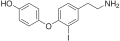 Chemical structure of 3-Iodothyronamine
 -
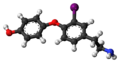 3D ball-and-stick model of 3-Iodothyronamine


Advertise on WikiMD — 81,000+ full articles, ~900,000 total pages, ~250 million page views. Global reach, limited time promotional rates from $1/page/day. Learn more · View stats

Medical Disclaimer: WikiMD is for informational purposes only and is not a substitute for professional medical advice. Content may be inaccurate or outdated and should not be used for diagnosis or treatment. Always consult your healthcare provider for medical decisions. Verify information with trusted sources such as CDC.gov and NIH.gov. By using this site, you agree that WikiMD is not liable for any outcomes related to its content. See full disclaimer.
Credits:Most images are courtesy of Wikimedia commons, and templates, categories Wikipedia, licensed under CC BY SA or similar.
Translate page: - East Asian
中文,
日本,
한국어,
South Asian
हिन्दी,
தமிழ்,
తెలుగు,
Urdu,
ಕನ್ನಡ,
Southeast Asian
Indonesian,
Vietnamese,
Thai,
မြန်မာဘာသာ,
বাংলা
European
español,
Deutsch,
français,
Greek,
português do Brasil,
polski,
română,
русский,
Nederlands,
norsk,
svenska,
suomi,
Italian
Middle Eastern & African
عربى,
Turkish,
Persian,
Hebrew,
Afrikaans,
isiZulu,
Kiswahili,
Other
Bulgarian,
Hungarian,
Czech,
Swedish,
മലയാളം,
मराठी,
ਪੰਜਾਬੀ,
ગુજરાતી,
Portuguese,
Ukrainian

