Coxal Articulation or Hip-joint: Difference between revisions

From WikiMD's Wellness Encyclopedia

CSV import
No edit summary
 
Line 1: Line 1:
[[Anatomy]] > [[Gray's Anatomy| Gray's Anatomy of the Human Body]] > III. Syndesmology > 7. Articulations of the Lower Extremity. a. Coxal Articulation or Hip-joint  
{{SI}}
[[Anatomy]] > [[Gray's Anatomy|Gray's Anatomy of the Human Body]] > III. [[Syndesmology]] > 7. [[Articulations of the Lower Extremity]] > '''Coxal Articulation or Hip-joint'''


[[Henry Gray]] (1821–1865).  Anatomy of the Human Body.  1918.
== '''Coxal Articulation or Hip-joint''' (''Articulatio coxae'') ==
Articulations of the Lower Extremity.
The articulations of the Lower Extremity comprise the following: 


# I. Hip.
The '''hip joint''', or '''coxal articulation''', is a [[synovial joint]] of the [[ball-and-socket joint|ball-and-socket]] (''[[enarthrodial]]'') type. It connects the [[lower limb]] to the [[pelvis]] and is formed by the articulation between the [[head of femur|head of the femur]] and the [[acetabulum]] of the [[hip bone]].  
# II. Knee.
# III. Tibiofibular.
# IV. Ankle.
# V. Intertarsal.
# VI. Tarsometatarsal.
# VII. Intermetatarsal.
# VIII. Metatarsophalangeal.
# IX. Articulations of the Digits.


=='''Coxal Articulation or Hip-joint '''(Articulatio Coxae)==
The joint allows a wide range of [[movement]]s, including [[flexion]], [[extension]], [[abduction]], [[adduction]], [[rotation]], and [[circumduction]], while also providing significant [[stability]] due to its deep socket and strong surrounding [[ligaments]] and [[muscles]].


This articulation is an [[enarthrodial]] or ball-and-socket joint, formed by the reception of the head of the [[femur]] into the cup-shaped cavity of the [[acetabulum]]. The articular cartilage on the head of the femur, thicker at the center than at the circumference, covers the entire surface with the exception of the fovea capitis femoris, to which the ligamentum teres is attached; that on the acetabulum forms an incomplete marginal ring, the [[lunate]] surface. Within the lunate surface there is a circular depression devoid of cartilage, occupied in the fresh state by a mass of fat, covered by synovial membrane. The ligaments of the joint are: 
== '''Articulating Surfaces''' ==
* The '''[[head of the femur]]''' is covered with [[articular cartilage]] except at the [[fovea capitis femoris]], where the [[ligamentum teres femoris]] attaches.
* The '''[[acetabulum]]''' is a deep, hemispherical cavity of the [[hip bone]] formed by the fusion of the [[ilium]], [[ischium]], and [[pubis]].
* The acetabular surface is incomplete inferiorly due to the presence of the [[acetabular notch]] and features the '''[[lunate surface]]''', which bears the weight of the body.


* The Articular Capsule.
== '''Ligaments of the Hip Joint''' ==
* The Pubocapsular.
The joint is stabilized by several strong ligaments:
* The Iliofemoral.
* The Ligamentum Teres Femoris.
* The Ischiocapsular.
* The Glenoidal Labrum.
* The Transverse Acetabular.


=== '''The Articular Capsule (''capsula articularis; capsular ligament'') (Figs. 339, 340)''' ===
* '''[[Articular capsule]] (''capsula articularis'')''': Encloses the joint and attaches to the [[acetabulum]] and [[neck of femur]].
The articular capsule is strong and dense. ''Above'' it is attached to the margin of the acetabulum 5 to 6 mm. beyond the glenoidal labrum behind; but in ''front'' it is attached to the outer margin of the [[labrum]], and, opposite to the notch where the margin of the cavity is deficient, it is connected to the transverse ligament, and by a few fibers to the edge of the obturator foramen. It surrounds the neck of the femur, and is attached, in ''front'' to the intertrochanteric line; ''above'' to the base of the neck; ''behind'' to the neck, about 1.25 cm. above the intertrochanteric crest; ''below'' to the lower part of the neck, close to the lesser trochanter.
* '''[[Iliofemoral ligament]] (''ligamentum iliofemorale'')''': Also known as the Y-ligament or ligament of [[Bigelow]], one of the strongest ligaments in the body. Prevents [[hyperextension]] during standing.
From its femoral attachment some of the fibers are reflected upward along the neck as longitudinal bands, termed '''[[retinacula]]''' The capsule is much thicker at the upper and forepart of the joint, where the greatest amount of resistance is required; behind and below, it is thin and loose. It consists of two sets of fibers, circular and longitudinal. The circular fibers, '''[[zona orbicularis]]''' are most abundant at the lower and back part of the capsule (Fig. 342), and form a sling or collar around the neck of the femur.
* '''[[Pubofemoral ligament]] (''ligamentum pubofemorale'')''': Strengthens the capsule inferiorly and anteriorly.
* '''[[Ischiofemoral ligament]] (''ligamentum ischiofemorale'')''': Reinforces the posterior aspect of the capsule.
* '''[[Ligamentum teres femoris]] (''ligament of head of femur'')''': A weak ligament inside the joint that contains a branch of the [[obturator artery]].
* '''[[Acetabular labrum]] (''labrum acetabulare'')''': A fibrocartilaginous rim that deepens the acetabular cavity.
* '''[[Transverse acetabular ligament]]''': Bridges the acetabular notch and continues the labrum across the inferior part of the rim.


[[Anteriorly]] they blend with the deep surface of the iliofemoral ligament, and gain an attachment to the anterior inferior iliac spine. The longitudinal fibers are greatest in amount at the upper and front part of the capsule, where they are reinforced by distinct bands, or accessory ligaments, of which the most important is the '''[[iliofemoral]] ligament''' The other accessory bands are known as the '''[[pubocapsular]]''' and the '''ischiocapsular ligaments''' 
== '''Synovial Membrane''' ==
The [[synovial membrane]] lines the inner surface of the capsule, covers the [[ligamentum teres]], and reflects over the [[acetabular fat pad]] and [[acetabular fossa]]. It may communicate with the [[iliopsoas bursa]].


The external surface of the capsule is rough, covered by numerous muscles, and separated in front from the [[Psoas]] major and [[Iliacus]] by a bursa, which not infrequently communicates by a circular aperture with the cavity of the joint
== '''Muscular Relations''' ==
Muscles surrounding the hip joint include:


[[File:Gray339.png|thumb|FIG. 339– Right hip-joint from the front. (Spalteholz.) (''Picture From the Classic Gray's Anatomy'')]]  
* '''Anteriorly''': [[Psoas major]], [[Iliacus]]
* '''Posteriorly''': [[Piriformis]], [[Obturator internus]], [[Gemelli]], [[Quadratus femoris]]
* '''Laterally''': [[Gluteus medius]], [[Gluteus minimus]]
* '''Medially''': [[Obturator externus]], [[Pectineus]]


==='''The Iliofemoral Ligament (''ligamentum iliofemorale; Y-ligament; ligament of Bigelow'') (Fig. 339)'''===
== '''Blood Supply''' ==
The iliofemoral ligament is a band of great strength which lies in front of the joint; it is intimately connected with the capsule, and serves to strengthen it in this situation.
The hip joint receives [[arterial supply]] from:
* [[Medial circumflex femoral artery]]
* [[Lateral circumflex femoral artery]]
* [[Obturator artery]]
* [[Superior gluteal artery]]
* [[Inferior gluteal artery]]


It is attached, ''above'' to the lower part of the anterior inferior iliac spine; ''below'' it divides into two bands, one of which passes downward and is fixed to the lower part of the intertrochanteric line; the other is directed downward and lateralward and is attached to the upper part of the same line. Between the two bands is a thinner part of the capsule.
== '''Innervation''' ==
The joint is innervated by branches of:
* [[Femoral nerve]]
* [[Obturator nerve]]
* [[Sciatic nerve]]
* [[Superior gluteal nerve]]
* [[Nerve to quadratus femoris]]


In some cases there is no division, and the ligament spreads out into a flat triangular band which is attached to the whole length of the intertrochanteric line. This ligament is frequently called the Y-shaped ligament of Bigelow; and its upper band is sometimes named the '''iliotrochanteric ligament'''
== '''Movements''' ==
The hip joint allows:
* [[Flexion]] – by [[iliopsoas]], [[rectus femoris]], [[sartorius]]
* [[Extension]] – by [[gluteus maximus]], [[hamstrings]]
* [[Abduction]] – by [[gluteus medius]] and [[gluteus minimus]]
* [[Adduction]] – by [[adductor longus]], [[adductor brevis]], [[adductor magnus]], [[gracilis]]
* [[Lateral rotation]] – by [[obturator externus]], [[piriformis]], [[gluteus maximus]]
* [[Medial rotation]] – by [[tensor fasciae latae]], [[gluteus minimus]]


[[File:Gray340.png|thumb|FIG. 340– The hip-joint from behind. (Quain.) (''Picture From the Classic Gray's Anatomy'')]]
== '''Comparative Anatomy''' ==
Compared to the [[shoulder joint]], the hip joint is more stable but less mobile. The deep acetabulum and strong ligaments enhance its load-bearing capacity.
==='''The Pubocapsular Ligament (''ligamentum pubocapsulare; pubofemoral ligament'')'''===
This ligament is attached, ''above'' to the obturator crest and the superior ramus of the pubis; ''below'' it blends with the capsule and with the deep surface of the vertical band of the oliofemoral ligament. 
==='''The Ischiocapsular Ligament (''ligamentum ischiocapsulare; ischiocapsular band; ligament of Bertin'')'''===
The ischiocapsular ligament consists of a triangular band of strong fibers, which spring from the ischium below and behind the acetabulum, and blend with the circular fibers of the capsule (Fig. 340). 
===='''The Ligamentum Teres Femoris (Fig. 341)'''====
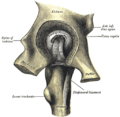
The ligamentum teres femoris is a triangular, somewhat flattened band implanted by its apex into the [[antero-superior]] part of the [[fovea]] [[capitis]] [[femoris]]; its base is attached by two bands, one into either side of the acetabular notch, and between these bony attachments it blends with the transverse ligament. It is ensheathed by the synovial membrane, and varies greatly in strength in different subjects; occasionally only the [[synovial]] fold exists, and in rare cases even this is absent. The ligament is made tense when the thigh is semiflexed and the limb then adducted or rotated outward; it is, on the other hand, relaxed when the limb is abducted. It has, however, but little influence as a ligament.


[[File:Gray341.png|thumb|FIG. 341– Left hip-joint, opened by removing the floor of the acetabulum from within the pelvis. (''Picture From the Classic Gray's Anatomy'')]]
== '''Clinical Significance''' ==
* '''[[Hip fracture]]''': Common in the elderly, often requiring [[hip replacement]] surgery.
==='''The Glenoidal Labrum (''labrum glenoidale; cotyloid ligament'')'''===
* '''[[Hip dislocation]]''': Typically caused by trauma, especially in [[motor vehicle accidents]].
The glenoidal labrum is a fibrocartilaginous rim attached to the margin of the acetabulum, the cavity of which it deepens; at the same time it protects the edge of the bone, and fills up the inequalities of its surface. It bridges over the notch as the '''[[transverse]] ligament''' and thus forms a complete circle, which closely surrounds the head of the femur and assists in holding it in its place. It is triangular on section, its base being attached to the margin of the acetabulum, while its opposite edge is free and sharp. Its two surfaces are invested by synovial membrane, the external one being in contact with the capsule, the internal one being inclined inward so as to narrow the acetabulum, and embrace the cartilaginous surface of the head of the femur. It is much thicker above and behind than below and in front, and consists of compact fibers.
* '''[[Osteoarthritis of the hip]]''': A degenerative condition causing pain and reduced mobility.
* '''[[Avascular necrosis]]''': Disruption of blood supply to the femoral head, leading to joint destruction.


[[File:Gray342.png|thumb|left|FIG. 342– Hip-joint, front view. The capsular ligament has been largely removed. (''Picture From the Classic Gray's Anatomy'')]]
== '''Additional Images''' ==
 
[[File:Gray342.png|thumb|FIG. 343– Capsule of hip-joint (distended). Posterior aspect. (''Picture From the Classic Gray's Anatomy'')]]
==='''The Transverse Acetabular Ligament (''ligamentum transversum acetabuli; transverse ligament'')'''===
This ligament is in reality a portion of the glenoidal [[labrum]], though differing from it in having no cartilage cells among its fibers. It consists of strong, flattened fibers, which cross the acetabular notch, and convert it into a foramen through which the nutrient vessels enter the joint. 
==='''Synovial Membrane (Fig. 343)'''===
* The synovial membrane is very extensive. Commencing at the margin of the cartilaginous surface of the head of the femur, it covers the portion of the neck which is contained within the joint; from the neck it is reflected on the internal surface of the capsule, covers both surfaces of the [[glenoidal]] labrum and the mass of fat contained in the depression at the bottom of the acetabulum, and ensheathes the ligamentum teres as far as the head of the [[femur]]. The joint cavity sometimes communicates through a hole in the capsule between the vertical band of the [[iliofemoral]] ligament and the pubocapsular ligament with a bursa situated on the deep surfaces of the Psoas major and Iliacus.   
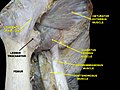
* The '''muscles''' in relation with the joint are, in ''front'' the Psoas major and Iliacus, separated from the capsule by a bursa; ''above'' the reflected head of the Rectus femoris and Glutaeus minimus, the latter being closely adherent to the capsule; ''[[medially]]'' the Obturator externus and Pectineus; ''behind'' the Piriformis, Gemellus superior, Obturator internus, Gemellus inferior, Obturator externus, and Quadratus femoris (Fig. 344). 
 
[[File:Gray344.png|thumb|FIG. 344– Structures surrounding right hip-joint. (''Picture From the Classic Gray's Anatomy'')]]
The '''[[arteries]]''' supplying the joint are derived from the obturator, medial femoral circumflex, and superior and inferior gluteals. 
The '''[[nerves]]''' are articular branches from the sacral plexus, [[sciatic]], obturator, accessory obturator, and a filament from the branch of the femoral supplying the Rectus [[femoris]].
==='''Movements'''===
The movements of the hip are very extensive, and consist of [[flexion]], [[extension]], [[adduction]], abduction, [[circumduction]], and [[rotation]].  The length of the neck of the femur and its inclinations to the body of the bone have the effect of converting the angular movements of flexion, extension, adduction, and abduction partially into rotatory movements in the joint. Thus when the thigh is flexed or extended, the head of the femur, on account of the ''[[medial]]'' inclination of the neck, rotates within the acetabulum with only a slight amount of gliding to and fro. The ''forward'' slope of the neck similarly affects the movements of adduction and abduction. Conversely rotation of the thigh which is permitted by the ''upward'' inclination of the neck, is not a simple rotation of the head of the femur in the acetabulum, but is accompanied by a certain amount of gliding. 
 
The hip-joint presents a very striking contrast to the shoulder-joint in the much more complete mechanical arrangements for its security and for the limitation of its movements. In the shoulder, as has been seen, the head of the humerus is not adapted at all in size to the glenoid cavity, and is hardly restrained in any of its ordinary movements by the capsule. In the hip-joint, on the contrary, the head of the femur is closely fitted to the acetabulum for an area extending over nearly half a sphere, and at the margin of the bony cup it is still more closely embraced by the glenoidal labrum, so that the head of the femur is held in its place by that ligament even when the fibers of the capsule have been quite divided. 
 
The iliofemoral ligament is the strongest of all the ligaments in the body, and is put on the stretch by any attempt to extend the femur beyond a straight line with the trunk. That is to say, this ligament is the chief agent in maintaining the erect position without muscular fatigue; for a vertical line passing through the center of gravity of the trunk falls behind the centers of rotation in the hip-joints, and therefore the pelvis tends to fall backward, but is prevented by the tension of the iliofemoral ligaments. 
 
The security of the joint may be provided for also by the two bones being directly united through the ligamentum teres; but it is doubtful whether this ligament has much influence upon the mechanism of the joint. When the knee is flexed, flexion of the hip-joint is arrested by the soft parts of the thigh and abdomen being brought into contact, and when the knee is extended, by the action of the hamstring muscles; extension is checked by the tension of the iliofemoral ligament; adduction by the thighs coming into contact; adduction with flexion by the lateral band of the iliofemoral ligament and the lateral part of the capsule; abduction by the medial band of the iliofemoral ligament and the pubocapsular ligament; rotation outward by the lateral band of the iliofemoral ligament; and rotation inward by the ischiocapsular ligament and the hinder part of the capsule. 
 
The muscles which ''[[flex]]'' the femur on the pelvis are the Psoas major, Iliacus, Rectus femoris, Sartorius, Pectineus, Adductores longus and brevis, and the anterior fibers of the Glutaei medius and minimus. ''[[Extension]]'' is mainly performed by the Glutaeus maximus, assisted by the hamstring muscles and the ischial head of the Adductor magnus.
 
The thigh is ''[[adducted]]'' by the Adductores magnus, longus, and brevis, the Pectineus, the Gracilis, and lower part of the Glutaeus maximus, and ''[[abducted]]'' by the Glutaei medius and minimus, and the upper part of the Glutaeus maximus. The muscles which ''[[rotate]]'' the thigh ''inward'' are the Glutaeus minimus and the anterior fibers of the Glutaeus medius, the Tensor fasciae latae and the Iliacus and Psoas major; while those which rotate it ''outward'' are the posterior fibers of the Glutaeus medius, the Piriformis, Obturatores externus and internus, Gemelli superior and inferior, Quadratus femoris, Glutaeus maximus, the Adductores longus, brevis, and magnus, the Pectineus, and the Sartorius.
==Clinical significance==
A [[hip fracture]] is a  [[bone fracture|break]] that occurs in the upper part of the femur.<ref name=AO2009>{{Cite web|url=http://orthoinfo.aaos.org/topic.cfm?topic=A00392|title=Hip Fractures|date=April 2009|website=OrthoInfo - AAOS|access-date=2017-09-27|url-status=live|archiveurl=https://web.archive.org/web/20170629225405/http://orthoinfo.aaos.org/topic.cfm?topic=A00392|archivedate=29 June 2017|df=dmy-all}}</ref> Symptoms may include pain around the hip particularly with movement and shortening of the leg.<ref name=AO2009/> The hip joint can be replaced by a [[prosthesis]] in a [[hip replacement]] operation due to fractures or illnesses such as [[osteoarthritis]]. [[Hip pain]] can have multiple sources and can also be associated with [[lower back pain]].
==Additional images==
<gallery>
<gallery>
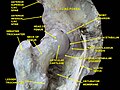
File:Slide2DAD.JPG|Hip joint. Lateral view.
File:Slide2DAD.JPG|Hip joint – lateral view
File:Slide2DADA.JPG|Hip joint. Lateral view.
File:Slide1BIBI.JPG|Anterior thigh muscles related to hip joint
File:Slide1BIBI.JPG|Muscles of Thigh. Anterior views.
File:Gray341.png|Hip joint opened from above
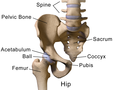
File:Blausen 0488 HipAnatomy.png|Illustration of Hip (Frontal view).
File:Gray344.png|Muscular anatomy around hip joint
File:Iliopectineal line, ilioischial line, tear drop, acetabular fossa, and anterior and posterior wall of the acetabulumi.jpg|[[Projectional radiography|X-ray]] of the hip, with measurements used in [[X-ray of hip dysplasia]] in adults.<ref>{{cite journal|last1=Ruiz Santiago|first1=Fernando|last2=Santiago Chinchilla|first2=Alicia|last3=Ansari|first3=Afshin|last4=Guzmán Álvarez|first4=Luis|last5=Castellano García|first5=Maria del Mar|last6=Martínez Martínez|first6=Alberto|last7=Tercedor Sánchez|first7=Juan|title=Imaging of Hip Pain: From Radiography to Cross-Sectional Imaging Techniques|journal=Radiology Research and Practice|volume=2016|year=2016|pages=1–15|issn=2090-1941|doi=10.1155/2016/6369237|pmid=26885391|pmc=4738697}} ([https://creativecommons.org/licenses/by/4.0/ Attribution 4.0 International (CC BY 4.0)]</ref>
File:Blausen 0488 HipAnatomy.png|Hip anatomy (frontal view)
</gallery>
</gallery>
== External links ==
{{Wiktionary|hip}}


{{Commons category|Hip}}
== '''See Also''' ==
{{Commons category|Hip joint}}
* [[Hip bone]]
* [https://web.archive.org/web/20101029215447/http://hippreservation.org/ Hip Preservation Awareness, information and support for hip impingement, hip dysplasia, and related issues in young adults (12-adult)]
* [[Pelvis]]
* [https://web.archive.org/web/20161112070349/http://www.hipsknees.info/flash/HTML-HIPS/demo.html Hip anatomy video]
* [[Femur]]
* [https://archive.is/20121208143935/http://machinedesign.com/ContentItem/60950/Highperformancehips.aspx High-performance hips]
* [[Joint]]
* [https://web.archive.org/web/20180620102137/http://www.fixedbrain.com/icd-10/hip-pain-icd-10/ Hip Pain ICD10]
* [[Synovial joint]]
* [http://www.fixedbrain.com/icd-10/right-ankle-pain-icd-10/ Right Ankle Pain ICD10]
* [[Ligament]]
 
== '''External Links''' ==
* {{Commons category|Hip joint}}
* {{SUNYAnatomyLabs|21|st|21|01}}
* {{MedlinePlus|002975}}
* {{OrthoInfo|topic=A00392}}


{{Human regional anatomy}}
{{Joints of lower limbs}}
{{Grays adapted}}
[[Category:Bones of the lower limb]]
[[Category:Bones of the lower limb]]
[[Category:Joints|*Hip]]
[[Category:Joints]]
[[Category:Hip|*]]
[[Category:Hip]]
{{grays}}
__NOINDEX__
__NOINDEX__

Latest revision as of 22:34, 30 March 2025

Editor-In-Chief: Prab R Tumpati, MD
Obesity, Sleep & Internal medicine
Founder, WikiMD Wellnesspedia &
W8MD medical weight loss NYC and sleep center NYC
Anatomy > Gray's Anatomy of the Human Body > III. Syndesmology > 7. Articulations of the Lower Extremity > Coxal Articulation or Hip-joint

Coxal Articulation or Hip-joint (Articulatio coxae)[edit]

The hip joint, or coxal articulation, is a synovial joint of the ball-and-socket (enarthrodial) type. It connects the lower limb to the pelvis and is formed by the articulation between the head of the femur and the acetabulum of the hip bone.

The joint allows a wide range of movements, including flexion, extension, abduction, adduction, rotation, and circumduction, while also providing significant stability due to its deep socket and strong surrounding ligaments and muscles.

Articulating Surfaces[edit]

Ligaments of the Hip Joint[edit]

The joint is stabilized by several strong ligaments:

Synovial Membrane[edit]

The synovial membrane lines the inner surface of the capsule, covers the ligamentum teres, and reflects over the acetabular fat pad and acetabular fossa. It may communicate with the iliopsoas bursa.

Muscular Relations[edit]

Muscles surrounding the hip joint include:

Blood Supply[edit]

The hip joint receives arterial supply from:

Innervation[edit]

The joint is innervated by branches of:

Movements[edit]

The hip joint allows:

Comparative Anatomy[edit]

Compared to the shoulder joint, the hip joint is more stable but less mobile. The deep acetabulum and strong ligaments enhance its load-bearing capacity.

Clinical Significance[edit]

Additional Images[edit]

See Also[edit]

External Links[edit]


Gray's Anatomy[edit]

Anatomy atlases (external)[edit]

[1] - Anatomy Atlases

Adapted from the Classic Grays Anatomy of the Human Body 1918 edition (public domain)