Osteopontin: Difference between revisions
CSV import |
CSV import |
||
| Line 44: | Line 44: | ||
{{Cancer}} | {{Cancer}} | ||
{{medicine-stub}} | {{medicine-stub}} | ||
<gallery> | |||
File:OPN2.jpg|Osteopontin | |||
File:Journal.pmed.0020314.g001_Osteopontin.png|Osteopontin | |||
File:Osteoclast1.jpg|Osteopontin | |||
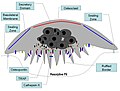
File:Biological_functions_of_OPN.jpg|Osteopontin | |||
</gallery> | |||
Latest revision as of 04:31, 18 February 2025
Osteopontin (OPN), also known as bone sialoprotein I (BSP-1 or BNSP), early T-lymphocyte activation (ETA-1), and secreted phosphoprotein 1 (SPP1), is a protein that in humans is encoded by the SPP1 gene. It is involved in biomineralization, cell migration, cell adhesion, and immune response.
Structure[edit]
Osteopontin is a negatively charged glycoprotein with a molecular weight of approximately 44 kDa. It contains a large number of modified amino acids, including phosphorylated serine and threonine residues, and is heavily glycosylated.
Function[edit]
Osteopontin plays a critical role in the bone remodeling process. It is secreted by osteoblasts during bone formation, binding to hydroxyapatite crystals in the bone matrix and inhibiting crystal growth. It is also involved in the recruitment and binding of osteoclasts to the bone matrix, facilitating bone resorption.
In addition to its role in bone remodeling, osteopontin has been implicated in a variety of other physiological and pathological processes, including inflammation, immunity, angiogenesis, cancer, and kidney stone formation.
Clinical significance[edit]
Elevated levels of osteopontin have been associated with a variety of diseases, including osteoporosis, rheumatoid arthritis, cancer, and kidney disease. It has been suggested as a potential biomarker for these conditions.
In cancer, osteopontin has been shown to promote tumor progression, metastasis, and chemoresistance. It is overexpressed in a variety of cancers, including breast cancer, lung cancer, and colorectal cancer, and its expression level has been correlated with tumor stage, grade, and prognosis.
See also[edit]
- Bone remodeling
- Osteoblast
- Osteoclast
- Glycoprotein
- Phosphorylation
- Hydroxyapatite
- Inflammation
- Immunity
- Angiogenesis
- Cancer
- Kidney stone
- Osteoporosis
- Rheumatoid arthritis
- Kidney disease
References[edit]
<references />
Template:Cell adhesion proteins
| Immune system proteins | ||||||||||
|---|---|---|---|---|---|---|---|---|---|---|
This immune system related article is a stub.
|
| Bone by Jeff Smith | ||||||
|---|---|---|---|---|---|---|
|
| Overview of tumors, cancer and oncology (C00–D48, 140–239) | ||||||||||||||||||||||
|---|---|---|---|---|---|---|---|---|---|---|---|---|---|---|---|---|---|---|---|---|---|---|
|

-
 Osteopontin
 -
 Osteopontin
 -
 Osteopontin
 -
 Osteopontin


