Paracoccidioidomycosis: Difference between revisions
No edit summary Tag: visualeditor-wikitext |
CSV import |
||
| Line 51: | Line 51: | ||
[[Category:Fungal diseases]] | [[Category:Fungal diseases]] | ||
<gallery> | |||
File:Histopathology_of_paracoccidioidomycosis.jpg|Histopathology of paracoccidioidomycosis | |||
File:Paracoccidioidomycosis_lesions.png|Paracoccidioidomycosis lesions | |||
</gallery> | |||
Revision as of 01:24, 18 February 2025
A systemic fungal infection caused by paracoccidioides brasiliensis that is most often seen in immunocompromised patients. It affects the mucous membranes, lymph nodes, lungs and bones.
Definition
Paracoccidioidomycosis is an infection caused by the fungus Paracoccidioides. This fungus lives in parts of Central and South America. Anyone who lives in or visits areas where Paracoccidioides lives can get paracoccidioidomycosis, but it most often affects men who work outdoors in rural areas.
Symptoms
Many people who are infected with Paracoccidioides never develop symptoms. For people who develop symptoms, paracoccidioidomycosis usually affects the lungs and skin. Other symptoms include:
- Lesions in the mouth and throat
- Weight loss
- Swollen lymph nodes
- Cough
- Fever
- Shortness of breath
- Fatigue
- Enlarged liver and spleen
The symptoms of paracoccidioidomycosis can be different for different groups of people. In adults, paracoccidioidomycosis usually affects the lungs and causes lesions in the mouth and throat. Children are more likely to have swollen lymph nodes and skin lesions.
Paracoccidioidomycosis can occur in healthy people and people with weakened immune systems. In people with weakened immune systems (for example, due to HIV/AIDS), the symptoms usually get worse more quickly.
Risk and Prevention
Who gets paracoccidioidomycosis?
Anyone who lives in or visits areas where Paracoccidioides lives can get paracoccidioidomycosis, but it most often affects men who work outdoors in rural areas of Central and South America. In children, boys and girls are equally likely to get paracoccidioidomycosis. Most cases of paracoccidioidomycosis occur in Brazil, Venezuela, Colombia, and Argentina.
How can I prevent paracoccidioidomycosis?
It’s difficult to avoid breathing in the fungus that causes paracoccidioidomycosis in areas where it’s common in the environment. Many people who breathe in this fungus never get sick from it.
Sources
People get paracoccidioidomycosis after breathing in the fungus Paracoccidioides from the environment in certain parts of Central and South America. Paracoccidioidomycosis does not spread from person to person. The exact time between inhaling the fungus and getting paracoccidioidomycosis is not known, but scientists believe that many people are exposed to the fungus as children in areas where it’s common in the environment.
The specific habitat of the fungus Paracoccidioides is also not exactly known, but it has been found in soil near armadillo burrows.
Diagnosis and Testing
Healthcare providers use a patient’s symptoms as well as laboratory tests and imaging tests, such as a chest X-ray, to diagnose paracoccidioidomycosis. Often, a healthcare provider will perform a biopsy, which is a small sample from the body part that is affected. The sample is sent to a laboratory for a fungal culture or to be examined under the microscope. A blood test can also help diagnose paracoccidioidomycosis.
Treatment
Paracoccidioidomycosis can be treated with antifungal medicines such as itraconazole and amphotericin B. Another medicine often used to treat paracoccidioidomycosis is trimethoprim/sulfamethoxazole (TMP/SMX), which is also known as co-trimoxazole and by several different brand names, including Bactrim, Septra, and Cotrim. Patients usually need treatment for about one year.
 | |
|---|---|
 |
 |
-
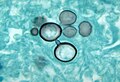 Histopathology of paracoccidioidomycosis
 -
 Paracoccidioidomycosis lesions


