Yunis–Varon syndrome
| Yunis–Varon syndrome | |
|---|---|
| Synonyms | YVS |
| Pronounce | N/A |
| Specialty | N/A |
| Symptoms | N/A |
| Complications | N/A |
| Onset | N/A |
| Duration | N/A |
| Types | N/A |
| Causes | N/A |
| Risks | N/A |
| Diagnosis | N/A |
| Differential diagnosis | N/A |
| Prevention | N/A |
| Treatment | N/A |
| Medication | N/A |
| Prognosis | N/A |
| Frequency | N/A |
| Deaths | N/A |
Yunis–Varon syndrome (YVS) is a rare genetic disorder characterized by skeletal abnormalities, craniofacial dysmorphism, and ectodermal dysplasia. It is an autosomal recessive condition, meaning that an individual must inherit two copies of the mutated gene, one from each parent, to be affected.
Signs and Symptoms[edit]
Individuals with Yunis–Varon syndrome typically present with a range of clinical features, which may include:
- Craniofacial abnormalities: These may include micrognathia (small jaw), cleft palate, and hypertelorism (wide-set eyes).
- Skeletal abnormalities: Affected individuals often have absent thumbs, hypoplastic or missing clavicles, and shortened limbs.
- Ectodermal dysplasia: This can manifest as hypotrichosis (sparse hair), dental anomalies, and nail dysplasia.
- Growth retardation: Many individuals experience failure to thrive and short stature.
- Neurological issues: These may include developmental delay and intellectual disability.
Genetics[edit]
Yunis–Varon syndrome is caused by mutations in the FIG4 gene, which is located on chromosome 6. The FIG4 gene is involved in the regulation of phosphoinositides, which are important for cell membrane dynamics and intracellular signaling.
Diagnosis[edit]
Diagnosis of Yunis–Varon syndrome is based on clinical evaluation and the identification of characteristic features. Genetic testing can confirm the diagnosis by identifying mutations in the FIG4 gene. Prenatal diagnosis is possible if the mutations in the family are known.
Management[edit]
There is no cure for Yunis–Varon syndrome, and treatment is primarily supportive. Management may include:
- Orthopedic surgery to address skeletal abnormalities.
- Speech therapy and occupational therapy to support developmental progress.
- Dental care to manage dental anomalies.
- Nutritional support to address feeding difficulties and growth issues.
Prognosis[edit]
The prognosis for individuals with Yunis–Varon syndrome varies depending on the severity of the symptoms. Some individuals may have a relatively mild form of the disorder, while others may experience significant health challenges.
Epidemiology[edit]
Yunis–Varon syndrome is extremely rare, with only a few dozen cases reported in the medical literature. It affects both males and females equally.
See Also[edit]
External Links[edit]
NIH genetic and rare disease info[edit]
Yunis–Varon syndrome is a rare disease.
| Rare and genetic diseases | ||||||
|---|---|---|---|---|---|---|
|
Rare diseases - Yunis–Varon syndrome
|
| Genetic disorders relating to deficiencies of transcription factor or coregulators | ||||||||||||||||||||||||||||||||||
|---|---|---|---|---|---|---|---|---|---|---|---|---|---|---|---|---|---|---|---|---|---|---|---|---|---|---|---|---|---|---|---|---|---|---|
|
-
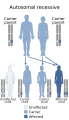 Autosomal recessive inheritance pattern


Medical Disclaimer: WikiMD is for informational purposes only and is not a substitute for professional medical advice. Content may be inaccurate or outdated and should not be used for diagnosis or treatment. Always consult your healthcare provider for medical decisions. Verify information with trusted sources such as CDC.gov and NIH.gov. By using this site, you agree that WikiMD is not liable for any outcomes related to its content. See full disclaimer.
Credits:Most images are courtesy of Wikimedia commons, and templates, categories Wikipedia, licensed under CC BY SA or similar.
Translate page: - East Asian
中文,
日本,
한국어,
South Asian
हिन्दी,
தமிழ்,
తెలుగు,
Urdu,
ಕನ್ನಡ,
Southeast Asian
Indonesian,
Vietnamese,
Thai,
မြန်မာဘာသာ,
বাংলা
European
español,
Deutsch,
français,
Greek,
português do Brasil,
polski,
română,
русский,
Nederlands,
norsk,
svenska,
suomi,
Italian
Middle Eastern & African
عربى,
Turkish,
Persian,
Hebrew,
Afrikaans,
isiZulu,
Kiswahili,
Other
Bulgarian,
Hungarian,
Czech,
Swedish,
മലയാളം,
मराठी,
ਪੰਜਾਬੀ,
ગુજરાતી,
Portuguese,
Ukrainian

