Pyrrolysine
Pyrrolysine (Pyl) is an amino acid used in the biosynthesis of proteins in some methanogenic archaea and bacteria. It is the 22nd genetically encoded amino acid, and the only one that is encoded by an amber codon (UAG). Pyrrolysine is encoded by the codon UAG, which is normally a stop codon in other organisms.
Structure[edit]
Pyrrolysine is a derivative of lysine, with a pyrroline ring attached to the amino acid's side chain. This gives it a larger size and different chemical properties than lysine.
Biosynthesis[edit]
The biosynthesis of pyrrolysine involves a series of enzymatic reactions. The first step is the adenylation of lysine by the enzyme PylB. This is followed by the reduction of the adenylated lysine to a dehydroalanine by PylC. The dehydroalanine is then converted to pyrrolysine by PylD.
Function[edit]
Pyrrolysine is used in the active site of certain methyltransferase enzymes, where it plays a crucial role in the methylation of amines. These enzymes are involved in the metabolism of methane in methanogenic archaea.
Discovery[edit]
Pyrrolysine was discovered in 2002 by a team of researchers led by Joseph A. Krzycki at Ohio State University. It was the first new amino acid to be discovered in 22 years.
See also[edit]
| Encoded (proteinogenic) amino acids | ||||||||||||||||
|---|---|---|---|---|---|---|---|---|---|---|---|---|---|---|---|---|
|
Bases: adenine (A), cytosine (C), guanine (G) and thymine (T) or uracil (U).
Amino acids: Alanine (Ala, A), Arginine (Arg, R), Asparagine (Asn, N), Aspartic acid (Asp, D), Cysteine (Cys, C), Glutamic acid (Glu, E), Glutamine (Gln, Q), Glycine (Gly, G), Histidine (His, H), Isoleucine (Ile, I), Leucine (Leu, L), Lysine (Lys, K), Methionine (Met, M), Phenylalanine (Phe, F), Proline (Pro, P), Serine (Ser, S), Threonine (Thr, T), Tryptophan (Trp, W), Tyrosine (Tyr, Y), Valine (Val, V)

This WikiMD article can only be edited by registered and verified editors. You can log in or register.
Pyrrolysine gallery[edit]
-
 Pyrrolysine spin
 -
 Pyrrolysine structure
 -
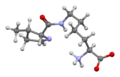 Pyrrolysine from PDB 3D


Advertise on WikiMD — 81,000+ full articles, ~900,000 total pages, ~250 million page views. Global reach, limited time promotional rates from $1/page/day. Learn more · View stats

Translate page: - East Asian
中文,
日本,
한국어,
South Asian
हिन्दी,
தமிழ்,
తెలుగు,
Urdu,
ಕನ್ನಡ,
Southeast Asian
Indonesian,
Vietnamese,
Thai,
မြန်မာဘာသာ,
বাংলা
European
español,
Deutsch,
français,
Greek,
português do Brasil,
polski,
română,
русский,
Nederlands,
norsk,
svenska,
suomi,
Italian
Middle Eastern & African
عربى,
Turkish,
Persian,
Hebrew,
Afrikaans,
isiZulu,
Kiswahili,
Other
Bulgarian,
Hungarian,
Czech,
Swedish,
മലയാളം,
मराठी,
ਪੰਜਾਬੀ,
ગુજરાતી,
Portuguese,
Ukrainian
About WikiMD • Contact • Disclaimer • Privacy • Copyright • Site statistics
Some content and images may originate from Wikimedia Commons or Wikipedia and remain subject to their stated licenses. Unless otherwise noted, eligible WikiMD content is available under CC BY-SA 4.0.
WikiMD Wellnesspedia — Free health & wellness information for patients, students, and health professionals.

