Medication
Substance used to diagnose, cure, treat, or prevent disease
[[File: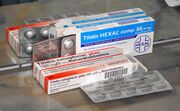 |frameless|alt=]]

| Pronunciation | |
|---|---|
| Other names | Medicine, drug, pharmaceutical, pharmaceutical preparation, pharmaceutical product, medicinal product, medicament, remedy |
| Medical specialty | |
| Uses | |
| Complications | |
| Approach | |
| Types | |
| Recovery time | |
| Other options | |
| Frequency |


|thumb]]
Substance used to diagnose, cure, treat, or prevent disease
Medication (also called medicine, pharmaceutical drug, or simply drug) is a substance used to diagnose, cure, treat, or prevent disease.[1] Drug therapy, or pharmacotherapy, plays a vital role in modern medicine and is supported by the fields of pharmacology and pharmacy.
Medications can be classified in various ways, including:
- Prescription drugs – Require a medical prescription.
- Over-the-counter (OTC) drugs – Available without prescription.
- By mode of action – E.g., painkillers, antibiotics, antihypertensives.
- By target system – E.g., nervous system drugs, cardiovascular drugs.
- By chemical composition – E.g., small molecules, biologics.
- By therapeutic effect – E.g., anti-inflammatory, antiviral.
The World Health Organization (WHO) maintains a list of essential medicines, considered the most effective and safe for healthcare systems worldwide.
Drug Discovery and Development[edit]
The development of new medications is a complex and costly process that involves: 1. Drug Discovery – Identifying potential drug candidates through research. 2. Preclinical Testing – Evaluating efficacy and safety in lab and animal studies. 3. Clinical Trials – Human testing in phases (I–III) to assess safety, dosage, and effectiveness. 4. Regulatory Approval – Submission to agencies like the FDA (U.S.) or EMA (Europe) for market approval. 5. Post-Market Surveillance – Ongoing monitoring for safety and effectiveness.
On average, it takes 10–15 years and costs over $1 billion to bring a new drug to market.
Drug Administration and Dosage[edit]
Medications can be administered via different routes:
- Oral (PO) – Tablets, capsules, syrups.
- Injection (IV, IM, SC) – Intravenous, intramuscular, subcutaneous.
- Topical – Creams, ointments, transdermal patches.
- Inhalation – Nebulizers, inhalers.
- Sublingual & Buccal – Under the tongue or inside the cheek.
- Ophthalmic & Otic – Eye and ear drops.
- Rectal & Vaginal – Suppositories, creams.
Dosage forms include:
- Solids – Tablets, capsules, powders.
- Liquids – Syrups, suspensions, solutions.
- Injectables – IV fluids, vaccines.
- Other – Sprays, patches, gels.
Types of Medications[edit]
Medications are classified based on therapeutic use:
1. For Pain and Fever[edit]
- Analgesics – Paracetamol, Ibuprofen, Morphine.
- Antipyretics – Reduce fever, e.g., Aspirin, Acetaminophen.
2. For Infections[edit]
- Antibiotics – Treat bacterial infections, e.g., Penicillin, Azithromycin.
- Antivirals – Treat viral infections, e.g., Oseltamivir (Tamiflu).
- Antifungals – Treat fungal infections, e.g., Fluconazole, Clotrimazole.
- Antiparasitics – Treat parasites, e.g., Ivermectin, Chloroquine.
3. For Cardiovascular Conditions[edit]
- Antihypertensives – Lower blood pressure, e.g., Amlodipine, Lisinopril.
- Anticoagulants – Prevent blood clots, e.g., Warfarin, Heparin.
- Statins – Lower cholesterol, e.g., Atorvastatin, Simvastatin.
4. For Central Nervous System (CNS)[edit]
- Antidepressants – Treat depression, e.g., Fluoxetine, Sertraline.
- Anxiolytics – Reduce anxiety, e.g., Diazepam, Lorazepam.
- Antiepileptics – Treat seizures, e.g., Valproate, Carbamazepine.
- Stimulants – Treat ADHD, e.g., Methylphenidate (Ritalin).
5. For Endocrine Disorders[edit]
- Insulin – Treats diabetes.
- Thyroid hormones – Treats hypothyroidism, e.g., Levothyroxine.
- Oral contraceptives – Birth control pills.
6. For Respiratory Conditions[edit]
- Bronchodilators – Treat asthma and COPD, e.g., Salbutamol.
- Antihistamines – Treat allergies, e.g., Loratadine, Cetirizine.
7. For Gastrointestinal Disorders[edit]
- Antacids – Neutralize stomach acid, e.g., Omeprazole, Ranitidine.
- Laxatives – Relieve constipation, e.g., Psyllium.
- Antiemetics – Prevent nausea, e.g., Ondansetron.
Medication Regulation[edit]
Medication regulation ensures safety, efficacy, and quality. Key regulatory agencies include:
- FDA (United States)
- EMA (European Medicines Agency)
- MHRA (UK Medicines and Healthcare Products Regulatory Agency)
- TGA (Australia Therapeutic Goods Administration)
- WHO (World Health Organization)
These agencies oversee:
- Clinical trials and drug approvals.
- Prescription vs. OTC classification.
- Generic vs. Brand-name approvals.
- Post-market surveillance.
Pharmaceutical Pricing and Access[edit]
Drug pricing varies by region and is influenced by:
- Research and development costs.
- Patent protection (usually 20 years).
- Government regulations.
- Market demand.
Efforts to improve access include:
- WHO Essential Medicines List – Recommends affordable, life-saving drugs.
- Compulsory Licensing – Allows generic production in emergencies.
- Pharmaceutical Assistance Programs – Help low-income patients.
Controversies and Issues[edit]
1. Access to Essential Medicines Many life-saving drugs remain unaffordable or unavailable in low-income countries due to:
- Patent monopolies restricting generic production.
- High production costs.
- Inefficient healthcare infrastructure.
2. Drug Safety and Side Effects Some medications have led to major health concerns:
- Thalidomide tragedy (1950s-60s) – Severe birth defects.
- Opioid crisis (1990s-present) – Overprescription and addiction.
3. Environmental Impact Pharmaceutical waste enters the environment through:
- Improper disposal.
- Water contamination from excreted drugs.
- Livestock antibiotics affecting ecosystems.
History of Medications[edit]
Ancient Medicine
- Egyptians (1500 BC) – Used honey, herbs, and minerals.
- Greeks (400 BC) – Hippocrates pioneered rational medicine.
- Chinese Medicine (200 BC) – Used herbal compounds.
Modern Advances
- 19th Century – Discovery of aspirin, morphine, and vaccines.
- 20th Century – Development of antibiotics (penicillin), insulin, and chemotherapy.
- 21st Century – Advances in biologics, gene therapy, and personalized medicine.
See Also[edit]
- Pharmacology
- Prescription drug
- Over-the-counter drug
- List of pharmaceutical companies
- Drug development
- Regulation of therapeutic goods
External Links[edit]
| Major chemical drug groups | ||||||||||
|---|---|---|---|---|---|---|---|---|---|---|
|
| Pharmacy | ||||||
|---|---|---|---|---|---|---|
* Category
|

This WikiMD article can only be edited by registered and verified editors. You can log in or register.
- ↑ Federal Food, Drug, and Cosmetic Act, SEC. 210.. U.S. Food and Drug Administration.Accessed 17 August 2008.

Medical Disclaimer: WikiMD is for informational purposes only and is not a substitute for professional medical advice. Content may be inaccurate or outdated and should not be used for diagnosis or treatment. Always consult your healthcare provider for medical decisions. Verify information with trusted sources such as CDC.gov and NIH.gov. By using this site, you agree that WikiMD is not liable for any outcomes related to its content. See full disclaimer.
Credits:Most images are courtesy of Wikimedia commons, and templates, categories Wikipedia, licensed under CC BY SA or similar.
Translate page: - East Asian
中文,
日本,
한국어,
South Asian
हिन्दी,
தமிழ்,
తెలుగు,
Urdu,
ಕನ್ನಡ,
Southeast Asian
Indonesian,
Vietnamese,
Thai,
မြန်မာဘာသာ,
বাংলা
European
español,
Deutsch,
français,
Greek,
português do Brasil,
polski,
română,
русский,
Nederlands,
norsk,
svenska,
suomi,
Italian
Middle Eastern & African
عربى,
Turkish,
Persian,
Hebrew,
Afrikaans,
isiZulu,
Kiswahili,
Other
Bulgarian,
Hungarian,
Czech,
Swedish,
മലയാളം,
मराठी,
ਪੰਜਾਬੀ,
ગુજરાતી,
Portuguese,
Ukrainian

