Aminoacyl tRNA synthetase
Aminoacyl_tRNA_synthetase[edit]
-
 Structure of an aminoacyl-tRNA synthetase
 -
 Crystal structure of a tRNA synthetase
 -
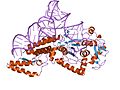 Aminoacyl-tRNA synthetase complex
 -
 General structure of aminoacyl-tRNA synthetase
 -
 Aminoacyl-tRNA synthetase sequence alignment


Aminoacyl tRNA Synthetase[edit]
Aminoacyl tRNA synthetase is a crucial enzyme in the process of protein synthesis. It plays a vital role in the translation of the genetic code by attaching the appropriate amino acid to its corresponding tRNA. This process is essential for the accurate translation of mRNA into a polypeptide chain.
Function[edit]
Aminoacyl tRNA synthetases are responsible for the esterification of a specific amino acid to its corresponding tRNA. This reaction occurs in two steps:
- The amino acid is activated by ATP, forming an aminoacyl-adenylate intermediate and releasing pyrophosphate.
- The activated amino acid is then transferred to the 3' end of the tRNA, forming an aminoacyl-tRNA and releasing AMP.
This process ensures that the tRNA is "charged" with the correct amino acid, which is then used by the ribosome during translation.
Classification[edit]
Aminoacyl tRNA synthetases are classified into two classes based on their structure and mechanism:
- Class I synthetases typically attach the amino acid to the 2'-OH group of the terminal adenosine of tRNA. They generally have a Rossmann fold and are mostly monomeric.
- Class II synthetases attach the amino acid to the 3'-OH group and often have an antiparallel _-sheet structure. They are usually dimeric or multimeric.
Specificity[edit]
The specificity of aminoacyl tRNA synthetases is critical for the fidelity of protein synthesis. Each synthetase must recognize its corresponding amino acid and tRNA with high specificity. This is achieved through:
- Active site recognition: The enzyme's active site is tailored to bind only the correct amino acid.
- tRNA recognition: Specific nucleotide sequences and structural features of the tRNA are recognized by the synthetase.
Editing Mechanisms[edit]
To prevent errors in protein synthesis, some aminoacyl tRNA synthetases have editing mechanisms to correct mistakes. These mechanisms include:
- Pre-transfer editing: Hydrolysis of incorrectly activated aminoacyl-adenylate before it is transferred to tRNA.
- Post-transfer editing: Hydrolysis of incorrectly charged aminoacyl-tRNA.
Clinical Significance[edit]
Mutations in aminoacyl tRNA synthetases can lead to various human diseases, including neurological disorders and cancer. These enzymes are also targets for antibiotic development, as they are essential for bacterial survival.
Related Pages[edit]
| Encoded (proteinogenic) amino acids | ||||||||||||||||
|---|---|---|---|---|---|---|---|---|---|---|---|---|---|---|---|---|
|
Ad. Transform your health with W8MD Weight Loss, Sleep & MedSpa

Tired of being overweight?
Special offer:
Budget GLP-1 weight loss medications
- Semaglutide starting from $29.99/week and up with insurance for visit of $59.99 and up per week self pay.
- Tirzepatide starting from $45.00/week and up (dose dependent) or $69.99/week and up self pay
✔ Same-week appointments, evenings & weekends
Learn more:
- GLP-1 weight loss clinic NYC
- W8MD's NYC medical weight loss
- W8MD Philadelphia GLP-1 shots
- Philadelphia GLP-1 injections
- Affordable GLP-1 shots NYC
|
WikiMD Medical Encyclopedia |
Medical Disclaimer: WikiMD is for informational purposes only and is not a substitute for professional medical advice. Content may be inaccurate or outdated and should not be used for diagnosis or treatment. Always consult your healthcare provider for medical decisions. Verify information with trusted sources such as CDC.gov and NIH.gov. By using this site, you agree that WikiMD is not liable for any outcomes related to its content. See full disclaimer.
Credits:Most images are courtesy of Wikimedia commons, and templates, categories Wikipedia, licensed under CC BY SA or similar.
Translate this page: - East Asian
中文,
日本,
한국어,
South Asian
हिन्दी,
தமிழ்,
తెలుగు,
Urdu,
ಕನ್ನಡ,
Southeast Asian
Indonesian,
Vietnamese,
Thai,
မြန်မာဘာသာ,
বাংলা
European
español,
Deutsch,
français,
Greek,
português do Brasil,
polski,
română,
русский,
Nederlands,
norsk,
svenska,
suomi,
Italian
Middle Eastern & African
عربى,
Turkish,
Persian,
Hebrew,
Afrikaans,
isiZulu,
Kiswahili,
Other
Bulgarian,
Hungarian,
Czech,
Swedish,
മലയാളം,
मराठी,
ਪੰਜਾਬੀ,
ગુજરાતી,
Portuguese,
Ukrainian
