Mahi-mahi: Difference between revisions
No edit summary |
CSV import |
||
| Line 52: | Line 52: | ||
[[Category:Fish of Aruba]] | [[Category:Fish of Aruba]] | ||
{{nt}} | {{nt}} | ||
<gallery> | |||
File:Coryphaenahippurus.JPG|Mahi-mahi | |||
File:Fresco of a fisherman, Akrotiri, Greece.jpg|Fresco of a fisherman | |||
File:IMAG0302.jpg|Mahi-mahi | |||
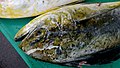
File:IMAG0303.jpg|Mahi-mahi | |||
File:Common dolphinfish, capture production, thousand tonnes, 1950-2022.svg|Common dolphinfish capture production | |||
File:Mahi mahi costa rica.jpg|Mahi-mahi Costa Rica | |||
File:Lines of sargassum Sargasso Sea.jpg|Lines of sargassum | |||
File:GrilledMahiMahi.jpg|Grilled Mahi-mahi | |||
</gallery> | |||
Latest revision as of 00:56, 20 February 2025
Mahi-mahi

This fish related article is a stub.
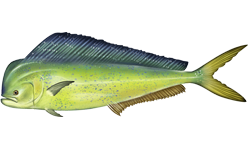
The mahi-mahi (Coryphaena hippurus), also known as the common dolphinfish, is a surface-dwelling ray-finned fish found in off-shore temperate, tropical, and subtropical waters worldwide. The name "mahi-mahi" comes from the Hawaiian language, meaning "strong-strong," which refers to the fish's fighting ability when hooked.
Taxonomy and Nomenclature[edit]
The mahi-mahi belongs to the family Coryphaenidae, which includes only one other species, the pompano dolphinfish (Coryphaena equiselis). The scientific name Coryphaena hippurus was given by Carl Linnaeus in 1758. The term "dolphinfish" is often used to describe this species, but it should not be confused with the dolphin, which is a marine mammal.
Morphology[edit]
Mahi-mahi are known for their vibrant coloration, which includes bright blues, greens, and yellows. They have a compressed body with a long dorsal fin extending from the head almost to the tail. The head is blunt and the mouth is large, equipped with sharp teeth. Adult males, known as "bulls," have a prominent forehead that protrudes above the body, while females, or "cows," have a more rounded head.
Distribution and Habitat[edit]
Mahi-mahi are found in the Atlantic Ocean, Gulf of Mexico, Caribbean Sea, and the Pacific Ocean. They prefer warm waters and are often found near the surface. These fish are highly migratory and are known to travel long distances in search of food.
Diet and Feeding Behavior[edit]
Mahi-mahi are carnivorous and feed on a variety of prey, including small fish, squid, and crustaceans. They are opportunistic feeders and are known for their speed and agility in capturing prey. Mahi-mahi often hunt in groups, which increases their efficiency in capturing food.
Reproduction[edit]
Mahi-mahi are prolific breeders, with spawning occurring throughout the year in warm waters. Females can lay between 80,000 to 1,000,000 eggs per spawning event. The eggs are pelagic, meaning they float in the open water, and hatch within 36 to 48 hours. Juvenile mahi-mahi grow rapidly, reaching maturity in 4 to 5 months.
Economic and Culinary Importance[edit]
Mahi-mahi is a popular game fish and is highly valued for its firm, flavorful flesh. It is commonly served grilled, baked, or fried, and is a staple in many tropical and subtropical cuisines. The fish is also important to commercial fisheries, with significant catches reported in the United States, Mexico, and Costa Rica.
Conservation Status[edit]
According to the International Union for Conservation of Nature (IUCN), the mahi-mahi is listed as "Least Concern" due to its wide distribution and high reproductive rate. However, overfishing and bycatch in tuna and swordfish fisheries pose potential threats to local populations.
See Also[edit]
External Links[edit]
| Meat | ||||||||||
|---|---|---|---|---|---|---|---|---|---|---|
|
-
 Mahi-mahi
 -
 Fresco of a fisherman
 -
 Mahi-mahi
 -
 Mahi-mahi
 -
 Common dolphinfish capture production
 -
 Mahi-mahi Costa Rica
 -
 Lines of sargassum
 -
 Grilled Mahi-mahi


