Medication: Difference between revisions
No edit summary |
No edit summary |
||
| Line 19: | Line 19: | ||
| eMedicine = | | eMedicine = | ||
}} | }} | ||
[[File:Drawing_by_Marguerite_Martyn_of_a_visiting_nurse_with_medicine_and_four_babies,_1918.jpg|Medication|thumb]] | [[File:Drawing_by_Marguerite_Martyn_of_a_visiting_nurse_with_medicine_and_four_babies,_1918.jpg|Medication|thumb]] | ||
[[File:VariousPills.jpg|thumb|An example of a medication is a [[prescription drug]].]]|thumb]] | [[File:VariousPills.jpg|thumb|An example of a medication is a [[prescription drug]].]]|thumb]] | ||
| Line 169: | Line 167: | ||
* [[Drug development]] | * [[Drug development]] | ||
* [[Regulation of therapeutic goods]] | * [[Regulation of therapeutic goods]] | ||
== External Links == | == External Links == | ||
* [https://www.who.int/medicines/publications/essentialmedicines/en/ WHO Model List of Essential Medicines] | * [https://www.who.int/medicines/publications/essentialmedicines/en/ WHO Model List of Essential Medicines] | ||
* [https://www.fda.gov/drugs U.S. FDA Drugs Portal] | * [https://www.fda.gov/drugs U.S. FDA Drugs Portal] | ||
* [https://www.ema.europa.eu/en/medicines European Medicines Agency] | * [https://www.ema.europa.eu/en/medicines European Medicines Agency] | ||
{{Major Drug Groups}} | {{Major Drug Groups}} | ||
{{Pharmacy}} | {{Pharmacy}} | ||
Latest revision as of 01:08, 20 March 2025
Substance used to diagnose, cure, treat, or prevent disease
[[File: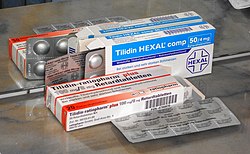 |frameless|alt=]]

| Pronunciation | |
|---|---|
| Other names | Medicine, drug, pharmaceutical, pharmaceutical preparation, pharmaceutical product, medicinal product, medicament, remedy |
| Medical specialty | |
| Uses | |
| Complications | |
| Approach | |
| Types | |
| Recovery time | |
| Other options | |
| Frequency |


|thumb]]
Substance used to diagnose, cure, treat, or prevent disease
Medication (also called medicine, pharmaceutical drug, or simply drug) is a substance used to diagnose, cure, treat, or prevent disease.<ref>
Federal Food, Drug, and Cosmetic Act, SEC. 210.(link). U.S. Food and Drug Administration.
Accessed 17 August 2008.
</ref> Drug therapy, or pharmacotherapy, plays a vital role in modern medicine and is supported by the fields of pharmacology and pharmacy.
Medications can be classified in various ways, including:
- Prescription drugs – Require a medical prescription.
- Over-the-counter (OTC) drugs – Available without prescription.
- By mode of action – E.g., painkillers, antibiotics, antihypertensives.
- By target system – E.g., nervous system drugs, cardiovascular drugs.
- By chemical composition – E.g., small molecules, biologics.
- By therapeutic effect – E.g., anti-inflammatory, antiviral.
The World Health Organization (WHO) maintains a list of essential medicines, considered the most effective and safe for healthcare systems worldwide.
Drug Discovery and Development[edit]
The development of new medications is a complex and costly process that involves: 1. Drug Discovery – Identifying potential drug candidates through research. 2. Preclinical Testing – Evaluating efficacy and safety in lab and animal studies. 3. Clinical Trials – Human testing in phases (I–III) to assess safety, dosage, and effectiveness. 4. Regulatory Approval – Submission to agencies like the FDA (U.S.) or EMA (Europe) for market approval. 5. Post-Market Surveillance – Ongoing monitoring for safety and effectiveness.
On average, it takes 10–15 years and costs over $1 billion to bring a new drug to market.
Drug Administration and Dosage[edit]
Medications can be administered via different routes:
- Oral (PO) – Tablets, capsules, syrups.
- Injection (IV, IM, SC) – Intravenous, intramuscular, subcutaneous.
- Topical – Creams, ointments, transdermal patches.
- Inhalation – Nebulizers, inhalers.
- Sublingual & Buccal – Under the tongue or inside the cheek.
- Ophthalmic & Otic – Eye and ear drops.
- Rectal & Vaginal – Suppositories, creams.
Dosage forms include:
- Solids – Tablets, capsules, powders.
- Liquids – Syrups, suspensions, solutions.
- Injectables – IV fluids, vaccines.
- Other – Sprays, patches, gels.
Types of Medications[edit]
Medications are classified based on therapeutic use:
1. For Pain and Fever[edit]
- Analgesics – Paracetamol, Ibuprofen, Morphine.
- Antipyretics – Reduce fever, e.g., Aspirin, Acetaminophen.
2. For Infections[edit]
- Antibiotics – Treat bacterial infections, e.g., Penicillin, Azithromycin.
- Antivirals – Treat viral infections, e.g., Oseltamivir (Tamiflu).
- Antifungals – Treat fungal infections, e.g., Fluconazole, Clotrimazole.
- Antiparasitics – Treat parasites, e.g., Ivermectin, Chloroquine.
3. For Cardiovascular Conditions[edit]
- Antihypertensives – Lower blood pressure, e.g., Amlodipine, Lisinopril.
- Anticoagulants – Prevent blood clots, e.g., Warfarin, Heparin.
- Statins – Lower cholesterol, e.g., Atorvastatin, Simvastatin.
4. For Central Nervous System (CNS)[edit]
- Antidepressants – Treat depression, e.g., Fluoxetine, Sertraline.
- Anxiolytics – Reduce anxiety, e.g., Diazepam, Lorazepam.
- Antiepileptics – Treat seizures, e.g., Valproate, Carbamazepine.
- Stimulants – Treat ADHD, e.g., Methylphenidate (Ritalin).
5. For Endocrine Disorders[edit]
- Insulin – Treats diabetes.
- Thyroid hormones – Treats hypothyroidism, e.g., Levothyroxine.
- Oral contraceptives – Birth control pills.
6. For Respiratory Conditions[edit]
- Bronchodilators – Treat asthma and COPD, e.g., Salbutamol.
- Antihistamines – Treat allergies, e.g., Loratadine, Cetirizine.
7. For Gastrointestinal Disorders[edit]
- Antacids – Neutralize stomach acid, e.g., Omeprazole, Ranitidine.
- Laxatives – Relieve constipation, e.g., Psyllium.
- Antiemetics – Prevent nausea, e.g., Ondansetron.
Medication Regulation[edit]
Medication regulation ensures safety, efficacy, and quality. Key regulatory agencies include:
- FDA (United States)
- EMA (European Medicines Agency)
- MHRA (UK Medicines and Healthcare Products Regulatory Agency)
- TGA (Australia Therapeutic Goods Administration)
- WHO (World Health Organization)
These agencies oversee:
- Clinical trials and drug approvals.
- Prescription vs. OTC classification.
- Generic vs. Brand-name approvals.
- Post-market surveillance.
Pharmaceutical Pricing and Access[edit]
Drug pricing varies by region and is influenced by:
- Research and development costs.
- Patent protection (usually 20 years).
- Government regulations.
- Market demand.
Efforts to improve access include:
- WHO Essential Medicines List – Recommends affordable, life-saving drugs.
- Compulsory Licensing – Allows generic production in emergencies.
- Pharmaceutical Assistance Programs – Help low-income patients.
Controversies and Issues[edit]
1. Access to Essential Medicines Many life-saving drugs remain unaffordable or unavailable in low-income countries due to:
- Patent monopolies restricting generic production.
- High production costs.
- Inefficient healthcare infrastructure.
2. Drug Safety and Side Effects Some medications have led to major health concerns:
- Thalidomide tragedy (1950s-60s) – Severe birth defects.
- Opioid crisis (1990s-present) – Overprescription and addiction.
3. Environmental Impact Pharmaceutical waste enters the environment through:
- Improper disposal.
- Water contamination from excreted drugs.
- Livestock antibiotics affecting ecosystems.
History of Medications[edit]
Ancient Medicine
- Egyptians (1500 BC) – Used honey, herbs, and minerals.
- Greeks (400 BC) – Hippocrates pioneered rational medicine.
- Chinese Medicine (200 BC) – Used herbal compounds.
Modern Advances
- 19th Century – Discovery of aspirin, morphine, and vaccines.
- 20th Century – Development of antibiotics (penicillin), insulin, and chemotherapy.
- 21st Century – Advances in biologics, gene therapy, and personalized medicine.
See Also[edit]
- Pharmacology
- Prescription drug
- Over-the-counter drug
- List of pharmaceutical companies
- Drug development
- Regulation of therapeutic goods
External Links[edit]
| Major chemical drug groups | ||||||||||
|---|---|---|---|---|---|---|---|---|---|---|
|
| Pharmacy | ||||||
|---|---|---|---|---|---|---|
* Category
|


