|
|
| (3 intermediate revisions by the same user not shown) |
| Line 1: |
Line 1: |
| {{taxobox | | {{DISPLAYTITLE:Mahi-mahi}} |
| | {{Infobox fish |
| | name = Mahi-mahi | | | name = Mahi-mahi |
| | image = Coryphaena hippurus.png | | | image = Coryphaena hippurus.png |
| | | image_caption = Mahi-mahi (''Coryphaena hippurus'') |
| | status = LC | | | status = LC |
| | status_system = iucn3.1 | | | status_system = IUCN3.1 |
| | status_ref = <ref>Collette, B., Acero, A., Amorim, A.F., Boustany, A., Canales Ramirez, C., Cardenas, G., Carpenter, K.E., de Oliveira Leite Jr., N., Di Natale, A., Fox, W., Fredou, F.L., Graves, J., Viera Hazin, F.H., Juan Jorda, M., Minte Vera, C., Miyabe, N., Montano Cruz, R., Nelson, R., Oxenford, H., Schaefer, K., Serra, R., Sun, C., Teixeira Lessa, R.P., Pires Ferreira Travassos, P.E., Uozumi, Y. & Yanez, E. 2011. ''[http://www.iucnredlist.org/details/154712/0 Coryphaena hippurus]''. In: IUCN 2012. IUCN Red List of Threatened Species. Version 2012.2. <[http://www.iucnredlist.org www.iucnredlist.org]>. Downloaded on 23 June 2013.</ref> | | | taxon = Coryphaena hippurus |
| | regnum = [[Animal]]ia
| | | authority = [[Carl Linnaeus|Linnaeus]], 1758 |
| | phylum = [[Chordate|Chordata]]
| |
| | classis = [[Actinopterygii]]
| |
| | ordo = [[Perciformes]]
| |
| | familia = [[Coryphaenidae]]
| |
| | genus = ''[[Coryphaena]]''
| |
| | species = '''''C. hippurus'''''
| |
| | binomial = ''Coryphaena hippurus''
| |
| | binomial_authority = [[Carolus Linnaeus|Linnaeus]], 1758 | |
| | synonyms =
| |
| * ''Scomber pelagicus'' <small>Linnaeus, 1758</small>
| |
| * ''Coryphaena fasciolata'' <small>Pallas, 1770</small>
| |
| * ''Coryphaena chrysurus'' <small>Lacepède, 1801</small>
| |
| * ''Coryphaena imperialis'' <small>Rafinesque, 1810</small>
| |
| * ''Lepimphis hippuroides'' <small>Rafinesque, 1810</small>
| |
| * ''Coryphaena immaculata'' <small>Agassiz, 1831</small>
| |
| * ''Lampugus siculus'' <small>Valenciennes, 1833</small>
| |
| * ''Coryphaena scomberoides'' <small>Valenciennes, 1833</small>
| |
| * ''Coryphaena margravii'' <small>Valenciennes, 1833</small>
| |
| * ''Coryphaena suerii'' <small>Valenciennes, 1833</small>
| |
| * ''Coryphaena dorado'' <small>Valenciennes, 1833</small>
| |
| * ''Coryphaena dolfyn'' <small>Valenciennes, 1833</small>
| |
| * ''Coryphaena virgata'' <small>Valenciennes, 1833</small>
| |
| * ''Coryphaena argyrurus'' <small>Valenciennes, 1833</small>
| |
| * ''Coryphaena vlamingii'' <small>Valenciennes, 1833</small>
| |
| * ''Coryphaena nortoniana'' <small>R. T. Lowe, 1839</small>
| |
| * ''Coryphaena japonica'' <small>Temminck & Schlegel, 1845</small>
| |
| }} | | }} |
| [[File:Akrotiri - Fresco of a fisherman.jpg|thumb|upright|Young fisherman with '''dolphinfishes''' from [[Akrotiri]] ([[Minoan civilisation]]).]]
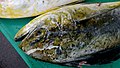
| | The '''mahi-mahi''' (''Coryphaena hippurus''), also known as the common dolphinfish, is a surface-dwelling ray-finned fish found in off-shore temperate, tropical, and subtropical waters worldwide. The name "mahi-mahi" comes from the [[Hawaiian language]], meaning "strong-strong," which refers to the fish's fighting ability when hooked. |
|
| |
|
| The '''mahi-mahi''' ({{IPAc-en|ˈ|m|ɑː|h|iː|ˈ|m|ɑː|h|iː}})<ref>[http://dictionary.reference.com/browse/mahi+mahi Dictionary.com: define Mahi-mahi]</ref> or '''common dolphinfish'''<ref name=Fishbase/> (''Coryphaena hippurus'') is a surface-dwelling [[ray-finned fish]] found in off-shore [[temperate]], [[tropical]] and [[subtropical]] waters worldwide. Also known widely as '''dorado''', it is one of two members of the [[Coryphaenidae]] family, the other being the [[pompano dolphinfish]]. | | ==Taxonomy and Nomenclature== |
| | The mahi-mahi belongs to the family [[Coryphaenidae]], which includes only one other species, the pompano dolphinfish (''Coryphaena equiselis''). The scientific name ''Coryphaena hippurus'' was given by [[Carl Linnaeus]] in 1758. The term "dolphinfish" is often used to describe this species, but it should not be confused with the [[dolphin]], which is a marine mammal. |
|
| |
|
| The name mahi-mahi means ''[[Reduplication|very]] strong'' in Hawaiian. In other languages the fish is known as '''dorade coryphène''', '''lampuga''', '''llampuga''', '''lampuka''', '''lampuki,''' '''rakingo''', '''calitos''', or '''maverikos'''.
| | ==Morphology== |
| | Mahi-mahi are known for their vibrant coloration, which includes bright blues, greens, and yellows. They have a compressed body with a long dorsal fin extending from the head almost to the tail. The head is blunt and the mouth is large, equipped with sharp teeth. Adult males, known as "bulls," have a prominent forehead that protrudes above the body, while females, or "cows," have a more rounded head. |
|
| |
|
| == Nomenclature == | | ==Distribution and Habitat== |
| The common English name of ''dolphin'' causes much confusion. This fish is not related to the marine mammals also known as ''[[dolphin]]s'' (family Delphinidae). Additionally, two species of dolphinfish exist, the common dolphinfish (''Coryphaena hippurus'') and the pompano dolphin (''Coryphaena equiselis''). Both these species are commonly marketed by their Pacific name, mahi-mahi.
| | Mahi-mahi are found in the [[Atlantic Ocean]], [[Gulf of Mexico]], [[Caribbean Sea]], and the [[Pacific Ocean]]. They prefer warm waters and are often found near the surface. These fish are highly migratory and are known to travel long distances in search of food. |
|
| |
|
| The fish is called mahi-mahi in the [[Hawaiian language]],<ref>{{Hawaiian Dictionaries|dolphin|q=dolphin}}</ref> and "mahi mahi" and "mahi-mahi" are commonly used elsewhere.<ref name=Fishbase_names>{{cite web |url= http://www.fishbase.org/comnames/CommonNamesList.php?ID=6&GenusName=Coryphaena&SpeciesName=hippurus&StockCode=1884 |title=Common names of ''Coryphaena hippurus'' |work=Fishbase |accessdate=16 August 2011}}</ref>
| | ==Diet and Feeding Behavior== |
| | Mahi-mahi are carnivorous and feed on a variety of prey, including small fish, [[squid]], and [[crustaceans]]. They are opportunistic feeders and are known for their speed and agility in capturing prey. Mahi-mahi often hunt in groups, which increases their efficiency in capturing food. |
|
| |
|
| In the Pacific and along the English speaking coast of South Africa they are also commonly called by the Spanish name, Dorado {{Citation needed|date=December 2013}}. In the Mediterranean island of Malta, this fish is referred to as the lampuka.<ref>{{cite web|title=Maltese cuisine|url=http://www.wikimd.org
| | ==Reproduction== |
| /wiki/Maltese_cuisine|publisher=Wikipedia}}</ref>
| | Mahi-mahi are prolific breeders, with spawning occurring throughout the year in warm waters. Females can lay between 80,000 to 1,000,000 eggs per spawning event. The eggs are pelagic, meaning they float in the open water, and hatch within 36 to 48 hours. Juvenile mahi-mahi grow rapidly, reaching maturity in 4 to 5 months. |
|
| |
|
| [[Linnaeus]] named the genus, derived from the Greek word, ''koryphe'', meaning top or apex, in 1758. Synonyms for the species include ''Coryphaena argyrurus'', ''Coryphaena chrysurus'' and ''Coryphaena dolfyn''.<ref name=Fishbase>{{ cite web | title = ''Coryphaena hippurus'' | url = http://www.fishbase.org/Summary/SpeciesSummary.php?id=6 |work= [[FishBase]] | accessdate = 16 August 2011 }}</ref>
| | ==Economic and Culinary Importance== |
| | Mahi-mahi is a popular game fish and is highly valued for its firm, flavorful flesh. It is commonly served grilled, baked, or fried, and is a staple in many tropical and subtropical cuisines. The fish is also important to commercial fisheries, with significant catches reported in the [[United States]], [[Mexico]], and [[Costa Rica]]. |
|
| |
|
| == General statistics == | | ==Conservation Status== |
| Mahi-mahi can live up to 5 years, although they seldom exceed four. Catches average {{convert|7|to|13|kg|lb}}. They seldom exceed {{convert|15|kg|lb}}, and mahi-mahi over {{convert|18|kg|lb}} are exceptional.
| | According to the [[International Union for Conservation of Nature]] (IUCN), the mahi-mahi is listed as "Least Concern" due to its wide distribution and high reproductive rate. However, overfishing and bycatch in tuna and swordfish fisheries pose potential threats to local populations. |
| | |
| Mahi-mahi have compressed bodies and long [[dorsal fin]]s extending nearly the entire length of their bodies. Their caudal fins and [[anal fins]] are sharply concave. They are distinguished by dazzling colors: golden on the sides, and bright blues and greens on the sides and back. Mature males have prominent foreheads protruding well above the body proper. Females have a rounded head. Females are also usually smaller than males.
| |
| | |
| The pectoral fins of the mahi-mahi are iridescent blue. The flank is broad and golden. 3 black diagonal stripes appear on each side of the fish as it swiftly darts after prey.
| |
|
| |
| Out of the water, the fish often change color (giving rise to their [[Spanish language|Spanish]] name, ''dorado'', "golden"), going though several hues before finally fading to a muted yellow-grey upon death.
| |
| | |
| Mahi-mahi are among the fastest-growing fish. They spawn in warm ocean currents throughout much of the year, and their young are commonly found in seaweed. Mahi-mahi are carnivorous, feeding on [[flying fish]], [[crab]]s, [[squid]], [[mackerel]], and other [[forage fish]]. They have also been known to eat [[zooplankton]] and [[crustacean]]s.
| |
| | |
| Males and females are sexually mature in their first year, usually by 4–5 months old. Spawning can occur at body lengths of 20 cm. Females may spawn two to three times per year, and produce between 80,000 and 1,000,000 eggs per event.
| |
| | |
| In waters averaging 28 °C/83 °F, mahi-mahi larvae are found year-round, with greater numbers detected in spring and fall. In one study, seventy percent of the youngest larvae collected in the northern Gulf of Mexico were found at a depth greater than 180 meters. Spawning occurs normally in captivity, with 100,000 eggs per event. Problems maintaining salinity, food of adequate nutritional value and proper size, and dissolved oxygen are responsible for larval mortality rates of 20-40%.
| |
| <ref name=ADW>{{cite web |url= http://animaldiversity.ummz.umich.edu/site/accounts/information/Coryphaena_hippurus.html |title=''Coryphaena hippurus'' |first=Joshua |last=Bostwick |year=2000 |work=Animal Diversity Web |accessdate=August 17, 2011}}</ref>
| |
| Mahi-mahi fish are mostly found in the surface water. Juveniles feed on shrimp, fish and crabs found in rafts of [[Sargassum]] weeds. Their flesh is soft and oily, similar to sardines. The body is slightly slender and long, making them fast swimmers; they can swim as fast as 50 knots (92.6 km/h, 57.5 mph).<ref>{{cite web|url= http://www.ohwy.com/us/h/hardhead.htm|title= Hardhead Catfish_ Arius felis}}</ref>
| |
| | |
| == Recreational fishing ==
| |
| {{main|Mahi-mahi fishing}}
| |
| | |
| Mahi-mahi are highly sought for sport fishing and commercial purposes. Sport fishermen seek them due to their beauty, size, food quality, and healthy population. Mahi-mahi is popular in many restaurants.
| |
| | |
| Mahi-mahi can be found in the [[Caribbean Sea]], on the west coast of North and South America, the Pacific coast of [[Costa Rica]], the [[Gulf of Mexico]], the [[Atlantic]] coast of [[Florida]] and [[West Africa]], [[South China Sea]] and [[Southeast Asia]], [[Hawaii]] and many other places worldwide.
| |
| | |
| Fishing charters most often look for floating debris and [[frigatebird]]s near the edge of the reef in about {{convert|120|ft|m}} of water. Mahi-mahi (and many other fish) often swim near debris such as floating wood, palm trees and fronds, or sargasso weed lines and around [[Fish aggregating device|fish buoys]]. [[Sargassum|Sargasso]] is floating seaweed that sometimes holds a complete ecosystem from microscopic creatures to seahorses and baitfish. Frigatebirds dive for food accompanying the debris or sargasso. Experienced fishing guides can tell what species are likely around the debris by the birds' behavior.
| |
| | |
| Thirty- to fifty-pound gear is more than adequate when trolling for mahi-mahi. Fly-casters may especially seek frigatebirds to find big mahi-mahis, and then use a bait-and-switch technique. [[Ballyhoo]] or a net full of live [[sardine]]s tossed into the water can excite the mahi-mahis into a feeding frenzy. Hookless teaser lures can have the same effect. After tossing the teasers or live [[chumming|chum]], fishermen throw the fly to the feeding mahi-mahi. Once on a line, mahi-mahi are fast, flashy and acrobatic, with beautiful blue, yellow, green and even red dots of color.
| |
| | |
| {{clear}}
| |
| | |
| == Commercial fishing ==
| |
| The [[United States]] and the [[Caribbean]] countries are the primary consumers of this fish, but many European countries are increasing their consumption every year.{{citation needed|date=May 2010}} It is a popular eating fish in Australia, usually caught and sold as a by-product by tuna and swordfish commercial fishing operators. [[Japan]] and Hawaii are significant consumers. The [[Arabian Sea]], particularly the coast of [[Oman]], also has mahi-mahi. At first, mahi-mahi were mostly [[bycatch]] (incidental catch) in the tuna and swordfish [[longline fishing|longline]] fishery. Now they are sought by commercial fishermen on their own merits.
| |
| | |
| In [[French Polynesia]], fishermen use [[harpoon]]s, using a specifically designed boat, the ''poti marara'', to pursue it, because mahi-mahi do not dive. The ''poti marara'' is a powerful motorized V-shaped boat, optimized for high agility and speed, and driven with a stick so the pilot can hold his harpoon with his right hand.
| |
| | |
| == Environmental and food safety concerns ==
| |
| Depending on how it is caught, mahi-mahi is classed differently by various sustainability rating systems. It is also a potential vector of toxic microorganisms.
| |
| | |
| *The [[Monterey Bay Aquarium]] classifies mahi-mahi, when caught in the US Atlantic, as a Best Choice, the top of its three environmental impact categories. The Aquarium advises to avoid imported mahi-mahi harvested by long line but rates troll and pole-and-line caught as a Good Alternative.
| |
| | |
| *The [[Natural Resources Defense Council]] (NRDC) classifies mahi-mahi as a "moderate [[mercury (element)|mercury]]" fish or shellfish (its second lowest of four categories), and suggests eating six servings or fewer per month.<ref>{{ cite web | url = http://www.nrdc.org/health/effects/mercury/guide.asp | title = Consumer Guide to Mercury in Fish }}</ref>
| |
| | |
| *The [[Environmental Defense Fund]] (EDF) classifies mahi-mahi caught by line/pole in the US as "Eco-Best" in its three-category system,<ref>{{ cite web | url = http://www.edf.org/page.cfm?tagID=1540 | title = Seafood Selector: Find a Fish }}</ref> but classifies all mahi-mahi caught by longline as only "Eco-OK" or "Eco-Worst" due to longline "high levels [of] bycatch, injuring or killing seabirds, sea turtles and sharks."<ref>{{ cite web | url = http://www.edf.org/page.cfm?tagID=16957 | title = Mahimahi, imported longline, Eco-Worst }}</ref>
| |
| | |
| The mahi-mahi is also a common vector for [[ciguatera]] poisoning.<ref>{{ cite web | url = http://research.myfwc.com/features/view_article.asp?id=1187 | title = Ciguatera Fish Poisoning (CFP) | publisher = Fish and Wildlife Research Institute | date = | accessdate = 2010-01-04 }}</ref>
| |
|
| |
|
| | ==See Also== |
| | * [[Coryphaenidae]] |
| | * [[Pelagic fish]] |
| | * [[Game fish]] |
| | ==External Links== |
| | * [https://www.fishbase.se/summary/87 FishBase: Coryphaena hippurus] |
| | * [https://www.iucnredlist.org/species/154712/4612021 IUCN Red List: Coryphaena hippurus] |
| | {{Meat|state=expanded}} |
| | [[Category:Commercial fish]] |
| | [[Category:Coryphaena|mahi-mahi]] |
| | [[Category:Fish described in 1758]] |
| | [[Category:Taxa named by Carl Linnaeus]] |
| | [[Category:Fish of the Atlantic Ocean]] |
| | [[Category:Native Hawaiian cuisine]] |
| | [[Category:Hawaiian words and phrases]] |
| | [[Category:Pantropical fish]] |
| | [[Category:Game fish]] |
| | [[Category:Cuisine of the Southern United States]] |
| | [[Category:Fish of Aruba]] |
| | {{nt}} |
| <gallery> | | <gallery> |
| File:Mahi mahi costa rica.jpg|Bull (male) mahi-mahi | | File:Coryphaenahippurus.JPG|Mahi-mahi |
| File:Lines of Sargassum.jpg|Mahimahi are attracted to [[sargassum]], a floating brown algae that serves as both a hiding place and source of food. Lines of Sargassum can stretch for miles along the ocean surface | | File:Fresco of a fisherman, Akrotiri, Greece.jpg|Fresco of a fisherman |
| File:GrilledMahiMahi.jpg|[[Grilling|Grilled]] mahi-mahi | | File:IMAG0302.jpg|Mahi-mahi |
| | File:IMAG0303.jpg|Mahi-mahi |
| | File:Common dolphinfish, capture production, thousand tonnes, 1950-2022.svg|Common dolphinfish capture production |
| | File:Mahi mahi costa rica.jpg|Mahi-mahi Costa Rica |
| | File:Lines of sargassum Sargasso Sea.jpg|Lines of sargassum |
| | File:GrilledMahiMahi.jpg|Grilled Mahi-mahi |
| </gallery> | | </gallery> |
|
| |
| == Notes ==
| |
| {{reflist|33em}}
| |
|
| |
| == References ==
| |
| * [http://www.fishwatch.gov/seafood_profiles/species/mahimahi/species_pages/atlantic_mahimahi.htm Atlantic mahimahi] ''NOAA FishWatch''. Retrieved 11 November 2012.
| |
| * [http://www.fishwatch.gov/seafood_profiles/species/mahimahi/species_pages/pacific_mahimahi.htm Pacific mahimahi] ''NOAA FishWatch''. Retrieved 11 November 2012.
| |
|
| |
| == External links ==
| |
| {{commons|Coryphaena hippurus}}
| |
| {{wikispecies|Coryphaena hippurus}}
| |
|
| |
| * {{ITIS |id=168791 |taxon=Coryphaena hippurus |accessdate=11 March 2006}}
| |
| * {{FishBase_species|genus=Coryphaena|species=hippurus|year=2004|month=October}}
| |
| * [http://www.mbayaq.org/cr/cr_seafoodwatch/download.asp Monterey Bay Aquarium's Regional Seafood Watch]
| |
| * [http://www.blueocean.org/seafood/index.asp?SpeciesIDs=Species13,Species97 Blue Ocean Institute's Guide to Ocean Friendly Seafood]
| |
|
| |
| [[Category:Coryphaenidae]]
| |
| [[Category:Edible fish]]
| |
| [[Category:Commercial fish]]
| |
| [[Category:Sport fish]]
| |
| [[Category:Hawaiian cuisine]]
| |
| [[Category:Animals described in 1758]]
| |
| [[Category:Saltwater fish of Florida]]{{food}}
| |
| {{adapted}}
| |
This fish related article is a stub.
The mahi-mahi (Coryphaena hippurus), also known as the common dolphinfish, is a surface-dwelling ray-finned fish found in off-shore temperate, tropical, and subtropical waters worldwide. The name "mahi-mahi" comes from the Hawaiian language, meaning "strong-strong," which refers to the fish's fighting ability when hooked.
Taxonomy and Nomenclature[edit]
The mahi-mahi belongs to the family Coryphaenidae, which includes only one other species, the pompano dolphinfish (Coryphaena equiselis). The scientific name Coryphaena hippurus was given by Carl Linnaeus in 1758. The term "dolphinfish" is often used to describe this species, but it should not be confused with the dolphin, which is a marine mammal.
Morphology[edit]
Mahi-mahi are known for their vibrant coloration, which includes bright blues, greens, and yellows. They have a compressed body with a long dorsal fin extending from the head almost to the tail. The head is blunt and the mouth is large, equipped with sharp teeth. Adult males, known as "bulls," have a prominent forehead that protrudes above the body, while females, or "cows," have a more rounded head.
Distribution and Habitat[edit]
Mahi-mahi are found in the Atlantic Ocean, Gulf of Mexico, Caribbean Sea, and the Pacific Ocean. They prefer warm waters and are often found near the surface. These fish are highly migratory and are known to travel long distances in search of food.
Diet and Feeding Behavior[edit]
Mahi-mahi are carnivorous and feed on a variety of prey, including small fish, squid, and crustaceans. They are opportunistic feeders and are known for their speed and agility in capturing prey. Mahi-mahi often hunt in groups, which increases their efficiency in capturing food.
Reproduction[edit]
Mahi-mahi are prolific breeders, with spawning occurring throughout the year in warm waters. Females can lay between 80,000 to 1,000,000 eggs per spawning event. The eggs are pelagic, meaning they float in the open water, and hatch within 36 to 48 hours. Juvenile mahi-mahi grow rapidly, reaching maturity in 4 to 5 months.
Economic and Culinary Importance[edit]
Mahi-mahi is a popular game fish and is highly valued for its firm, flavorful flesh. It is commonly served grilled, baked, or fried, and is a staple in many tropical and subtropical cuisines. The fish is also important to commercial fisheries, with significant catches reported in the United States, Mexico, and Costa Rica.
Conservation Status[edit]
According to the International Union for Conservation of Nature (IUCN), the mahi-mahi is listed as "Least Concern" due to its wide distribution and high reproductive rate. However, overfishing and bycatch in tuna and swordfish fisheries pose potential threats to local populations.
See Also[edit]
External Links[edit]