Allylamine: Difference between revisions
CSV import |
CSV import |
||
| Line 4: | Line 4: | ||
File:Allylamines.svg|Allylamines structure | File:Allylamines.svg|Allylamines structure | ||
</gallery> | </gallery> | ||
==Allylamine== | |||
'''Allylamine''' is an organic compound with the formula C<sub>3</sub>H<sub>7</sub>NH<sub>2</sub>. It is the simplest unsaturated amine, consisting of a propene group attached to an amino group. Allylamine is a colorless liquid with a strong ammonia-like odor and is used in the synthesis of various pharmaceuticals and polymers. | |||
==Chemical Properties== | |||
Allylamine is a primary amine and exhibits typical amine chemistry. It is a nucleophile and can participate in a variety of chemical reactions, including alkylation, acylation, and condensation reactions. The presence of the double bond in allylamine allows it to undergo additional reactions such as polymerization and addition reactions. | |||
The compound is miscible with water and most organic solvents. It has a boiling point of 53 °C and a melting point of -88 °C. Allylamine is flammable and should be handled with care due to its volatility and potential health hazards. | |||
==Synthesis== | |||
Allylamine can be synthesized through several methods. One common method is the reaction of allyl chloride with ammonia. This reaction typically requires a catalyst and is conducted under controlled conditions to prevent polymerization of the product. | |||
Another method involves the reduction of allyl cyanide using hydrogen in the presence of a catalyst such as palladium on carbon. This method is advantageous as it provides a high yield of allylamine. | |||
==Applications== | |||
Allylamine is used in the production of pharmaceuticals, particularly in the synthesis of antifungal agents such as [[terbinafine]]. It is also used in the manufacture of rubber chemicals, corrosion inhibitors, and as a building block in organic synthesis. | |||
In polymer chemistry, allylamine is used to produce polyallylamine, a polymer that finds applications in water treatment, paper manufacturing, and as a flocculant. | |||
==Safety and Handling== | |||
Allylamine is a hazardous chemical and should be handled with appropriate safety precautions. It is toxic if inhaled, ingested, or absorbed through the skin. Exposure can cause irritation to the respiratory tract, skin, and eyes. Prolonged exposure may lead to more severe health effects. | |||
Proper personal protective equipment (PPE) such as gloves, goggles, and lab coats should be worn when handling allylamine. Work with allylamine should be conducted in a well-ventilated area, preferably under a fume hood. | |||
==Related Pages== | |||
* [[Amine]] | |||
* [[Allyl group]] | |||
* [[Terbinafine]] | |||
* [[Polymer]] | |||
{{Organic compounds}} | |||
{{Chemistry}} | |||
[[Category:Allylamines]] | |||
[[Category:Organic compounds]] | |||
[[Category:Amines]] | |||
Latest revision as of 00:35, 19 February 2025
-
 Allylamine
 -
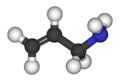 3D model of Allylamine
 -
 Allylamines structure


Allylamine[edit]
Allylamine is an organic compound with the formula C3H7NH2. It is the simplest unsaturated amine, consisting of a propene group attached to an amino group. Allylamine is a colorless liquid with a strong ammonia-like odor and is used in the synthesis of various pharmaceuticals and polymers.
Chemical Properties[edit]
Allylamine is a primary amine and exhibits typical amine chemistry. It is a nucleophile and can participate in a variety of chemical reactions, including alkylation, acylation, and condensation reactions. The presence of the double bond in allylamine allows it to undergo additional reactions such as polymerization and addition reactions.
The compound is miscible with water and most organic solvents. It has a boiling point of 53 °C and a melting point of -88 °C. Allylamine is flammable and should be handled with care due to its volatility and potential health hazards.
Synthesis[edit]
Allylamine can be synthesized through several methods. One common method is the reaction of allyl chloride with ammonia. This reaction typically requires a catalyst and is conducted under controlled conditions to prevent polymerization of the product.
Another method involves the reduction of allyl cyanide using hydrogen in the presence of a catalyst such as palladium on carbon. This method is advantageous as it provides a high yield of allylamine.
Applications[edit]
Allylamine is used in the production of pharmaceuticals, particularly in the synthesis of antifungal agents such as terbinafine. It is also used in the manufacture of rubber chemicals, corrosion inhibitors, and as a building block in organic synthesis.
In polymer chemistry, allylamine is used to produce polyallylamine, a polymer that finds applications in water treatment, paper manufacturing, and as a flocculant.
Safety and Handling[edit]
Allylamine is a hazardous chemical and should be handled with appropriate safety precautions. It is toxic if inhaled, ingested, or absorbed through the skin. Exposure can cause irritation to the respiratory tract, skin, and eyes. Prolonged exposure may lead to more severe health effects.
Proper personal protective equipment (PPE) such as gloves, goggles, and lab coats should be worn when handling allylamine. Work with allylamine should be conducted in a well-ventilated area, preferably under a fume hood.
Related Pages[edit]
| Organic compounds | ||||||||||
|---|---|---|---|---|---|---|---|---|---|---|
This organic compounds related article is a stub.
|
| Branches of chemistry | ||||||||||
|---|---|---|---|---|---|---|---|---|---|---|
|
