Photoelectrochemistry
Photoelectrochemistry is a branch of electrochemistry that studies the interaction of light with electrochemical systems. It involves the simultaneous occurrence of photochemical and electrochemical processes. The discipline is particularly significant in the field of energy conversion, especially in the context of solar cells and photoelectrochemical cells.
Overview[edit]
Photoelectrochemistry is based on the photoelectric effect, a phenomenon first explained by Albert Einstein. When light is absorbed by a material, it can excite electrons, promoting them to a higher energy state and allowing them to participate in chemical reactions. This process is fundamental to the operation of photoelectrochemical cells.
Photoelectrochemical Cells[edit]
Photoelectrochemical cells are devices that convert light energy into electrical energy or use light to drive chemical reactions. They are a type of electrochemical cell, but unlike conventional electrochemical cells, they are capable of using light as a source of energy. This makes them particularly useful for harnessing solar energy.
Applications[edit]
Photoelectrochemistry has a wide range of applications, from energy conversion to environmental remediation. It is used in the design of solar cells, photoelectrochemical cells, and photoelectrochemical water splitting systems. It also has potential applications in the field of environmental chemistry, for example in the degradation of pollutants.
See Also[edit]
- Electrochemistry
- Photoelectric effect
- Solar cells
- Photoelectrochemical cells
- Photoelectrochemical water splitting
References[edit]

 | This physics-related article is a stub. You can help WikiMD by expanding the page. |
 | This article about energy, its collection, its distribution, or its uses is a stub. You can help WikiMD by expanding the page. |
 | This medical article is a stub. You can help WikiMD by expanding the page. |
-
 N-type semiconductor and liquid junction
 -
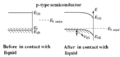 P-type semiconductor and liquid junction


Advertise on WikiMD — 81,000+ full articles, ~900,000 total pages, ~250 million page views. Global reach, limited time promotional rates from $1/page/day. Learn more · View stats

Translate page: - East Asian
中文,
日本,
한국어,
South Asian
हिन्दी,
தமிழ்,
తెలుగు,
Urdu,
ಕನ್ನಡ,
Southeast Asian
Indonesian,
Vietnamese,
Thai,
မြန်မာဘာသာ,
বাংলা
European
español,
Deutsch,
français,
Greek,
português do Brasil,
polski,
română,
русский,
Nederlands,
norsk,
svenska,
suomi,
Italian
Middle Eastern & African
عربى,
Turkish,
Persian,
Hebrew,
Afrikaans,
isiZulu,
Kiswahili,
Other
Bulgarian,
Hungarian,
Czech,
Swedish,
മലയാളം,
मराठी,
ਪੰਜਾਬੀ,
ગુજરાતી,
Portuguese,
Ukrainian
About WikiMD • Contact • Disclaimer • Privacy • Copyright • Site statistics
Some content and images may originate from Wikimedia Commons or Wikipedia and remain subject to their stated licenses. Unless otherwise noted, eligible WikiMD content is available under CC BY-SA 4.0.
WikiMD Wellnesspedia — Free health & wellness information for patients, students, and health professionals.

