Magnetochemistry
Magnetochemistry is an area of chemistry that studies the magnetic properties of chemical compounds. This field is closely related to physical chemistry, quantum chemistry, and solid-state physics.
Overview[edit]
Magnetochemistry involves the study of the magnetic properties of chemical compounds. Magnetic properties arise from the spin and orbital angular momentum of the electrons. The phenomena involved in magnetochemistry are quite complex, with the simplest case being the lone pair electrons.
History[edit]
The field of magnetochemistry has its roots in the 19th century with the work of Michael Faraday and James Clerk Maxwell. Faraday discovered that the plane of polarization of light could be rotated by a magnetic field, a phenomenon now known as the Faraday effect. Maxwell's equations, which unify electricity and magnetism, also play a crucial role in understanding magnetochemical phenomena.
Magnetic Moments[edit]
The magnetic moment of a system measures the system's tendency to align with a magnetic field. In magnetochemistry, the magnetic moment is often determined by the spin and orbital angular momentum of the electrons.
Applications[edit]
Magnetochemistry has a wide range of applications, including in medicine, material science, and engineering. For example, magnetic resonance imaging (MRI) is a medical imaging technique used in radiology to form pictures of the anatomy and the physiological processes of the body.
See also[edit]
References[edit]

 | This physics-related article is a stub. You can help WikiMD by expanding the page. |
 | This medical article is a stub. You can help WikiMD by expanding the page. |
-
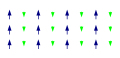 Diagram of ferrimagnetic ordering
 -
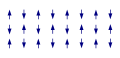 Diagram of antiferromagnetic ordering
 -
 Crystal Field Theory low spin splitting diagram
 -
 Crystal Field Theory high spin splitting diagram


Advertise on WikiMD — 81,000+ full articles, ~900,000 total pages, ~250 million page views. Global reach, limited time promotional rates from $1/page/day. Learn more · View stats

Translate page: - East Asian
中文,
日本,
한국어,
South Asian
हिन्दी,
தமிழ்,
తెలుగు,
Urdu,
ಕನ್ನಡ,
Southeast Asian
Indonesian,
Vietnamese,
Thai,
မြန်မာဘာသာ,
বাংলা
European
español,
Deutsch,
français,
Greek,
português do Brasil,
polski,
română,
русский,
Nederlands,
norsk,
svenska,
suomi,
Italian
Middle Eastern & African
عربى,
Turkish,
Persian,
Hebrew,
Afrikaans,
isiZulu,
Kiswahili,
Other
Bulgarian,
Hungarian,
Czech,
Swedish,
മലയാളം,
मराठी,
ਪੰਜਾਬੀ,
ગુજરાતી,
Portuguese,
Ukrainian
About WikiMD • Contact • Disclaimer • Privacy • Copyright • Site statistics
Some content and images may originate from Wikimedia Commons or Wikipedia and remain subject to their stated licenses. Unless otherwise noted, eligible WikiMD content is available under CC BY-SA 4.0.
WikiMD Wellnesspedia — Free health & wellness information for patients, students, and health professionals.

