Surimi


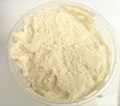
Surimi is a processed seafood product that is widely used in various cuisines around the world. It is made from fish or other meat that has been minced and then processed to mimic the texture and color of more expensive seafood such as crab, lobster, and shrimp.
History[edit]
The production of surimi dates back several centuries in Japan, where it was originally developed as a method to preserve fish. The term "surimi" literally means "ground meat" in Japanese. The modern surimi industry began in the 1960s, and it has since become a significant part of the global seafood market.
Production Process[edit]
The production of surimi involves several steps:
- Selection of Fish: Typically, white-fleshed fish such as Alaska pollock or Pacific whiting are used.
- Deboning and Washing: The fish is deboned and washed to remove fat, blood, and other impurities.
- Refining: The minced fish is then refined to achieve a smooth texture.
- Additives: Various additives such as starch, egg whites, and flavorings are mixed in to enhance the texture and taste.
- Shaping and Cooking: The mixture is shaped into various forms and cooked to set the texture.
Uses[edit]
Surimi is used in a variety of dishes, including:
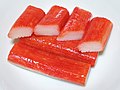
- Imitation crab meat (also known as "krab" or "crab sticks")
- Fish balls
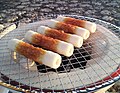
- Kamaboko (a type of Japanese fish cake)
- Tempura
Nutritional Information[edit]
Surimi is a low-fat, high-protein food. However, it often contains added salt and sugar, which can affect its nutritional profile. It is also a good source of omega-3 fatty acids.
Global Market[edit]
The surimi industry is a significant part of the global seafood market. Major producers include Japan, United States, and Thailand. The product is exported worldwide and is particularly popular in Asia and North America.
Related Pages[edit]
Categories[edit]
| Seafood | ||||||||||
|---|---|---|---|---|---|---|---|---|---|---|
|

-
 Surimi
 -
 Kanikama
 -
 Frozen fish tofu
 -
 Horikawa kamaboko
 -
 Narutomaki
 -
 Iwashidama
 -
 Glasaal Surimi
 -
 Oita gyorokke
 -
 Agekamaboko
 -
 Surimi salad
 -
 Jako-ten udon
 -
 Tikutikutikuwa


.jpg)


.jpg)

.jpg)
Ad. Transform your health with W8MD Weight Loss, Sleep & MedSpa

Tired of being overweight?
Special offer:
Budget GLP-1 weight loss medications
- Semaglutide starting from $29.99/week and up with insurance for visit of $59.99 and up per week self pay.
- Tirzepatide starting from $45.00/week and up (dose dependent) or $69.99/week and up self pay
✔ Same-week appointments, evenings & weekends
Learn more:
- GLP-1 weight loss clinic NYC
- W8MD's NYC medical weight loss
- W8MD Philadelphia GLP-1 shots
- Philadelphia GLP-1 injections
- Affordable GLP-1 shots NYC
|
WikiMD Medical Encyclopedia |
Medical Disclaimer: WikiMD is for informational purposes only and is not a substitute for professional medical advice. Content may be inaccurate or outdated and should not be used for diagnosis or treatment. Always consult your healthcare provider for medical decisions. Verify information with trusted sources such as CDC.gov and NIH.gov. By using this site, you agree that WikiMD is not liable for any outcomes related to its content. See full disclaimer.
Credits:Most images are courtesy of Wikimedia commons, and templates, categories Wikipedia, licensed under CC BY SA or similar.
Translate this page: - East Asian
中文,
日本,
한국어,
South Asian
हिन्दी,
தமிழ்,
తెలుగు,
Urdu,
ಕನ್ನಡ,
Southeast Asian
Indonesian,
Vietnamese,
Thai,
မြန်မာဘာသာ,
বাংলা
European
español,
Deutsch,
français,
Greek,
português do Brasil,
polski,
română,
русский,
Nederlands,
norsk,
svenska,
suomi,
Italian
Middle Eastern & African
عربى,
Turkish,
Persian,
Hebrew,
Afrikaans,
isiZulu,
Kiswahili,
Other
Bulgarian,
Hungarian,
Czech,
Swedish,
മലയാളം,
मराठी,
ਪੰਜਾਬੀ,
ગુજરાતી,
Portuguese,
Ukrainian
