Basophil
Basophils are a type of white blood cell and are classified under granulocytes, which are characterized by the presence of granules in their cytoplasm. Basophils are the least common of the granulocytes, comprising about 0.01% to 0.3% of circulating white blood cells. Despite their low numbers, they play a crucial role in the immune response, especially in inflammation and allergic reactions.
.png)


.jpg)
Morphology and Function[edit]
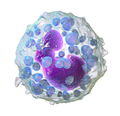
Basophils are round cells, approximately 12–15 micrometers in diameter, with a segmented nucleus. They are filled with large, coarse, bluish-black granules which obscure the nucleus. These granules contain:
- Histamine: A compound that increases blood flow to the affected area, leading to the common symptoms of an allergic reaction such as redness, heat, and swelling.
- Heparin: An anticoagulant that prevents blood from clotting too quickly.
- Leukotrienes: Lipids that mediate inflammatory responses.
The primary function of basophils is to participate in the body's immune response against parasites, especially parasitic worms. They also have a significant role in allergic reactions, asthma, and other inflammatory conditions. When an allergen enters the body, basophils release their granular contents into the bloodstream, leading to the symptoms of an allergic reaction.
Development[edit]
Basophils develop from stem cells in the bone marrow. The process, known as hematopoiesis, involves several stages of differentiation. Once mature, basophils leave the bone marrow and enter the bloodstream, where they circulate for a few hours before migrating into tissues throughout the body.
Clinical Significance[edit]
Abnormal basophil levels can be an indication of various diseases:
- Basophilia (increased basophil count): Can be seen in myeloproliferative disorders, such as chronic myeloid leukemia, and in some forms of inflammatory conditions like rheumatoid arthritis.
- Basopenia (decreased basophil count): Less commonly noted but can occur with hyperthyroidism, acute infections, and after a severe allergic reaction.
Interactions with Other Cells[edit]
Basophils interact with other immune cells like T cells. They can present antigens to T cells and secrete cytokines that regulate the function of these and other immune cells.
See also[edit]
- Granulocytes
- White blood cell
- Mast cell - Another cell type involved in allergic responses.
External links[edit]
- Basophil Information - American Society of Hematology
- International Immunology Foundation - Comprehensive information on immune cells.
 | |
|---|---|
 |
 |
| Myeloid blood cells and plasma | ||||||
|---|---|---|---|---|---|---|
|
| Lymphocytic adaptive immune system and complement | ||||||||||||||||
|---|---|---|---|---|---|---|---|---|---|---|---|---|---|---|---|---|
|
-
 Basophil
 -
 Basophil

Ad. Transform your health with W8MD Weight Loss, Sleep & MedSpa

Tired of being overweight?
Special offer:
Budget GLP-1 weight loss medications
- Semaglutide starting from $29.99/week and up with insurance for visit of $59.99 and up per week self pay.
- Tirzepatide starting from $45.00/week and up (dose dependent) or $69.99/week and up self pay
✔ Same-week appointments, evenings & weekends
Learn more:
- GLP-1 weight loss clinic NYC
- W8MD's NYC medical weight loss
- W8MD Philadelphia GLP-1 shots
- Philadelphia GLP-1 injections
- Affordable GLP-1 shots NYC
|
WikiMD Medical Encyclopedia |
Medical Disclaimer: WikiMD is for informational purposes only and is not a substitute for professional medical advice. Content may be inaccurate or outdated and should not be used for diagnosis or treatment. Always consult your healthcare provider for medical decisions. Verify information with trusted sources such as CDC.gov and NIH.gov. By using this site, you agree that WikiMD is not liable for any outcomes related to its content. See full disclaimer.
Credits:Most images are courtesy of Wikimedia commons, and templates, categories Wikipedia, licensed under CC BY SA or similar.
Translate this page: - East Asian
中文,
日本,
한국어,
South Asian
हिन्दी,
தமிழ்,
తెలుగు,
Urdu,
ಕನ್ನಡ,
Southeast Asian
Indonesian,
Vietnamese,
Thai,
မြန်မာဘာသာ,
বাংলা
European
español,
Deutsch,
français,
Greek,
português do Brasil,
polski,
română,
русский,
Nederlands,
norsk,
svenska,
suomi,
Italian
Middle Eastern & African
عربى,
Turkish,
Persian,
Hebrew,
Afrikaans,
isiZulu,
Kiswahili,
Other
Bulgarian,
Hungarian,
Czech,
Swedish,
മലയാളം,
मराठी,
ਪੰਜਾਬੀ,
ગુજરાતી,
Portuguese,
Ukrainian
