Bare lymphocyte syndrome
| Bare lymphocyte syndrome | |
|---|---|
| [[File:|250px|alt=|]] | |
| Synonyms | |
| Pronounce | |
| Field | |
| Symptoms | |
| Complications | |
| Onset | |
| Duration | |
| Types | |
| Causes | |
| Risks | |
| Diagnosis | |
| Differential diagnosis | |
| Prevention | |
| Treatment | |
| Medication | |
| Prognosis | |
| Frequency | |
| Deaths | |
Bare lymphocyte syndrome is a condition caused by mutations in certain genes of the major histocompatibility complex or involved with the processing and presentation of MHC molecules. It is a form of severe combined immunodeficiency.<ref name="pmid10938133">,
 Associations and interactions between bare lymphocyte syndrome factors,
 Mol. Cell. Biol.,

 Vol. 20(Issue: 17),
 pp. 6587–99,
 DOI: 10.1128/MCB.20.17.6587-6599.2000,
 PMID: 10938133,
 PMC: 86141,</ref>
Presentation
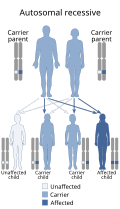
The bare lymphocyte syndrome, type II (BLS II) is a rare recessive genetic condition in which a group of genes called major histocompatibility complex class II (MHC class II) are not expressed.
The result is that the immune system is severely compromised and cannot effectively fight infection. Clinically, this is similar to severe combined immunodeficiency (SCID), in which lymphocyte precursor cells are improperly formed. As a notable contrast, however, bare lymphocyte syndrome does not result in decreased B- and T-cell counts, as the development of these cells is not impaired.
Symptoms
TAP deficiency syndrome is the best characterized of BLS I.<ref name=":0">Gadola, S. D.,
 TAP deficiency syndrome. IMMUNODEFICIENCY REVIEW,
 Clinical and Experimental Immunology,

 Vol. 121(Issue: 2),
 pp. 173–178,
 DOI: 10.1046/j.1365-2249.2000.01264.x,
 PMID: 10931128,
 PMC: 1905688,</ref> Symptoms can include recurrent bacterial infections of the respiratory tract and chronic skin lesions. Bronchiectasis and respiratory failure and complete destruction of the nose and cerebral abscess are severe complications.<ref name=":0" />
Diarrhea can be among the associated conditions.<ref name="urlImmunologic Disease and Disorders">
Immunologic Disease and Disorders(link). {{{website}}}.
</ref>
Genetics
BLS II
The genetic basis for BLSII is not due to defects in the MHC II genes themselves. The genetic basis is the result of mutations in genes that code for proteins (transcription factors) that normally regulate the expression (gene transcription) of the MHC II genes. That is, one of the several proteins that are required to switch on MHC II genes in various cells types (primarily those in the immune system) is absent. The genes responsible were cloned by the laboratories of Bernard Mach<ref>,
 The bare lymphocyte syndrome and the regulation of MHC expression,
 Annu. Rev. Immunol.,
 2001,
 Vol. 19,
 pp. 331–73,
 DOI: 10.1146/annurev.immunol.19.1.331,
 PMID: 11244040,</ref> in Switzerland and Jeremy Boss<ref>,
 The bare lymphocyte syndrome: molecular clues to the transcriptional regulation of major histocompatibility complex class II genes,
 Am. J. Hum. Genet.,
 1999,
 Vol. 65(Issue: 2),
 pp. 279–86,
 DOI: 10.1086/302519,
 PMID: 10417269,
 PMC: 1377925,</ref> at Emory University in Atlanta, Georgia.
Mutation in any one of four genes can lead to BLS II. The genes' names are:
- class II trans-activator (CIITA)
- regulatory factor of the Xbox 5 (RFX5)
- RFX-associated protein (RFXAP)
- RFX ankyrin repeats (RFXANK; also known as RFXB)
BLS I
BLS I, also called "HLA class I deficiency", which is much more rare, is associated with TAP2, TAP1, or TAPBP deficiencies.<ref name=OMIM>Online Mendelian Inheritance in Man (OMIM) 604571 </ref> The TAP proteins are involved in pumping degraded cytosolic peptides across the endoplasmic reticulum membrane so they can bind HLA class I. Once the peptide:HLA class I complex forms, it is transported to the membrane of the cell. However, a defect in the TAP proteins prevents pumping of peptides into the endoplasmic reticulum so no peptide:HLA class I complexes form, and therefore, no HLA class I is expressed on the membrane. Just like BLS II, the defect isn't in the MHC protein, but rather another accessory protein.
Diagnosis
Classification
- Type 1: MHC class I
- Type 2: MHC class II
Treatment
Though BLSII is an attractive candidate for gene therapy, bone marrow transplant is currently the only treatment.
References
External links
| Immune disorders: Lymphoid and complement immunodeficiency (D80–D85, 279.0–4) | ||||||||||||||||
|---|---|---|---|---|---|---|---|---|---|---|---|---|---|---|---|---|
|
-
 Bare lymphocyte syndrome

Ad. Transform your health with W8MD Weight Loss, Sleep & MedSpa

Tired of being overweight?
Get started with evidence based, physician-supervised
affordable GLP-1 weight loss injections
Now available in New York City and Philadelphia:
- Semaglutide starting from $59.99/week and up
- Tirzepatide starting from $69.99/week and up (dose dependent)
✔ Evidence-based medical weight loss ✔ Insurance-friendly visits available ✔ Same-week appointments, evenings & weekends
Learn more:
Start your transformation today with W8MD weight loss centers.
|
WikiMD Medical Encyclopedia |
Medical Disclaimer: WikiMD is for informational purposes only and is not a substitute for professional medical advice. Content may be inaccurate or outdated and should not be used for diagnosis or treatment. Always consult your healthcare provider for medical decisions. Verify information with trusted sources such as CDC.gov and NIH.gov. By using this site, you agree that WikiMD is not liable for any outcomes related to its content. See full disclaimer.
Credits:Most images are courtesy of Wikimedia commons, and templates, categories Wikipedia, licensed under CC BY SA or similar.
Translate this page: - East Asian
中文,
日本,
한국어,
South Asian
हिन्दी,
தமிழ்,
తెలుగు,
Urdu,
ಕನ್ನಡ,
Southeast Asian
Indonesian,
Vietnamese,
Thai,
မြန်မာဘာသာ,
বাংলা
European
español,
Deutsch,
français,
Greek,
português do Brasil,
polski,
română,
русский,
Nederlands,
norsk,
svenska,
suomi,
Italian
Middle Eastern & African
عربى,
Turkish,
Persian,
Hebrew,
Afrikaans,
isiZulu,
Kiswahili,
Other
Bulgarian,
Hungarian,
Czech,
Swedish,
മലയാളം,
मराठी,
ਪੰਜਾਬੀ,
ગુજરાતી,
Portuguese,
Ukrainian
