Parkin (cake): Difference between revisions
CSV import Tags: mobile edit mobile web edit |
CSV import |
||
| Line 25: | Line 25: | ||
{{Cakes}} | {{Cakes}} | ||
{{food-stub}} | {{food-stub}} | ||
<gallery> | |||
File:YorkShireParkin.jpg|Yorkshire Parkin | |||
File:Lancashire_Parkin_5022.JPG|Lancashire Parkin | |||
File:Darkparkin.JPG|Dark Parkin | |||
</gallery> | |||
Latest revision as of 01:55, 18 February 2025
Parkin or Yorkshire parkin is a traditional British cake, particularly associated with Yorkshire and Lancashire. The cake is made with oatmeal and treacle and has a moist, sticky texture. It is often baked to celebrate Guy Fawkes Night, also known as Bonfire Night, on the 5th of November.
History[edit]
The origins of parkin are believed to date back to the early Middle Ages. The cake was traditionally made with barley and oatmeal, which were readily available in the north of England. The addition of treacle, a by-product of the sugar refining process, became popular in the 18th century.
Ingredients and Preparation[edit]
Parkin is made with a mixture of oatmeal, flour, treacle, sugar, butter, and ginger. Some variations may also include black treacle or golden syrup to enhance the sweetness. The ingredients are mixed together and then baked in a moderate oven until the cake is firm but still moist. After baking, parkin is traditionally left to mature in a tin for several days to allow the flavors to develop.
Regional Variations[edit]
There are several regional variations of parkin. In Yorkshire, the cake is typically made with a higher proportion of oatmeal and is often baked in a loaf tin. Lancashire parkin, on the other hand, is made with more flour and is usually baked in a flat, round tin. Some versions of the cake in West Yorkshire also include black treacle to give the cake a darker color and a richer flavor.
Cultural Significance[edit]
Parkin is traditionally eaten on Guy Fawkes Night, a British holiday that commemorates the failed Gunpowder Plot of 1605. The cake is often served with a glass of mulled wine or cider to warm up the chilly November evening.
See Also[edit]
| British cuisine |
|---|
 |
| National cuisines |
| Regional cuisines |
| Overseas/Fusion cuisine |
| People |
| Cakes | ||||||||||
|---|---|---|---|---|---|---|---|---|---|---|
*
|

-
 Yorkshire Parkin
 -
 Lancashire Parkin
 -
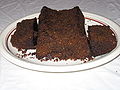 Dark Parkin


