Sachertorte

The Sachertorte is a specific type of chocolate cake, or torte, that was invented by Austrian Franz Sacher in 1832. It is one of the most famous Viennese culinary specialties.
History[edit]
The Sachertorte was created by Franz Sacher, who was a 16-year-old apprentice at the time, for Prince Metternich and his guests. The cake was an instant success and has since become a staple of Viennese cuisine.
Ingredients and Preparation[edit]
The ingredients of a Sachertorte are butter, sugar, semi-sweet chocolate, eggs, flour, apricot jam, and dark chocolate for the glaze. The preparation involves beating the butter and sugar together, melting the chocolate, separating the egg yolks from the whites, and then gradually adding the melted chocolate, flour, and beaten egg yolks to the butter and sugar mixture. The egg whites are beaten until they are stiff and then folded into the mixture. The batter is baked, and once cooled, it is cut in half horizontally, filled with apricot jam, and then iced with the dark chocolate glaze.
Variations[edit]
There are many variations of the Sachertorte, but the most famous is the one served at the Hotel Sacher in Vienna. The recipe is a closely guarded secret, and the cake is often served with unsweetened whipped cream.
Cultural Significance[edit]
The Sachertorte is not just a cake, but a symbol of Vienna and its rich culinary history. Every year on December 5th, Austria celebrates National Sachertorte Day.
See Also[edit]
References[edit]

-
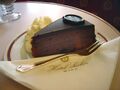 Sachertorte
 -
 Café Schwarzenberg
 -
 Sachertorte
 -
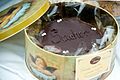 Sacher festival
 -
 Franz Sacher
 -
 Café Sacher shop interior


Advertise on WikiMD — 81,000+ full articles, ~900,000 total pages, ~250 million page views. Global reach, limited time promotional rates from $1/page/day. Learn more · View stats


Translate page: - East Asian
中文,
日本,
한국어,
South Asian
हिन्दी,
தமிழ்,
తెలుగు,
Urdu,
ಕನ್ನಡ,
Southeast Asian
Indonesian,
Vietnamese,
Thai,
မြန်မာဘာသာ,
বাংলা
European
español,
Deutsch,
français,
Greek,
português do Brasil,
polski,
română,
русский,
Nederlands,
norsk,
svenska,
suomi,
Italian
Middle Eastern & African
عربى,
Turkish,
Persian,
Hebrew,
Afrikaans,
isiZulu,
Kiswahili,
Other
Bulgarian,
Hungarian,
Czech,
Swedish,
മലയാളം,
मराठी,
ਪੰਜਾਬੀ,
ગુજરાતી,
Portuguese,
Ukrainian
About WikiMD • Contact • Disclaimer • Privacy • Copyright • Site statistics
Some content and images may originate from Wikimedia Commons or Wikipedia and remain subject to their stated licenses. Unless otherwise noted, eligible WikiMD content is available under CC BY-SA 4.0.
WikiMD Wellnesspedia — Free health & wellness information for patients, students, and health professionals.

