Mammoplasia: Difference between revisions
m 1 revision imported |
CSV import |
||
| Line 57: | Line 57: | ||
[[Category:Breast diseases]] | [[Category:Breast diseases]] | ||
[[Category:Medical terminology]] | [[Category:Medical terminology]] | ||
<gallery> | |||
File:Breast_changes_during_pregnancy_1.png|Breast changes during pregnancy | |||
File:Histology_of_lactating_breast,_annotated.png|Histology of lactating breast, annotated | |||
</gallery> | |||
Revision as of 01:10, 18 February 2025
| Mammoplasia | |
|---|---|

| |
| Synonyms | |
| Pronounce | |
| Field | |
| Symptoms | |
| Complications | |
| Onset | |
| Duration | |
| Types | |
| Causes | |
| Risks | |
| Diagnosis | |
| Differential diagnosis | |
| Prevention | |
| Treatment | |
| Medication | |
| Prognosis | |
| Frequency | |
| Deaths | |
Mammoplasia is the normal or spontaneous enlargement of human breasts.<ref name="Nathanson1946">,
 Present Concepts of Benign Breast Disease,
 New England Journal of Medicine,
 1946,
 Vol. 235(Issue: 15),
 pp. 548–553,
 DOI: 10.1056/NEJM194610102351505,</ref> Mammoplasia occurs normally during puberty and pregnancy in women, as well as during certain periods of the menstrual cycle.<ref name="JatoiKaufmann2010">,

 Management of Breast Diseases. online version,

 Springer Science & Business Media,


 ISBN 978-3-540-69743-5,


 Pages: 21–,</ref><ref name="ArunNarendra2012">,

 Progress in Obstetrics and Gynecology--3. online version,

 Jaypee Brothers Medical Publishers Pvt. Ltd.,


 ISBN 978-93-5090-575-3,


 Pages: 393–394,</ref><ref name="PescovitzEugster2004">,

 Pediatric Endocrinology: Mechanisms, Manifestations, and Management. online version,

 Lippincott Williams & Wilkins,
 2004,


 ISBN 978-0-7817-4059-3,


 Pages: 349–,</ref> When it occurs in males, it is called gynecomastia and is considered to be pathological.<ref name="PescovitzEugster2004" /> When it occurs in females and is extremely excessive, it is called macromastia (also known as gigantomastia or breast hypertrophy) and is similarly considered to be pathological.<ref name="CoranCaldamone2012">,

 Pediatric Surgery. online version,

 Elsevier Health Sciences,


 ISBN 978-0-323-09161-9,


 Pages: 773–,</ref><ref name="Dabbs2012">{{{last}}},
 David J. Dabbs,

 Breast Pathology. online version,

 Elsevier Health Sciences,
 2012,


 ISBN 978-1-4377-0604-8,


 Pages: 19–,</ref><ref name="LaverySanfilippo2012">,

 Pediatric and Adolescent Obstetrics and Gynecology. online version,

 Springer Science & Business Media,


 ISBN 978-1-4612-5064-7,


 Pages: 99–,</ref> Mammoplasia may be due to breast engorgement, which is temporary enlargement of the breasts caused by the production and storage of breast milk in association with lactation and/or galactorrhea (excessive or inappropriate production of milk).<ref name="TALWARSRIVASTAVA2002">,

 TEXTBOOK OF BIOCHEMISTRY AND HUMAN BIOLOGY. online version,

 PHI Learning Pvt. Ltd.,


 ISBN 978-81-203-1965-3,


 Pages: 959–,</ref> Mastodynia (breast tenderness/pain) frequently co-occurs with mammoplasia.<ref name="Zink1988">{{{last}}},
 Christoph Zink,

 Dictionary of Obstetrics and Gynecology. online version,

 Walter de Gruyter,


 ISBN 978-3-11-085727-6,


 Pages: 152–,</ref><ref name="SeegenschmiedtMakoski2009">,

 Radiotherapy for Non-Malignant Disorders. online version,

 Springer Science & Business Media,


 ISBN 978-3-540-68943-0,


 Pages: 719–,</ref>
During the luteal phase (latter half) of the menstrual cycle, due to increased mammary blood flow and/or premenstrual fluid retention caused by high circulating concentrations of estrogen and/or progesterone, the breasts temporarily increase in size, and this is experienced by women as fullness, heaviness, swollenness, and a tingling sensation.<ref name="LawrenceLawrence2015">,
 Breastfeeding: A Guide for the Medical Profession. online version,

 Elsevier Health Sciences,


 ISBN 978-0-323-35776-0,</ref><ref name="pmid1192144">,
 Changes in breast volume during normal menstrual cycle and after oral contraceptives,
 Br Med J,
 1975,
 Vol. 4(Issue: 5995),
 pp. 494–6,
 DOI: 10.1136/bmj.4.5995.494,
 PMID: 1192144,
 PMC: 1675650,</ref>
Mammoplasia can be an effect or side effect of various drugs, including estrogens,<ref name="JatoiKaufmann2010" /><ref name="Lewis1998">{{{last}}},
 Robert Alan Lewis,

 Lewis' Dictionary of Toxicology. online version,

 CRC Press,


 ISBN 978-1-56670-223-2,


 Pages: 470–,</ref> antiandrogens such as spironolactone,<ref name="Aronson2009">{{{last}}},
 Jeffrey K. Aronson,

 Meyler's Side Effects of Cardiovascular Drugs. online version,

 Elsevier,


 ISBN 978-0-08-093289-7,


 Pages: 255–,</ref> cyproterone acetate,<ref name="Martin2015">{{{last}}},
 Elizabeth Martin,

 Concise Medical Dictionary. online version,

 Oxford University Press,


 ISBN 978-0-19-968781-7,


 Pages: 189–,</ref> bicalutamide,<ref name="WalshWorthington2010">,

 Dr. Patrick Walsh's Guide to Surviving Prostate Cancer, Second Edition. online version,

 Grand Central Publishing,


 ISBN 978-1-4555-0016-1,


 Pages: 258–,</ref><ref name="Simon2004">{{{last}}},
 Harvey B. Simon,

 The Harvard Medical School Guide to Men's Health: Lessons from the Harvard Men's Health Studies. online version,

 Simon and Schuster,


 ISBN 978-0-684-87182-0,


 Pages: 403–,</ref> and finasteride,<ref>{{{last}}},
 Jeffrey K. Aronson,

 Meyler's Side Effects of Endocrine and Metabolic Drugs. online version,

 Elsevier,


 ISBN 978-0-08-093292-7,


 Pages: 155–,</ref><ref name="BurchumRosenthal2014">,

 Lehne's Pharmacology for Nursing Care. online version,

 Elsevier Health Sciences,


 ISBN 978-0-323-34026-7,


 Pages: 802–,</ref> growth hormone,<ref name="Kaur2003">{{{last}}},
 Sat Dharam Kaur,

 The Complete Natural Medicine Guide to Breast Cancer: A Practical Manual for Understanding, Prevention & Care. online version,

 R. Rose,
 2003,


 ISBN 978-0-7788-0083-5,</ref><ref name="SouzaCollett-Solberg2011">,
 Adverse effects of growth hormone replacement therapy in children,
 Arquivos Brasileiros de Endocrinologia & Metabologia,
 2011,
 Vol. 55(Issue: 8),
 pp. 559–565,
 DOI: 10.1590/S0004-27302011000800009,</ref> and drugs that elevate prolactin levels such as D2 receptor antagonists like antipsychotics (e.g., risperidone), metoclopramide, and domperidone<ref name="pmid18473017">,
 Pharmacological causes of hyperprolactinemia,
 Ther Clin Risk Manag,
 2007,
 Vol. 3(Issue: 5),
 pp. 929–51,

 PMID: 18473017,
 PMC: 2376090,</ref><ref name="MadhusoodananParida2010">,
 Hyperprolactinemia associated with psychotropics-a review,
 Human Psychopharmacology: Clinical and Experimental,
 2010,
 Vol. 25(Issue: 4),
 pp. 281–297,
 DOI: 10.1002/hup.1116,
 PMID: 20521318,</ref> and certain antidepressants like selective serotonin reuptake inhibitors (SSRIs) and tricyclic antidepressants (TCAs).<ref name="MadhusoodananParida2010" /><ref name="LiebermanTasman2006">,

 Handbook of Psychiatric Drugs. online version,

 John Wiley & Sons,


 ISBN 978-0-470-02821-6,


 Pages: 75–,</ref><ref name="KaufmanPodolsky2013">,
 Antidepressant-Selective Gynecomastia,
 Annals of Pharmacotherapy,
 2013,
 Vol. 47(Issue: 1),
 pp. e6,
 DOI: 10.1345/aph.1R491,
 PMID: 23324513,</ref> The risk appears to be less with serotonin-norepinephrine reuptake inhibitors (SNRIs) like venlafaxine.<ref name="pmid9479619" /> The "atypical" antidepressants mirtazapine and bupropion do not increase prolactin levels (bupropion may actually decrease prolactin levels), and hence there may be no risk with these agents.<ref name="pmid18473017" /> Other drugs that have been associated with mammoplasia include D-penicillamine, bucillamine, neothetazone, ciclosporin, indinavir, marijuana, and cimetidine.<ref name="Dabbs2012"/><ref name="DanceyKhan2008">,
 Gigantomastia – a classification and review of the literature,
 Journal of Plastic, Reconstructive & Aesthetic Surgery,
 2008,
 Vol. 61(Issue: 5),
 pp. 493–502,
 DOI: 10.1016/j.bjps.2007.10.041,
 PMID: 18054304,</ref>
A 1997 study found an association between the SSRIs and mammoplasia in 23 (39%) of its 59 female participants.<ref name="pmid9479619">,
 Breast enlargement during chronic antidepressant therapy,
 J Affect Disord,
 1997,
 Vol. 46(Issue: 2),
 pp. 151–6,
 DOI: 10.1016/s0165-0327(97)00086-4,
 PMID: 9479619,</ref> Studies have also found associations between SSRIs and galactorrhea.<ref name="LiebermanTasman2006"/><ref name="pmid20527996">,
 Antidepressant-induced hyperprolactinaemia: incidence, mechanisms and management,
 CNS Drugs,
 2010,
 Vol. 24(Issue: 7),
 pp. 563–74,
 DOI: 10.2165/11533140-000000000-00000,
 PMID: 20527996,</ref><ref name="MondalSaha2013">,
 A new logical insight and putative mechanism behind fluoxetine-induced amenorrhea, hyperprolactinemia and galactorrhea in a case series,
 Therapeutic Advances in Psychopharmacology,
 2013,
 Vol. 3(Issue: 6),
 pp. 322–334,
 DOI: 10.1177/2045125313490305,
 PMID: 24294485,
 PMC: 3840809,</ref><ref name="Sadock2013">{{{last}}},
 Benjamin Sadock,

 Kaplan & Sadock's Pocket Handbook of Psychiatric Drug Treatment. online version,

 Lippincott Williams & Wilkins,


 ISBN 978-1-4698-5538-7,


 Pages: 312–,</ref> These side effects seem to be due to hyperprolactinemia (elevated prolactin levels) induced by these drugs, an effect that appears to be caused by serotonin-mediated inhibition of tuberoinfundibular dopaminergic neurons that inhibit prolactin secretion.<ref name="pmid9479619" /><ref name="pmid20527996" /><ref name="MondalSaha2013" /> It is noteworthy that the mammoplasia these drugs can cause has been found to be highly correlated with concomitant weight gain (in the 1997 study, 83% of those who experienced weight gain also experienced mammoplasia, while only 30% of those who did not experience weight gain experienced mammoplasia).<ref name="pmid9479619" /> The mammoplasia associated with SSRIs is reported to be reversible with drug discontinuation.<ref name="Sadock2013" /> SSRIs have notably been associated with a modestly increased risk of breast cancer.<ref name="pmid25934397">,
 Anti-depressant therapy and cancer risk: A nested case-control study,
 Eur Neuropsychopharmacol,
 2015,
 Vol. 25(Issue: 8),
 pp. 1147–57,
 DOI: 10.1016/j.euroneuro.2015.04.010,
 PMID: 25934397,</ref> This is in accordance with higher prolactin levels being associated with increased breast cancer risk.<ref name="HankinsonWillett1999">,
 Plasma Prolactin Levels and Subsequent Risk of Breast Cancer in Postmenopausal Women,
 JNCI Journal of the National Cancer Institute,
 1999,
 Vol. 91(Issue: 7),
 pp. 629–634,
 DOI: 10.1093/jnci/91.7.629,
 PMID: 10203283,</ref><ref name="Tworoger2004">,
 Plasma Prolactin Concentrations and Risk of Postmenopausal Breast Cancer,
 Cancer Research,
 2004,
 Vol. 64(Issue: 18),
 pp. 6814–6819,
 DOI: 10.1158/0008-5472.CAN-04-1870,
 PMID: 15375001,</ref>
In puberty induction in hypogonadal girls and in feminizing hormone therapy in transgender women, as well as hormonal breast enhancement in women with breast hypoplasia or small breasts, mammoplasia is a desired effect.<ref name="pmid18174716">,
 Introduction and management of puberty in girls,
 Horm. Res.,
 2007,
 Vol. 68 Suppl 5(Issue: 5),
 pp. 80–3,
 DOI: 10.1159/000110584,
 PMID: 18174716,</ref><ref name="GöretzlehnerLauritzen2012">,

 Praktische Hormontherapie in der Gynäkologie. online version,

 Walter de Gruyter,


 ISBN 978-3-11-024568-4,


 Pages: 385–,</ref><ref name="ManselFodstad2007">,

 Metastasis of Breast Cancer. online version,

 Springer Science & Business Media,


 ISBN 978-1-4020-5866-0,


 Pages: 217–,</ref><ref name="pmid9610425">,
 Hormonal breast augmentation: prognostic relevance of insulin-like growth factor-I,
 Gynecol. Endocrinol.,
 1998,
 Vol. 12(Issue: 2),
 pp. 123–7,
 DOI: 10.3109/09513599809024960,
 PMID: 9610425,</ref>
See also
References
<references group="" responsive="1"></references>
External links
| Breast disease | ||||||||||
|---|---|---|---|---|---|---|---|---|---|---|
|
-
 Breast changes during pregnancy
 -
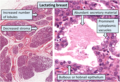 Histology of lactating breast, annotated

