Surimi: Difference between revisions
CSV import |
CSV import |
||
| Line 39: | Line 39: | ||
{{Seafood}} | {{Seafood}} | ||
{{medicine-stub}} | {{medicine-stub}} | ||
<gallery> | |||
File:TubOfSurimi.jpg|Surimi | |||
File:Kanikama.jpg|Kanikama | |||
File:Frozen fish tofu.jpg|Frozen fish tofu | |||
File:Horikawa kamaboko red 80g.jpg|Horikawa kamaboko | |||
File:Narutomaki 001.jpg|Narutomaki | |||
File:Iwashidama, in Toyokawa, Aichi (2014.12.31).jpg|Iwashidama | |||
File:Glasaal Surimi 02.jpg|Glasaal Surimi | |||
File:Oita gyorokke.jpg|Oita gyorokke | |||
File:2016-02-06 Agekamaboko-揚げかまぼこ 大黒天物産 12個 100円 DSCF8724.JPG|Agekamaboko | |||
File:Surimi salad1 (16714326780).jpg|Surimi salad | |||
File:Jako-ten udon by woinary in Matsuyama, Ehime.jpg|Jako-ten udon | |||
File:Tikutikutikuwa (cropped).jpg|Tikutikutikuwa | |||
</gallery> | |||
Latest revision as of 01:38, 20 February 2025
Surimi is a processed seafood product that is widely used in various cuisines around the world. It is made from fish or other meat that has been minced and then processed to mimic the texture and color of more expensive seafood such as crab, lobster, and shrimp.
History[edit]
The production of surimi dates back several centuries in Japan, where it was originally developed as a method to preserve fish. The term "surimi" literally means "ground meat" in Japanese. The modern surimi industry began in the 1960s, and it has since become a significant part of the global seafood market.
Production Process[edit]
The production of surimi involves several steps:
- Selection of Fish: Typically, white-fleshed fish such as Alaska pollock or Pacific whiting are used.
- Deboning and Washing: The fish is deboned and washed to remove fat, blood, and other impurities.
- Refining: The minced fish is then refined to achieve a smooth texture.
- Additives: Various additives such as starch, egg whites, and flavorings are mixed in to enhance the texture and taste.
- Shaping and Cooking: The mixture is shaped into various forms and cooked to set the texture.
Uses[edit]
Surimi is used in a variety of dishes, including:
- Imitation crab meat (also known as "krab" or "crab sticks")
- Fish balls
- Kamaboko (a type of Japanese fish cake)
- Tempura
Nutritional Information[edit]
Surimi is a low-fat, high-protein food. However, it often contains added salt and sugar, which can affect its nutritional profile. It is also a good source of omega-3 fatty acids.
Global Market[edit]
The surimi industry is a significant part of the global seafood market. Major producers include Japan, United States, and Thailand. The product is exported worldwide and is particularly popular in Asia and North America.
Related Pages[edit]
Categories[edit]
| Seafood | ||||||||||
|---|---|---|---|---|---|---|---|---|---|---|
|

-
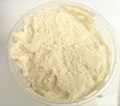 Surimi
 -
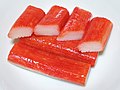 Kanikama
 -
 Frozen fish tofu
 -
 Horikawa kamaboko
 -
 Narutomaki
 -
 Iwashidama
 -
 Glasaal Surimi
 -
 Oita gyorokke
 -
 Agekamaboko
 -
 Surimi salad
 -
 Jako-ten udon
 -
Tikutikutikuwa


.jpg)


.jpg)


.jpg)