Nervous system: Difference between revisions
No edit summary |
CSV import |
||
| Line 36: | Line 36: | ||
{{Neuroscience-stub}} | {{Neuroscience-stub}} | ||
{{stub}} | {{stub}} | ||
<gallery> | |||
File:TE-Nervous_system_diagram.svg|Nervous system diagram | |||
File:Autonomic_and_Somatic_Nervous_System.png|Autonomic and Somatic Nervous System | |||
File:Neuron.svg|Neuron | |||
File:NSdiagram.svg|Nervous system diagram | |||
File:Visible_Human_head_slice.jpg|Visible Human head slice | |||
File:Bilaterian-plan.svg|Bilaterian plan | |||
File:Gray797.png|Nervous system | |||
File:Earthworm_nervous_system.png|Earthworm nervous system | |||
File:Spider_internal_anatomy-en.svg|Spider internal anatomy | |||
File:Chemical_synapse_schema_cropped.jpg|Chemical synapse schema | |||
File:Descartes-reflex.JPG|Descartes reflex | |||
File:Nervous_system_organization_en.svg|Nervous system organization | |||
</gallery> | |||
Latest revision as of 11:59, 18 February 2025
The nervous system is a complex network of nerves and cells, known as neurons, that transmit signals between different parts of the body. It is essentially the body's electrical wiring and is responsible for controlling the body's functions and maintaining its homeostasis.
Structure[edit]
The nervous system is divided into two main parts: the central nervous system (CNS) and the peripheral nervous system (PNS). The CNS consists of the brain and spinal cord, while the PNS includes all the nerves that branch out from the brain and spinal cord and extend to other parts of the body including muscles and organs.
Central Nervous System[edit]
The central nervous system is the control center of the body. It interprets incoming sensory information and issues instructions based on past experiences and current conditions. The brain is the most complex part of the nervous system and is responsible for controlling most functions of the body and mind. The spinal cord, on the other hand, is responsible for transmitting nerve signals to and from the brain and the rest of the body.
Peripheral Nervous System[edit]
The peripheral nervous system connects the central nervous system to the rest of the body. It consists of the somatic nervous system and the autonomic nervous system. The somatic nervous system is responsible for voluntary movement of the muscles and organs, while the autonomic nervous system is responsible for controlling involuntary functions such as heartbeat, blood flow, breathing, and digestion.
Function[edit]
The nervous system is responsible for coordinating all of the body's activities. It controls not only the movements of the muscles, but also the function of many organs within the body. It does this by receiving information from the sensory organs, interpreting this information, and then directing the body's response to it.
Diseases and Disorders[edit]
There are many diseases and disorders that can affect the nervous system. These include neurodegenerative diseases such as Alzheimer's disease and Parkinson's disease, neurodevelopmental disorders such as autism and ADHD, and neuropsychiatric disorders such as schizophrenia and depression.
See Also[edit]
| Nervous system | ||||
|---|---|---|---|---|
|
| Nervous tissue | ||||||||||||||||||||||
|---|---|---|---|---|---|---|---|---|---|---|---|---|---|---|---|---|---|---|---|---|---|---|
|
| Human systems and organs | ||||||||||||||
|---|---|---|---|---|---|---|---|---|---|---|---|---|---|---|
|

This article is a neuroscience stub. You can help WikiMD by expanding it!
 | |
|---|---|
 |
 |
-
 Nervous system diagram
 -
 Autonomic and Somatic Nervous System
 -
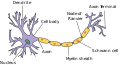 Neuron
 -
 Nervous system diagram
 -
 Visible Human head slice
 -
 Bilaterian plan
 -
 Nervous system
 -
 Earthworm nervous system
 -
 Spider internal anatomy
 -
 Chemical synapse schema
 -
 Descartes reflex
 -
 Nervous system organization


