Olfactory receptor neuron
Olfactory receptor neurons (ORNs) are specialized sensory neurons found in the olfactory epithelium, a small patch of tissue located in the back of the nasal cavity. These neurons are responsible for the detection of odor molecules, a process that forms the basis of the sense of smell.
Structure[edit]
Each olfactory receptor neuron is a bipolar neuron with a single dendrite on one end and an axon on the other. The dendrite extends to the surface of the olfactory epithelium and ends in a knob-like structure from which several long, thin cilia extend. These cilia are covered in mucus and are the site of odorant binding.
Function[edit]
When an odorant molecule binds to a receptor on the cilia of an olfactory receptor neuron, it triggers a series of biochemical events that result in an electrical signal being sent down the neuron's axon to the olfactory bulb, the brain's primary center for processing olfactory information. This signal is then relayed to other parts of the brain, where it is interpreted as a specific smell.
Olfactory Transduction[edit]
Olfactory transduction is the process by which the energy of a smell stimulus is converted into an electrical signal in the olfactory receptor neuron. This process involves several steps, including odorant binding, activation of a G-protein, and the opening of ion channels.
Regeneration[edit]
Unlike most neurons in the nervous system, olfactory receptor neurons are capable of regeneration. This is because they are derived from a population of basal cells in the olfactory epithelium that can divide and differentiate into new olfactory receptor neurons.
See Also[edit]

This WikiMD article can only be edited by registered and verified editors. You can log in or register.
-
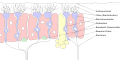 Olfactory receptor neuron
 -
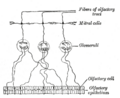 Olfactory receptor neuron
 -
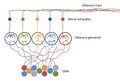 Olfactory receptor neuron
 -
 Olfactory receptor neuron


Advertise on WikiMD — 81,000+ full articles, ~900,000 total pages, ~250 million page views. Global reach, limited time promotional rates from $1/page/day. Learn more · View stats

Translate page: - East Asian
中文,
日本,
한국어,
South Asian
हिन्दी,
தமிழ்,
తెలుగు,
Urdu,
ಕನ್ನಡ,
Southeast Asian
Indonesian,
Vietnamese,
Thai,
မြန်မာဘာသာ,
বাংলা
European
español,
Deutsch,
français,
Greek,
português do Brasil,
polski,
română,
русский,
Nederlands,
norsk,
svenska,
suomi,
Italian
Middle Eastern & African
عربى,
Turkish,
Persian,
Hebrew,
Afrikaans,
isiZulu,
Kiswahili,
Other
Bulgarian,
Hungarian,
Czech,
Swedish,
മലയാളം,
मराठी,
ਪੰਜਾਬੀ,
ગુજરાતી,
Portuguese,
Ukrainian
About WikiMD • Contact • Disclaimer • Privacy • Copyright • Site statistics
Some content and images may originate from Wikimedia Commons or Wikipedia and remain subject to their stated licenses. Unless otherwise noted, eligible WikiMD content is available under CC BY-SA 4.0.
WikiMD Wellnesspedia — Free health & wellness information for patients, students, and health professionals.

