Tibia
The tibia, frequently referred to as the shin bone, stands as one of the two prominent long bones found in the lower leg. It holds the distinction of being the thicker and medial (situated closer to the center of the body) of the two bones, with the other being the fibula. Functionally, the tibia plays an integral role in weight-bearing and forming the structure of the knee and ankle joints.


Anatomy and Features[edit]
The tibia extends from the knee to the ankle and exhibits a variety of anatomical landmarks:
- Proximal End: This is the top end of the tibia, which forms the larger part of the knee joint. Notable features include:
- Medial and lateral condyles: These rounded structures articulate with the femur to form the knee joint.
- Tibial tuberosity: This is a pronounced bony prominence where the patellar ligament attaches.
Shaft: The elongated, central portion of the bone. It's triangular in cross-section and possesses:
- Anterior border: The most prominent ridge which is palpable as the shin.
- Medial surface: This faces towards the inside of the leg.
- Lateral surface: This is positioned between the anterior border and the fibula.
- Distal End: This is the lower end of the tibia which contributes to the ankle joint. It has an inward facing prominence called the medial malleolus, which is palpable on the inner aspect of the ankle.
Function[edit]
The tibia holds critical biomechanical functions, including:
- Support and Mobility: As one of the primary weight-bearing bones of the body, the tibia upholds the weight of the individual and transfers it from the knee to the ankle, ensuring mobility and stability.
- Muscle Attachment: Several muscles of the lower leg, such as the calf muscles, attach to the tibia. This gives it a vital role in movements like flexion and extension of the foot.
- Protection: The anterior border of the tibia, being close to the skin surface, offers protection to the vascular and nervous structures in the lower leg.
Clinical Significance[edit]
The tibia is prone to certain injuries and conditions:
- Fractures: Tibial fractures are common, especially in athletes and individuals involved in high-impact activities. These can range from hairline fractures to complex open fractures.
- Shin splints: Medically known as medial tibial stress syndrome, this condition is characterized by pain along the shin due to overuse, often seen in runners.
- Osgood-Schlatter disease: A condition often seen in growing adolescents where there's inflammation of the tibial tuberosity.
Additional images[edit]
-
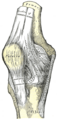 Right knee-joint. Anterior view.
 -
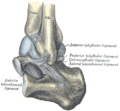 Left talocrural joint
 -
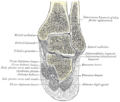 Coronal section through right talocrural and talocalcaneal joints
 -
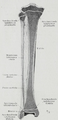 Longitudinal section of tibia showing interior
 -
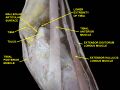 Dorsum of Foot. Ankle joint. Deep dissection
 -
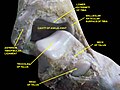 Ankle joint. Deep dissection. Anterior view
 -
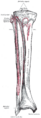 Bones of the right leg. Anterior surface
 -
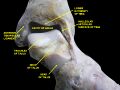 Dorsum of Foot. Ankle joint. Deep dissection.


See also[edit]
- Shin splints
- Squatting facets
- Fibula
- Femur
- Ankle joint
- Knee joint
- Bone fractures
- Musculoskeletal system
| Bones of the human leg | ||||||||||||||||||||||||||
|---|---|---|---|---|---|---|---|---|---|---|---|---|---|---|---|---|---|---|---|---|---|---|---|---|---|---|
|

Medical Disclaimer: WikiMD is for informational purposes only and is not a substitute for professional medical advice. Content may be inaccurate or outdated and should not be used for diagnosis or treatment. Always consult your healthcare provider for medical decisions. Verify information with trusted sources such as CDC.gov and NIH.gov. By using this site, you agree that WikiMD is not liable for any outcomes related to its content. See full disclaimer.
Credits:Most images are courtesy of Wikimedia commons, and templates, categories Wikipedia, licensed under CC BY SA or similar.
Translate this page: - East Asian
中文,
日本,
한국어,
South Asian
हिन्दी,
தமிழ்,
తెలుగు,
Urdu,
ಕನ್ನಡ,
Southeast Asian
Indonesian,
Vietnamese,
Thai,
မြန်မာဘာသာ,
বাংলা
European
español,
Deutsch,
français,
Greek,
português do Brasil,
polski,
română,
русский,
Nederlands,
norsk,
svenska,
suomi,
Italian
Middle Eastern & African
عربى,
Turkish,
Persian,
Hebrew,
Afrikaans,
isiZulu,
Kiswahili,
Other
Bulgarian,
Hungarian,
Czech,
Swedish,
മലയാളം,
मराठी,
ਪੰਜਾਬੀ,
ગુજરાતી,
Portuguese,
Ukrainian

