Gerdy's tubercle
Gerdy's Tubercle is a bony protrusion of the tibia located on the lateral aspect of the proximal tibia, just below the knee joint. It was named after the French surgeon Pierre Nicolas Gerdy who first described it in the 19th century.
Etymology[edit]
The term "Gerdy's Tubercle" is derived from the name of the French surgeon Pierre Nicolas Gerdy (1797-1856). Gerdy was a renowned anatomist and surgeon who made significant contributions to the field of orthopedics. He first described the tubercle that now bears his name.
Anatomy[edit]
Gerdy's Tubercle is located on the lateral aspect of the proximal tibia, just below the knee joint. It serves as the attachment point for the iliotibial band, a thick band of fibrous tissue that runs down the outside of the thigh. The tubercle is easily palpable and is often used as a landmark in clinical examination and surgical procedures.
Clinical Significance[edit]
Due to its location and function, Gerdy's Tubercle is often involved in conditions related to the knee joint and the iliotibial band. These include Iliotibial Band Syndrome, a common overuse injury of the knee, and Osgood-Schlatter disease, a condition seen in adolescents where the tendon that inserts into the tubercle becomes inflamed.
Related Terms[edit]
- Tibia: The larger of the two bones in the lower leg, the tibia is located on the medial (inside) side of the leg.
- Iliotibial Band: A thick band of fibrous tissue that runs down the outside of the thigh from the hip to the shin.
- Iliotibial Band Syndrome: A common overuse injury of the knee, often seen in runners and cyclists.
- Osgood-Schlatter disease: A condition seen in adolescents where the tendon that inserts into the tibial tubercle becomes inflamed.

This WikiMD article can only be edited by registered and verified editors. You can log in or register.
Gerdy's_tubercle[edit]
-
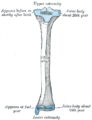 Gray's Anatomy illustration of the knee joint


Medical Disclaimer: WikiMD is for informational purposes only and is not a substitute for professional medical advice. Content may be inaccurate or outdated and should not be used for diagnosis or treatment. Always consult your healthcare provider for medical decisions. Verify information with trusted sources such as CDC.gov and NIH.gov. By using this site, you agree that WikiMD is not liable for any outcomes related to its content. See full disclaimer.
Credits:Most images are courtesy of Wikimedia commons, and templates, categories Wikipedia, licensed under CC BY SA or similar.
Translate page: - East Asian
中文,
日本,
한국어,
South Asian
हिन्दी,
தமிழ்,
తెలుగు,
Urdu,
ಕನ್ನಡ,
Southeast Asian
Indonesian,
Vietnamese,
Thai,
မြန်မာဘာသာ,
বাংলা
European
español,
Deutsch,
français,
Greek,
português do Brasil,
polski,
română,
русский,
Nederlands,
norsk,
svenska,
suomi,
Italian
Middle Eastern & African
عربى,
Turkish,
Persian,
Hebrew,
Afrikaans,
isiZulu,
Kiswahili,
Other
Bulgarian,
Hungarian,
Czech,
Swedish,
മലയാളം,
मराठी,
ਪੰਜਾਬੀ,
ગુજરાતી,
Portuguese,
Ukrainian

