Greater trochanter
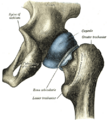
The Greater trochanter is a large, irregular, quadrilateral eminence and a part of the skeletal system located on the femur, the longest bone in the human body. It is situated at the junction of the neck and the body of the femur, and serves as the site of attachment for several important muscles.
Anatomy[edit]
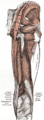
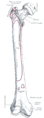
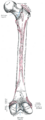
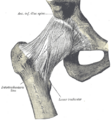
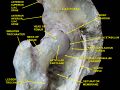
The greater trochanter is positioned on the proximal (near) end of the femur, lateral to the femoral neck. It is a prominent bony protrusion that can be palpated on the outside of the hip. The greater trochanter is divided into a number of facets, or flat surfaces, which correspond to the points of attachment of the gluteus minimus, gluteus medius, and piriformis muscles, among others.
Function[edit]
The primary function of the greater trochanter is to provide an attachment point for muscles that move the hip joint. These muscles include the gluteus medius and minimus, which are responsible for abducting and medially rotating the hip, and the piriformis, which laterally rotates the hip. The greater trochanter also serves as a lever arm, enhancing the mechanical advantage of these muscles.
Clinical Significance[edit]
Injuries or conditions affecting the greater trochanter can lead to pain and mobility issues. Trochanteric bursitis, an inflammation of the bursa located over the greater trochanter, is a common condition that can cause hip pain. Fractures of the greater trochanter can occur as a result of trauma or due to pathological conditions such as osteoporosis.
See Also[edit]
References[edit]

-
 Greater trochanter
 -
 Greater trochanter
 -
 Greater trochanter
 -
 Greater trochanter
 -
 Greater trochanter
 -
 Greater trochanter
 -
 Greater trochanter


Medical Disclaimer: WikiMD is for informational purposes only and is not a substitute for professional medical advice. Content may be inaccurate or outdated and should not be used for diagnosis or treatment. Always consult your healthcare provider for medical decisions. Verify information with trusted sources such as CDC.gov and NIH.gov. By using this site, you agree that WikiMD is not liable for any outcomes related to its content. See full disclaimer.
Credits:Most images are courtesy of Wikimedia commons, and templates, categories Wikipedia, licensed under CC BY SA or similar.
Translate page: - East Asian
中文,
日本,
한국어,
South Asian
हिन्दी,
தமிழ்,
తెలుగు,
Urdu,
ಕನ್ನಡ,
Southeast Asian
Indonesian,
Vietnamese,
Thai,
မြန်မာဘာသာ,
বাংলা
European
español,
Deutsch,
français,
Greek,
português do Brasil,
polski,
română,
русский,
Nederlands,
norsk,
svenska,
suomi,
Italian
Middle Eastern & African
عربى,
Turkish,
Persian,
Hebrew,
Afrikaans,
isiZulu,
Kiswahili,
Other
Bulgarian,
Hungarian,
Czech,
Swedish,
മലയാളം,
मराठी,
ਪੰਜਾਬੀ,
ગુજરાતી,
Portuguese,
Ukrainian

