Descending colon

Part of the large intestine
[[File: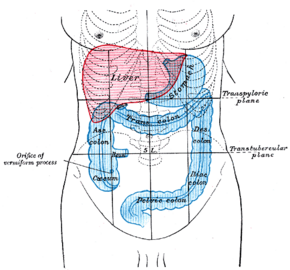 |frameless|alt=]]

| Details | |
|---|---|
| Synonyms | |
| Pronunciation | |
| Carnegie stage | |
| Days | |
| Precursor | Midgut |
| Gives rise to | |
| Part of | |
The descending colon is a part of the large intestine. It is located on the left side of the abdomen, extending from the transverse colon to the sigmoid colon. The descending colon plays a crucial role in the digestive system by absorbing water and electrolytes from feces.
Anatomy[edit]
The descending colon is a continuation of the transverse colon and extends downward to the sigmoid colon. It is retroperitoneal, meaning it is located behind the peritoneum. The descending colon is approximately 25-30 cm in length.
Blood Supply[edit]
The descending colon receives its blood supply from the left colic artery, a branch of the inferior mesenteric artery. Venous drainage is through the inferior mesenteric vein, which drains into the splenic vein and then into the portal vein.
Nerve Supply[edit]
The nerve supply to the descending colon is provided by the inferior mesenteric plexus, which contains both sympathetic and parasympathetic fibers. The sympathetic fibers originate from the lumbar splanchnic nerves, while the parasympathetic fibers come from the pelvic splanchnic nerves.
Lymphatic Drainage[edit]
Lymph from the descending colon drains into the inferior mesenteric lymph nodes. These nodes are located along the course of the inferior mesenteric artery.
Function[edit]
The primary function of the descending colon is to store the remains of digested food that will be emptied into the rectum. It also absorbs water and electrolytes, which helps to form solid stool.
Clinical Significance[edit]
Conditions that can affect the descending colon include diverticulitis, colorectal cancer, and inflammatory bowel disease. Symptoms of descending colon disorders may include abdominal pain, constipation, and diarrhea.
See Also[edit]
| Anatomy of the gastrointestinal tract, excluding the mouth | ||||||
|---|---|---|---|---|---|---|
|
 | This medical article is a stub. You can help WikiMD by expanding the page. |

Medical Disclaimer: WikiMD is for informational purposes only and is not a substitute for professional medical advice. Content may be inaccurate or outdated and should not be used for diagnosis or treatment. Always consult your healthcare provider for medical decisions. Verify information with trusted sources such as CDC.gov and NIH.gov. By using this site, you agree that WikiMD is not liable for any outcomes related to its content. See full disclaimer.
Credits:Most images are courtesy of Wikimedia commons, and templates, categories Wikipedia, licensed under CC BY SA or similar.
Translate page: - East Asian
中文,
日本,
한국어,
South Asian
हिन्दी,
தமிழ்,
తెలుగు,
Urdu,
ಕನ್ನಡ,
Southeast Asian
Indonesian,
Vietnamese,
Thai,
မြန်မာဘာသာ,
বাংলা
European
español,
Deutsch,
français,
Greek,
português do Brasil,
polski,
română,
русский,
Nederlands,
norsk,
svenska,
suomi,
Italian
Middle Eastern & African
عربى,
Turkish,
Persian,
Hebrew,
Afrikaans,
isiZulu,
Kiswahili,
Other
Bulgarian,
Hungarian,
Czech,
Swedish,
മലയാളം,
मराठी,
ਪੰਜਾਬੀ,
ગુજરાતી,
Portuguese,
Ukrainian

