Pterygomandibular raphe
Pterygomandibular raphe is a ligamentous band of the buccopharyngeal fascia, a deep fascia of the neck. It is a significant anatomical structure in the oral cavity, particularly in the field of dentistry and oral surgery.
Etymology[edit]
The term "pterygomandibular" is derived from the Greek words "pteryx" meaning wing, and "mandibula" meaning jaw. "Raphe" is also a Greek word, meaning seam or suture.
Anatomy[edit]
The pterygomandibular raphe extends from the pterygoid hamulus and the tensor veli palatini to the posterior end of the mylohyoid line of the mandible, behind the third molar tooth. It serves as a dividing line between the buccal (cheek) and oral (mouth) parts of the oral cavity.
Clinical significance[edit]
The pterygomandibular raphe is a crucial landmark in dentistry and oral surgery. It is the site of injection for an inferior alveolar nerve block, a common local anesthetic procedure in dentistry.
Related terms[edit]
- Pterygoid hamulus: A small hook-like structure on the lower end of the medial pterygoid plate of the sphenoid bone.
- Tensor veli palatini: A broad, thin, ribbon-like muscle in the head that tenses the soft palate.
- Mylohyoid line: A ridge on the inner surface of the mandible.
- Buccal: Pertaining to the cheek.
- Oral: Pertaining to the mouth.

This WikiMD article can only be edited by registered and verified editors. You can log in or register.
-
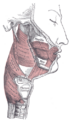 Anatomical illustration showing the pterygomandibular raphe.
 -
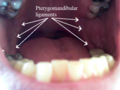 Open mouth view showing the pterygomandibular ligaments.


Medical Disclaimer: WikiMD is for informational purposes only and is not a substitute for professional medical advice. Content may be inaccurate or outdated and should not be used for diagnosis or treatment. Always consult your healthcare provider for medical decisions. Verify information with trusted sources such as CDC.gov and NIH.gov. By using this site, you agree that WikiMD is not liable for any outcomes related to its content. See full disclaimer.
Credits:Most images are courtesy of Wikimedia commons, and templates, categories Wikipedia, licensed under CC BY SA or similar.
Translate page: - East Asian
中文,
日本,
한국어,
South Asian
हिन्दी,
தமிழ்,
తెలుగు,
Urdu,
ಕನ್ನಡ,
Southeast Asian
Indonesian,
Vietnamese,
Thai,
မြန်မာဘာသာ,
বাংলা
European
español,
Deutsch,
français,
Greek,
português do Brasil,
polski,
română,
русский,
Nederlands,
norsk,
svenska,
suomi,
Italian
Middle Eastern & African
عربى,
Turkish,
Persian,
Hebrew,
Afrikaans,
isiZulu,
Kiswahili,
Other
Bulgarian,
Hungarian,
Czech,
Swedish,
മലയാളം,
मराठी,
ਪੰਜਾਬੀ,
ગુજરાતી,
Portuguese,
Ukrainian

