Gastric folds
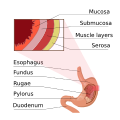
Gastric folds, also known as Rugae or gastric rugae, are large folds in the stomach that allow it to expand and contract. They are found in the stomach lining and are visible when the stomach is deflated. The term "gastric folds" is derived from the Latin word "gastricus," which means "stomach," and the English word "fold."
Etymology[edit]
The term "gastric" is derived from the Greek word "gaster," which means "stomach." The term "fold" comes from the Old English word "faldan," which means "to fold or bend."
Structure[edit]
Gastric folds are large, visible folds in the stomach lining. They are made up of mucous membrane, submucosa, and muscularis. The folds allow the stomach to expand and contract, accommodating varying amounts of food.
Function[edit]
The primary function of the gastric folds is to allow the stomach to expand and contract. This enables the stomach to accommodate varying amounts of food. The folds also help in the mechanical breakdown of food, increasing the surface area for digestion.
Clinical significance[edit]
Abnormalities in the gastric folds can lead to various medical conditions. For instance, Gastritis, an inflammation of the stomach lining, can cause the gastric folds to become swollen and inflamed. Gastric cancer can also cause changes in the appearance of the gastric folds.
See also[edit]
References[edit]

This WikiMD article can only be edited by registered and verified editors. You can log in or register.
-
 Gastric folds
 -
 Gastric folds


Advertise on WikiMD — 81,000+ full articles, ~900,000 total pages, ~250 million page views. Global reach, limited time promotional rates from $1/page/day. Learn more · View stats


Translate page: - East Asian
中文,
日本,
한국어,
South Asian
हिन्दी,
தமிழ்,
తెలుగు,
Urdu,
ಕನ್ನಡ,
Southeast Asian
Indonesian,
Vietnamese,
Thai,
မြန်မာဘာသာ,
বাংলা
European
español,
Deutsch,
français,
Greek,
português do Brasil,
polski,
română,
русский,
Nederlands,
norsk,
svenska,
suomi,
Italian
Middle Eastern & African
عربى,
Turkish,
Persian,
Hebrew,
Afrikaans,
isiZulu,
Kiswahili,
Other
Bulgarian,
Hungarian,
Czech,
Swedish,
മലയാളം,
मराठी,
ਪੰਜਾਬੀ,
ગુજરાતી,
Portuguese,
Ukrainian
About WikiMD • Contact • Disclaimer • Privacy • Copyright • Site statistics
Some content and images may originate from Wikimedia Commons or Wikipedia and remain subject to their stated licenses. Unless otherwise noted, eligible WikiMD content is available under CC BY-SA 4.0.
WikiMD Wellnesspedia — Free health & wellness information for patients, students, and health professionals.

