Colic flexures
Colic flexures are significant anatomical landmarks in the large intestine of the human body. They are bends in the colon that divide it into different segments. There are two main colic flexures: the hepatic flexure and the splenic flexure. These flexures play a crucial role in the movement and processing of waste material through the digestive system.
Hepatic Flexure[edit]
The hepatic flexure, also known as the right colic flexure, is located near the liver, which explains its name (hepatic relates to the liver). It marks the junction where the ascending colon turns to become the transverse colon. This flexure is situated in the right upper quadrant of the abdomen, just below the liver. The hepatic flexure is an important landmark for surgeons and radiologists as it can be a site for colonic obstruction and other gastrointestinal issues.
Splenic Flexure[edit]
The splenic flexure, or left colic flexure, is found near the spleen, hence its name. It represents the point where the transverse colon turns downward to become the descending colon. Located in the left upper quadrant of the abdomen, the splenic flexure is noted for being the highest point of the colon. Due to its sharp bend and the fact that it is a gravity-dependent area, the splenic flexure can be a site for the accumulation of fecal material, leading to splenic flexure syndrome, characterized by gas and bloating.
Clinical Significance[edit]
Both colic flexures are of clinical significance due to their roles in the passage of fecal matter and their potential involvement in various gastrointestinal conditions. Conditions such as colonic volvulus, colorectal cancer, and diverticulitis can affect the colic flexures. Their anatomical positions also make them critical landmarks in abdominal surgeries and diagnostic procedures like colonoscopy.
Diagnosis and Treatment[edit]
Diagnosis of conditions related to the colic flexures often involves imaging studies such as CT scans, MRIs, and X-rays, in addition to colonoscopy. Treatment varies depending on the underlying condition but may include dietary changes, medications, or surgery.
See Also[edit]
 | This medical article is a stub. You can help WikiMD by expanding the page. |
Colic flexures[edit]
-
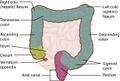 Large Intestine
 -
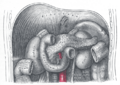 Diagram of the large intestine
 -
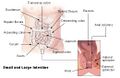 Illustration of the intestine
 -
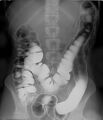 Human intestinal tract, as imaged via double-contrast barium enema


Sponsored Health Resource

W8MD Weight Loss, Sleep & MedSpa
Looking for physician-supervised weight loss, semaglutide, tirzepatide, or GLP-1 receptor agonist options? W8MD helps eligible patients in New York City, Brooklyn, New Jersey, Connecticut, Pennsylvania, Delaware, and greater Philadelphia with medical weight loss, sleep medicine, and long-term maintenance support.
GLP-1 specials: Affordable GLP-1 injections NYC and Philadelphia starting from $29.99/week and up for semaglutide with insurance accepted for qualifying visits, and $45/week and up for tirzepatide with insurance accepted for qualifying visits. Self-pay options start from $59.99/week and up for semaglutide and $69.99/week and up for tirzepatide.
Medical weight loss NYC | Affordable GLP-1 injections NYC | Budget GLP-1 weight loss shots Philadelphia | New Jersey medical weight loss | NYC medical weight loss | Philadelphia medical weight loss | Sleep clinic NYC | W8MD's Philadelphia GLP-1 doctor | Weight loss prescriptions NYC
Book a W8MD appointment · View GLP-1 specials
Paid promotional message. Eligibility, pricing, insurance coverage, medication availability, and results vary. Medical evaluation required.

Medical Disclaimer: WikiMD is for informational purposes only and is not a substitute for professional medical advice. Content may be inaccurate or outdated and should not be used for diagnosis or treatment. Always consult your healthcare provider for medical decisions. Verify information with trusted sources such as CDC.gov and NIH.gov. By using this site, you agree that WikiMD is not liable for any outcomes related to its content. See full disclaimer.
Credits:Most images are courtesy of Wikimedia commons, and templates, categories Wikipedia, licensed under CC BY SA or similar.
Translate page: - East Asian
中文,
日本,
한국어,
South Asian
हिन्दी,
தமிழ்,
తెలుగు,
Urdu,
ಕನ್ನಡ,
Southeast Asian
Indonesian,
Vietnamese,
Thai,
မြန်မာဘာသာ,
বাংলা
European
español,
Deutsch,
français,
Greek,
português do Brasil,
polski,
română,
русский,
Nederlands,
norsk,
svenska,
suomi,
Italian
Middle Eastern & African
عربى,
Turkish,
Persian,
Hebrew,
Afrikaans,
isiZulu,
Kiswahili,
Other
Bulgarian,
Hungarian,
Czech,
Swedish,
മലയാളം,
मराठी,
ਪੰਜਾਬੀ,
ગુજરાતી,
Portuguese,
Ukrainian

