Bleu d'Auvergne
Bleu d'Auvergne is a type of blue cheese that originated in the Auvergne region of south-central France. It is made from cow's milk, and is one of the cheeses granted a Protected Designation of Origin (PDO) by the European Union.
History[edit]
Bleu d'Auvergne was first created in the mid-19th century by a French farmer named Antoine Roussel. Roussel noted that the occurrence of blue molds on his curd resulted in an increased flavor, and began the practice of adding Penicillium molds to his cheese. The cheese quickly gained popularity, and by 1975, it was granted PDO status.
Production[edit]
The production of Bleu d'Auvergne involves several steps. The cow's milk is first heated and then combined with rennet, which causes the milk to curdle. The curd is then cut into small pieces, which are stirred and heated further. The Penicillium mold is added, and the mixture is poured into molds to shape the cheese. The cheese is then aged for a minimum of four weeks.
Characteristics[edit]
Bleu d'Auvergne is a creamy, rich cheese with a strong, pungent flavor. It has a moist, sticky rind and a soft, crumbly texture. The cheese is characterized by its blue-green mold, which is evenly distributed throughout the cheese.
Pairings[edit]
Bleu d'Auvergne pairs well with a variety of foods and beverages. It is often served with red wine, particularly those from the Auvergne region. It also complements fruits like pears and apples, and can be used in a variety of recipes, from salads to desserts.
See also[edit]
| Cheese | ||||||||||
|---|---|---|---|---|---|---|---|---|---|---|
|

-
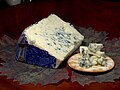 Bleu d'Auvergne cheese
 -
 Bleu auvergne


Advertise on WikiMD — 81,000+ full articles, ~900,000 total pages, ~250 million page views. Global reach, limited time promotional rates from $1/page/day. Learn more · View stats

Translate page: - East Asian
中文,
日本,
한국어,
South Asian
हिन्दी,
தமிழ்,
తెలుగు,
Urdu,
ಕನ್ನಡ,
Southeast Asian
Indonesian,
Vietnamese,
Thai,
မြန်မာဘာသာ,
বাংলা
European
español,
Deutsch,
français,
Greek,
português do Brasil,
polski,
română,
русский,
Nederlands,
norsk,
svenska,
suomi,
Italian
Middle Eastern & African
عربى,
Turkish,
Persian,
Hebrew,
Afrikaans,
isiZulu,
Kiswahili,
Other
Bulgarian,
Hungarian,
Czech,
Swedish,
മലയാളം,
मराठी,
ਪੰਜਾਬੀ,
ગુજરાતી,
Portuguese,
Ukrainian
About WikiMD • Contact • Disclaimer • Privacy • Copyright • Site statistics
Some content and images may originate from Wikimedia Commons or Wikipedia and remain subject to their stated licenses. Unless otherwise noted, eligible WikiMD content is available under CC BY-SA 4.0.
WikiMD Wellnesspedia — Free health & wellness information for patients, students, and health professionals.

