Acute promyelocytic leukemia
| Acute promyelocytic leukemia | |
|---|---|
.jpg) | |
| Synonyms | N/A |
| Pronounce | N/A |
| Specialty | N/A |
| Symptoms | Fatigue, bleeding, bruising, fever, infection |
| Complications | Disseminated intravascular coagulation, hemorrhage |
| Onset | Adulthood |
| Duration | Variable |
| Types | N/A |
| Causes | Genetic mutation (translocation between chromosomes 15 and 17) |
| Risks | Radiation, benzene exposure, chemotherapy |
| Diagnosis | Bone marrow biopsy, blood test |
| Differential diagnosis | Acute myeloid leukemia, chronic myeloid leukemia |
| Prevention | N/A |
| Treatment | All-trans retinoic acid, arsenic trioxide, chemotherapy |
| Medication | N/A |
| Prognosis | Generally good with treatment |
| Frequency | Rare |
| Deaths | N/A |
Acute Promyelocytic Leukemia (APL) is a subtype of acute myeloid leukemia (AML), characterized by the accumulation of promyelocytes in the bone marrow. It is classified as AML-M3 in the French-American-British (FAB) classification system.
Pathophysiology[edit]
APL is caused by a specific chromosomal translocation, t(15;17)(q24;q21), which results in the fusion of the promyelocytic leukemia (PML) gene on chromosome 15 and the retinoic acid receptor alpha (RARA) gene on chromosome 17. This PML-RARA fusion protein interferes with normal hematopoiesis and leads to the accumulation of promyelocytes.
Clinical Presentation[edit]
Patients with APL often present with symptoms related to cytopenias and coagulopathy. Common symptoms include:
- Fatigue and weakness due to anemia
- Infections due to neutropenia
- Bleeding and bruising due to thrombocytopenia and disseminated intravascular coagulation (DIC)
Diagnosis[edit]
The diagnosis of APL is confirmed through:
- Complete blood count (CBC) showing cytopenias
- Bone marrow biopsy revealing promyelocytes
- Cytogenetic analysis to detect the t(15;17) translocation
- Molecular testing for the PML-RARA fusion gene
Treatment[edit]
The treatment of APL has been revolutionized by the introduction of all-trans retinoic acid (ATRA) and arsenic trioxide (ATO). The standard treatment regimen includes:
- Induction therapy with ATRA and ATO
- Consolidation therapy to eliminate residual disease
- Maintenance therapy to prevent relapse
Prognosis[edit]
The prognosis for patients with APL has improved significantly with modern treatment protocols. The 5-year survival rate is over 80% with appropriate therapy. Early diagnosis and treatment are crucial to prevent complications such as DIC.
Complications[edit]
Complications of APL include:
Additional images[edit]
-
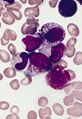 Faggot cell in AML-M3
 -
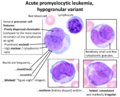 Peripheral blood smear of acute promyelocytic leukemia, hypogranular variant
 -
 Acute promyelocytic leukemia, hypogranular variant (M3v)


.jpg)
See Also[edit]
External Links[edit]
- [American Cancer Society: Acute Promyelocytic Leukemia]
- [Leukemia & Lymphoma Society: APL]
Sponsored Health Resource

W8MD Weight Loss, Sleep & MedSpa
Looking for physician-supervised weight loss, semaglutide, tirzepatide, or GLP-1 receptor agonist options? W8MD helps eligible patients in New York City, Brooklyn, New Jersey, Connecticut, Pennsylvania, Delaware, and greater Philadelphia with medical weight loss, sleep medicine, and long-term maintenance support.
GLP-1 specials: Affordable GLP-1 injections NYC and Philadelphia starting from $29.99/week and up for semaglutide with insurance accepted for qualifying visits, and $45/week and up for tirzepatide with insurance accepted for qualifying visits. Self-pay options start from $59.99/week and up for semaglutide and $69.99/week and up for tirzepatide.
- Medical weight loss NYC
- Affordable GLP-1 injections NYC
- Budget GLP-1 weight loss shots Philadelphia
- New Jersey medical weight loss
- NYC medical weight loss blog
- Philadelphia weight loss blog
- Sleep medicine and sleep apnea services
- W8MD MedSpa and wellness
Book a W8MD appointment · View GLP-1 specials
Paid promotional message. Eligibility, pricing, insurance coverage, medication availability, and results vary. Medical evaluation required.

Medical Disclaimer: WikiMD is for informational purposes only and is not a substitute for professional medical advice. Content may be inaccurate or outdated and should not be used for diagnosis or treatment. Always consult your healthcare provider for medical decisions. Verify information with trusted sources such as CDC.gov and NIH.gov. By using this site, you agree that WikiMD is not liable for any outcomes related to its content. See full disclaimer.
Credits:Most images are courtesy of Wikimedia commons, and templates, categories Wikipedia, licensed under CC BY SA or similar.
Translate page: - East Asian
中文,
日本,
한국어,
South Asian
हिन्दी,
தமிழ்,
తెలుగు,
Urdu,
ಕನ್ನಡ,
Southeast Asian
Indonesian,
Vietnamese,
Thai,
မြန်မာဘာသာ,
বাংলা
European
español,
Deutsch,
français,
Greek,
português do Brasil,
polski,
română,
русский,
Nederlands,
norsk,
svenska,
suomi,
Italian
Middle Eastern & African
عربى,
Turkish,
Persian,
Hebrew,
Afrikaans,
isiZulu,
Kiswahili,
Other
Bulgarian,
Hungarian,
Czech,
Swedish,
മലയാളം,
मराठी,
ਪੰਜਾਬੀ,
ગુજરાતી,
Portuguese,
Ukrainian

