Acrania
| Acrania | |
|---|---|

| |
| Synonyms | Exencephaly |
| Pronounce | N/A |
| Specialty | N/A |
| Symptoms | Absence of the skull |
| Complications | Anencephaly, stillbirth |
| Onset | Congenital |
| Duration | Permanent |
| Types | N/A |
| Causes | Neural tube defect |
| Risks | Genetic predisposition, environmental factors |
| Diagnosis | Ultrasound, MRI |
| Differential diagnosis | Anencephaly, encephalocele |
| Prevention | Folic acid supplementation |
| Treatment | Supportive care |
| Medication | N/A |
| Prognosis | Poor |
| Frequency | Rare |
| Deaths | N/A |
A rare congenital disorder characterized by the absence of the cranial vault
| Medical conditions | ||||||||||
|---|---|---|---|---|---|---|---|---|---|---|
This medical condition related article is a stub. You can help WikiMD by expanding it.
|
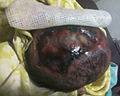
Acrania is a rare congenital disorder characterized by the partial or complete absence of the cranial vault, the protective bony structure that encases the brain. This condition is often associated with other neural tube defects, such as anencephaly.
Pathophysiology[edit]
Acrania occurs due to a failure in the closure of the neural tube during embryonic development. The neural tube is the precursor to the central nervous system, which includes the brain and spinal cord. In acrania, the mesenchyme that forms the skull does not develop properly, leading to the absence of the cranial bones.
Clinical Presentation[edit]
Infants with acrania are typically born with a malformed head due to the absence of the cranial bones. The brain is exposed or covered only by a thin membrane. This condition is often detected during prenatal ultrasound examinations.
Diagnosis[edit]
Acrania can be diagnosed prenatally through ultrasound imaging, which can reveal the absence of the cranial vault. Magnetic resonance imaging (MRI) may also be used to assess the extent of the defect and any associated anomalies.
Prognosis[edit]
The prognosis for infants with acrania is extremely poor. The condition is often incompatible with life due to the severe exposure and damage to the brain. Most affected pregnancies result in stillbirth or early neonatal death.
Management[edit]
There is no cure for acrania. Management is supportive and focuses on providing comfort care. In some cases, parents may choose to terminate the pregnancy upon diagnosis due to the poor prognosis.
Related Conditions[edit]
Acrania is often associated with other neural tube defects, such as:
Related pages[edit]
Gallery[edit]
-
 Acrania
 -
 Anencephaly

-
Acrania
-
Anencefalia
Ad. Transform your health with W8MD Weight Loss, Sleep & MedSpa

Tired of being overweight?
Special offer:
Budget GLP-1 weight loss medications
- Semaglutide starting from $29.99/week and up with insurance for visit of $59.99 and up per week self pay.
- Tirzepatide starting from $45.00/week and up (dose dependent) or $69.99/week and up self pay
✔ Same-week appointments, evenings & weekends
Learn more:
- GLP-1 weight loss clinic NYC
- W8MD's NYC medical weight loss
- W8MD Philadelphia GLP-1 shots
- Philadelphia GLP-1 injections
- Affordable GLP-1 shots NYC
|
WikiMD Medical Encyclopedia |
Medical Disclaimer: WikiMD is for informational purposes only and is not a substitute for professional medical advice. Content may be inaccurate or outdated and should not be used for diagnosis or treatment. Always consult your healthcare provider for medical decisions. Verify information with trusted sources such as CDC.gov and NIH.gov. By using this site, you agree that WikiMD is not liable for any outcomes related to its content. See full disclaimer.
Credits:Most images are courtesy of Wikimedia commons, and templates, categories Wikipedia, licensed under CC BY SA or similar.
Translate this page: - East Asian
中文,
日本,
한국어,
South Asian
हिन्दी,
தமிழ்,
తెలుగు,
Urdu,
ಕನ್ನಡ,
Southeast Asian
Indonesian,
Vietnamese,
Thai,
မြန်မာဘာသာ,
বাংলা
European
español,
Deutsch,
français,
Greek,
português do Brasil,
polski,
română,
русский,
Nederlands,
norsk,
svenska,
suomi,
Italian
Middle Eastern & African
عربى,
Turkish,
Persian,
Hebrew,
Afrikaans,
isiZulu,
Kiswahili,
Other
Bulgarian,
Hungarian,
Czech,
Swedish,
മലയാളം,
मराठी,
ਪੰਜਾਬੀ,
ગુજરાતી,
Portuguese,
Ukrainian
