Comparison of the Bones of the Hand and Foot

Editor-In-Chief: Prab R Tumpati, MD
Obesity, Sleep & Internal medicine
Founder, WikiMD Wellnesspedia &
W8MD's medical weight loss NYC, sleep center NYC
Philadelphia medical weight loss and Philadelphia sleep clinics
Anatomy > Gray's Anatomy of the Human Body > Osteology > 6d. Comparison of the Bones of the Hand and Foot
Henry Gray (1821–1865). Anatomy of the Human Body. 1918.
Comparison of the Bones of the Hand and Foot[edit]
The hand and foot are anatomically constructed on similar principles. Each consists of three main parts:
- A proximal segment: the carpus in the hand and the tarsus in the foot.
- A middle segment: the metacarpus in the hand and the metatarsus in the foot.
- A terminal segment: the phalanges in both.
Proximal Segment: Carpus and Tarsus[edit]
The proximal bones in each region are arranged in a series of small, cuboidal bones:
- The carpal bones (of the wrist)
- The tarsal bones (of the ankle)
These bones allow slight gliding movements and serve to distribute forces between the forearm bones or leg bones and the more distal bones. The tarsus is larger and arranged at a right angle to the tibia and fibula, providing a stable base for weight-bearing. In contrast, the carpus is aligned with the forearm and designed for flexibility and dexterity.
Middle Segment: Metacarpals and Metatarsals[edit]
The middle segment in both the hand and foot is composed of:
- Five metacarpal bones (in the hand)
- Five metatarsal bones (in the foot)
These long bones provide additional breadth and serve as levers during movement. The spaces between them accommodate the interosseous muscles and protect the palmar arches in the hand and plantar arches in the foot.
Notably:
- The metacarpal bone of the thumb is highly mobile, set at an angle for effective opposition, and articulates with the trapezium.
- The metatarsal bone of the great toe (hallux) is aligned with the other metatarsals, constructed for weight-bearing, and much less mobile.
Terminal Segment: Phalanges[edit]
The phalanges (finger and toe bones) form the digits in both limbs:
- More numerous, longer, and mobile in the hand to facilitate grasping and fine motor skills.
- Shorter, thicker, and less mobile in the foot, optimized for support and propulsion during gait.
Each finger and toe has three phalanges—proximal, middle, and distal—except for the thumb and great toe, which have only two.
Functional Differences and Adaptations[edit]
While structurally similar, the functional demands of the hand and foot have led to striking adaptations:
- The foot supports the full body weight in the standing position, requiring robust, stable bones and limited flexibility.
- The hand is specialized for manipulation, featuring delicate structures and a wide range of motion.
In particular:
- The tarsus includes weight-bearing bones such as the talus and calcaneus, arranged in longitudinal and transverse arches of the foot to absorb impact.
- The carpus forms a shallow concavity that creates the carpal tunnel, protecting the flexor tendons and median nerve.
Arch Structure in the Foot[edit]
To support body weight efficiently and absorb shock, the foot arches include:
These arches provide a spring-like support system, reinforced by ligaments, tendons, and the configuration of the bones.
Gallery[edit]
-
 Anterior muscles of the leg
 -
 Grays anatomy
 -
 Grays anatomy
 -
 Grays anatomy
 -
 Grays anatomy
 -
 Grays anatomy
 -
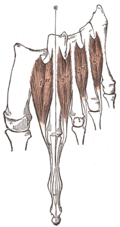 Grays anatomy
 -
 Grays anatomy


Muscles contributing to hand and foot function include:
- Intrinsic muscles of the hand
- Intrinsic muscles of the foot
- Extensor hallucis longus, flexor digitorum brevis, and other lower limb muscles vital for balance and propulsion.
See Also[edit]
- Skeletal system
- Arches of the foot
- Metacarpophalangeal joint
- Interphalangeal joints of the hand
- Opposition of the thumb
- Plantar fascia
- Carpal bones
- Tarsal bones
External Links[edit]
Gray's Anatomy[edit]
- Gray's Anatomy Contents
- Gray's Anatomy Subject Index
- About Classic Gray's Anatomy
- Glossary of anatomy terms
Anatomy atlases (external)[edit]
[1] - Anatomy Atlases
| Human systems and organs | ||||||||||||||
|---|---|---|---|---|---|---|---|---|---|---|---|---|---|---|
|
Adapted from the Classic Grays Anatomy of the Human Body 1918 edition (public domain)
| Human regional anatomy | ||||||||||
|---|---|---|---|---|---|---|---|---|---|---|
|
| Muscles of the hip and human leg | ||||||||||||||||||
|---|---|---|---|---|---|---|---|---|---|---|---|---|---|---|---|---|---|---|
|
Ad. Transform your health with W8MD Weight Loss, Sleep & MedSpa

Tired of being overweight?
Special offer:
Budget GLP-1 weight loss medications
- Semaglutide starting from $29.99/week and up with insurance for visit of $59.99 and up per week self pay.
- Tirzepatide starting from $45.00/week and up (dose dependent) or $69.99/week and up self pay
✔ Same-week appointments, evenings & weekends
Learn more:
- GLP-1 weight loss clinic NYC
- W8MD's NYC medical weight loss
- W8MD Philadelphia GLP-1 shots
- Philadelphia GLP-1 injections
- Affordable GLP-1 shots NYC
|
WikiMD Medical Encyclopedia |
Medical Disclaimer: WikiMD is for informational purposes only and is not a substitute for professional medical advice. Content may be inaccurate or outdated and should not be used for diagnosis or treatment. Always consult your healthcare provider for medical decisions. Verify information with trusted sources such as CDC.gov and NIH.gov. By using this site, you agree that WikiMD is not liable for any outcomes related to its content. See full disclaimer.
Credits:Most images are courtesy of Wikimedia commons, and templates, categories Wikipedia, licensed under CC BY SA or similar.
Translate this page: - East Asian
中文,
日本,
한국어,
South Asian
हिन्दी,
தமிழ்,
తెలుగు,
Urdu,
ಕನ್ನಡ,
Southeast Asian
Indonesian,
Vietnamese,
Thai,
မြန်မာဘာသာ,
বাংলা
European
español,
Deutsch,
français,
Greek,
português do Brasil,
polski,
română,
русский,
Nederlands,
norsk,
svenska,
suomi,
Italian
Middle Eastern & African
عربى,
Turkish,
Persian,
Hebrew,
Afrikaans,
isiZulu,
Kiswahili,
Other
Bulgarian,
Hungarian,
Czech,
Swedish,
മലയാളം,
मराठी,
ਪੰਜਾਬੀ,
ગુજરાતી,
Portuguese,
Ukrainian
