Aromatic amino acid
-
 L-Histidine
 -
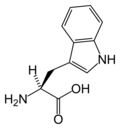 L-Tryptophan
 -
 L-Tyrosine
 -
 L-Phenylalanine
 -
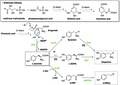 Aromatic_amino_acid


Aromatic Amino Acid[edit]
Aromatic amino acids are a class of amino acids that include an aromatic ring in their structure. These amino acids are essential components of proteins and play critical roles in various biological processes. The primary aromatic amino acids are phenylalanine, tyrosine, and tryptophan.
Structure[edit]
Aromatic amino acids are characterized by the presence of an aromatic ring, which is a planar, cyclic structure with conjugated double bonds. This ring structure is responsible for the unique chemical properties of these amino acids.
- Phenylalanine contains a benzyl side chain, which is a phenyl group attached to the alpha carbon of the amino acid.
- Tyrosine is similar to phenylalanine but has a hydroxyl group attached to the benzyl side chain, making it more polar.
- Tryptophan contains an indole group, which is a bicyclic structure consisting of a benzene ring fused to a pyrrole ring.
Biosynthesis[edit]
Aromatic amino acids are synthesized through the shikimate pathway in plants and microorganisms. This pathway is not present in animals, making these amino acids essential in the diet of humans and other animals.
- Phenylalanine is synthesized from chorismate via prephenate and phenylpyruvate intermediates.
- Tyrosine can be synthesized from phenylalanine through hydroxylation by the enzyme phenylalanine hydroxylase.
- Tryptophan is synthesized from chorismate through a series of reactions involving anthranilate and indole intermediates.
Functions[edit]
Aromatic amino acids serve several important functions in biological systems:
- Protein Synthesis: They are incorporated into proteins during translation, contributing to the structure and function of proteins.
- Precursor Molecules: They serve as precursors for the synthesis of various bioactive compounds.
 * Phenylalanine is a precursor for the synthesis of dopamine, norepinephrine, and epinephrine.
 * Tyrosine is involved in the synthesis of thyroid hormones and melanin.
 * Tryptophan is a precursor for the synthesis of serotonin and melatonin.
Metabolism[edit]
The metabolism of aromatic amino acids involves several pathways:
- Phenylalanine is metabolized to tyrosine, which can then be further degraded to fumarate and acetoacetate.
- Tyrosine is metabolized through the tyrosine degradation pathway, leading to the production of acetoacetate and fumarate.
- Tryptophan is metabolized through the kynurenine pathway, leading to the production of nicotinamide adenine dinucleotide (NAD+).
Clinical Significance[edit]
Disorders in the metabolism of aromatic amino acids can lead to various medical conditions:
- Phenylketonuria (PKU): A genetic disorder caused by a deficiency in phenylalanine hydroxylase, leading to the accumulation of phenylalanine.
- Alkaptonuria: A disorder caused by a deficiency in homogentisate 1,2-dioxygenase, affecting tyrosine metabolism.
- Tryptophan Metabolism Disorders: Disorders affecting tryptophan metabolism can lead to imbalances in serotonin and melatonin levels.
Related Pages[edit]
| Encoded (proteinogenic) amino acids | ||||||||||||||||
|---|---|---|---|---|---|---|---|---|---|---|---|---|---|---|---|---|
|
Ad. Transform your health with W8MD Weight Loss, Sleep & MedSpa

Tired of being overweight?
Special offer:
Budget GLP-1 weight loss medications
- Semaglutide starting from $29.99/week and up with insurance for visit of $59.99 and up per week self pay.
- Tirzepatide starting from $45.00/week and up (dose dependent) or $69.99/week and up self pay
✔ Same-week appointments, evenings & weekends
Learn more:
- GLP-1 weight loss clinic NYC
- W8MD's NYC medical weight loss
- W8MD Philadelphia GLP-1 shots
- Philadelphia GLP-1 injections
- Affordable GLP-1 shots NYC
|
WikiMD Medical Encyclopedia |
Medical Disclaimer: WikiMD is for informational purposes only and is not a substitute for professional medical advice. Content may be inaccurate or outdated and should not be used for diagnosis or treatment. Always consult your healthcare provider for medical decisions. Verify information with trusted sources such as CDC.gov and NIH.gov. By using this site, you agree that WikiMD is not liable for any outcomes related to its content. See full disclaimer.
Credits:Most images are courtesy of Wikimedia commons, and templates, categories Wikipedia, licensed under CC BY SA or similar.
Translate this page: - East Asian
中文,
日本,
한국어,
South Asian
हिन्दी,
தமிழ்,
తెలుగు,
Urdu,
ಕನ್ನಡ,
Southeast Asian
Indonesian,
Vietnamese,
Thai,
မြန်မာဘာသာ,
বাংলা
European
español,
Deutsch,
français,
Greek,
português do Brasil,
polski,
română,
русский,
Nederlands,
norsk,
svenska,
suomi,
Italian
Middle Eastern & African
عربى,
Turkish,
Persian,
Hebrew,
Afrikaans,
isiZulu,
Kiswahili,
Other
Bulgarian,
Hungarian,
Czech,
Swedish,
മലയാളം,
मराठी,
ਪੰਜਾਬੀ,
ગુજરાતી,
Portuguese,
Ukrainian
