Wine gum
Wine gum is a type of British confectionery, widely popular in the United Kingdom and other parts of the Commonwealth. Despite the name, wine gums do not typically contain wine or any other type of alcohol. The name is thought to derive from the sophisticated flavours of the sweets, which are intended to resemble the taste of certain wines.
History
Wine gums were first created by Charles Gordon Maynard in 1909. His father, Charles Riley Maynard, had established a sweet shop in London in 1896, and his son sought to create a new type of sweet that would appeal to adults as well as children. Despite initial resistance from his father, who was a teetotaler, Charles Gordon Maynard was able to convince him that the sweets did not contain any actual wine.
Production
Wine gums are made using a mixture of gelatin, sugar, corn syrup, and natural and artificial flavourings. The mixture is heated until it becomes a liquid, then poured into moulds and allowed to cool and set. The resulting sweets are chewy and have a slightly glossy surface.
Flavours and shapes
Wine gums come in a variety of shapes and colours, each associated with a different type of wine. For example, red wine gums are typically shaped like a grape and have a berry flavour, while white wine gums are often shaped like a bottle and have a citrus flavour. Other common flavours include apple, orange, and blackcurrant.
Cultural impact
Wine gums have become a staple of British confectionery, and are often associated with Christmas and other special occasions. They have also been featured in various forms of media, including books, films, and television shows.
See also
| British Confectionery | ||||||||
|---|---|---|---|---|---|---|---|---|
This British confectionery-related article is a stub.
|
| Candy | ||||||||||
|---|---|---|---|---|---|---|---|---|---|---|
|

Wine_gum
-
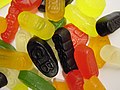 Bassetts winegums

Ad. Transform your life with W8MD's
GLP-1 weight loss injections special from $29.99 with insurance
|
WikiMD Medical Encyclopedia |
Medical Disclaimer: WikiMD is for informational purposes only and is not a substitute for professional medical advice. Content may be inaccurate or outdated and should not be used for diagnosis or treatment. Always consult your healthcare provider for medical decisions. Verify information with trusted sources such as CDC.gov and NIH.gov. By using this site, you agree that WikiMD is not liable for any outcomes related to its content. See full disclaimer.
Credits:Most images are courtesy of Wikimedia commons, and templates, categories Wikipedia, licensed under CC BY SA or similar.
Translate this page: - East Asian
中文,
日本,
한국어,
South Asian
हिन्दी,
தமிழ்,
తెలుగు,
Urdu,
ಕನ್ನಡ,
Southeast Asian
Indonesian,
Vietnamese,
Thai,
မြန်မာဘာသာ,
বাংলা
European
español,
Deutsch,
français,
Greek,
português do Brasil,
polski,
română,
русский,
Nederlands,
norsk,
svenska,
suomi,
Italian
Middle Eastern & African
عربى,
Turkish,
Persian,
Hebrew,
Afrikaans,
isiZulu,
Kiswahili,
Other
Bulgarian,
Hungarian,
Czech,
Swedish,
മലയാളം,
मराठी,
ਪੰਜਾਬੀ,
ગુજરાતી,
Portuguese,
Ukrainian
