Ampulla of Vater: Difference between revisions
CSV import |
CSV import |
||
| Line 5: | Line 5: | ||
File:Ultrasound_Scan_ND_090551_0930550_cr.png|Ultrasound scan of the Ampulla of Vater | File:Ultrasound_Scan_ND_090551_0930550_cr.png|Ultrasound scan of the Ampulla of Vater | ||
</gallery> | </gallery> | ||
==Ampulla of Vater== | |||
The '''ampulla of Vater''', also known as the '''hepatopancreatic ampulla''', is an important anatomical structure in the [[digestive system]] where the [[common bile duct]] and the [[pancreatic duct]] join and empty into the [[duodenum]]. It plays a crucial role in the regulation of bile and pancreatic juice flow into the small intestine, which is essential for the digestion of fats and other nutrients. | |||
==Anatomy== | |||
The ampulla of Vater is located in the second part of the [[duodenum]], which is the initial segment of the [[small intestine]]. It is situated at the major duodenal papilla, a small nipple-like projection on the inner surface of the duodenum. The ampulla is formed by the convergence of the common bile duct, which carries bile from the [[liver]] and [[gallbladder]], and the main pancreatic duct, which carries digestive enzymes from the [[pancreas]]. | |||
==Function== | |||
The primary function of the ampulla of Vater is to regulate the flow of bile and pancreatic juice into the duodenum. This regulation is controlled by the [[sphincter of Oddi]], a muscular valve that surrounds the ampulla. When the sphincter of Oddi relaxes, bile and pancreatic juice are released into the duodenum, aiding in the digestion and absorption of nutrients. The release of these fluids is typically stimulated by the presence of food in the stomach and duodenum. | |||
==Clinical Significance== | |||
The ampulla of Vater is a critical site for several medical conditions. One common issue is [[choledocholithiasis]], where [[gallstones]] block the common bile duct, leading to [[jaundice]] and [[pancreatitis]]. Another condition is [[ampullary cancer]], a rare form of cancer that arises from the ampulla itself. This can cause obstruction of the bile duct and pancreatic duct, leading to symptoms such as jaundice, weight loss, and abdominal pain. | |||
Endoscopic procedures, such as [[endoscopic retrograde cholangiopancreatography]] (ERCP), are often used to diagnose and treat conditions affecting the ampulla of Vater. These procedures can help remove blockages, take biopsies, or place stents to relieve obstructions. | |||
==Related Pages== | |||
* [[Common bile duct]] | |||
* [[Pancreatic duct]] | |||
* [[Duodenum]] | |||
* [[Sphincter of Oddi]] | |||
* [[Choledocholithiasis]] | |||
* [[Pancreatitis]] | |||
* [[Endoscopic retrograde cholangiopancreatography]] | |||
{{Digestive system}} | |||
[[Category:Digestive system]] | |||
[[Category:Gastroenterology]] | |||
Latest revision as of 00:39, 19 February 2025
-
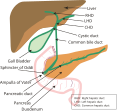 Diagram of the biliary system
 -
 Endoscopic view of the Ampulla of Vater
 -
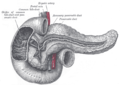 Anatomical illustration of the duodenum and pancreas
 -
 Ultrasound scan of the Ampulla of Vater


Ampulla of Vater[edit]
The ampulla of Vater, also known as the hepatopancreatic ampulla, is an important anatomical structure in the digestive system where the common bile duct and the pancreatic duct join and empty into the duodenum. It plays a crucial role in the regulation of bile and pancreatic juice flow into the small intestine, which is essential for the digestion of fats and other nutrients.
Anatomy[edit]
The ampulla of Vater is located in the second part of the duodenum, which is the initial segment of the small intestine. It is situated at the major duodenal papilla, a small nipple-like projection on the inner surface of the duodenum. The ampulla is formed by the convergence of the common bile duct, which carries bile from the liver and gallbladder, and the main pancreatic duct, which carries digestive enzymes from the pancreas.
Function[edit]
The primary function of the ampulla of Vater is to regulate the flow of bile and pancreatic juice into the duodenum. This regulation is controlled by the sphincter of Oddi, a muscular valve that surrounds the ampulla. When the sphincter of Oddi relaxes, bile and pancreatic juice are released into the duodenum, aiding in the digestion and absorption of nutrients. The release of these fluids is typically stimulated by the presence of food in the stomach and duodenum.
Clinical Significance[edit]
The ampulla of Vater is a critical site for several medical conditions. One common issue is choledocholithiasis, where gallstones block the common bile duct, leading to jaundice and pancreatitis. Another condition is ampullary cancer, a rare form of cancer that arises from the ampulla itself. This can cause obstruction of the bile duct and pancreatic duct, leading to symptoms such as jaundice, weight loss, and abdominal pain.
Endoscopic procedures, such as endoscopic retrograde cholangiopancreatography (ERCP), are often used to diagnose and treat conditions affecting the ampulla of Vater. These procedures can help remove blockages, take biopsies, or place stents to relieve obstructions.
Related Pages[edit]
- Common bile duct
- Pancreatic duct
- Duodenum
- Sphincter of Oddi
- Choledocholithiasis
- Pancreatitis
- Endoscopic retrograde cholangiopancreatography
| Anatomy of the gastrointestinal tract, excluding the mouth | ||||||
|---|---|---|---|---|---|---|
|
