Nelfinavir: Difference between revisions
Created page with " {{intro}} Nelfinavir is an antiretroviral protease inhibitor used in the therapy and prevention of human immunodeficiency virus (HIV) infection and the acquired immunodef..." |
CSV import |
||
| Line 18: | Line 18: | ||
{{antiviral agents}} | {{antiviral agents}} | ||
{{coststubd}} | {{coststubd}} | ||
<gallery> | |||
File:Nelfinavir_structure.svg|Chemical structure of Nelfinavir | |||
File:Nelfinavir_ball-and-stick.png|Ball-and-stick model of Nelfinavir | |||
File:Neutroncrosssectionboron.png|Neutron cross-section of Boron | |||
</gallery> | |||
Latest revision as of 00:42, 18 February 2025
[edit]
Nelfinavir is an antiretroviral protease inhibitor used in the therapy and prevention of human immunodeficiency virus (HIV) infection and the acquired immunodeficiency syndrome (AIDS).
[edit]
Nelfinavir can cause transient and usually asymptomatic elevations in serum aminotransferase levels and is a rare cause of clinically apparent, acute liver injury. In HBV or HCV coinfected patients, hepatic injury during antiretroviral therapy that includes nelfinavir may be a result of exacerbation of the underlying chronic hepatitis B or C, rather than a direct effect of the medication.
[edit]
Nelfinavir (nel fin' a vir) is a nonpeptidic protease inhibitor that acts by binding to the catalytic site of the HIV protease, thereby preventing the cleavage of viral polyprotein precursors into mature, functional proteins that are necessary for viral replication.
Nelfinavir was approved for use in the United States in 1997 for the therapy of HIV infection in both adults and children. Nelfinavir is available in tablets of 250 and 625 mg and as an oral suspension powder under the brand name Viracept.
[edit]
The recommended dosage of nelfinavir for adults is 1250 mg twice or 750 mg three times daily.
[edit]
Common side effects include nausea, diarrhea, gastrointestinal upset, fatigue and, with long term use, hyperlipidemia and lipodystrophy.
Antiviral agents[edit]
Drugs for HIV Infection, in the Subclass Antiretroviral Agents
- Fusion Inhibitors (HIV)
- Integrase Inhibitors (HIV)
- Nonnucleoside Reverse Transcriptase Inhibitors (HIV)
- Interferon Based Therapies
HCV NS5A Inhibitors
HCV NS5B (Polymerase) Inhibitors
- Asunaprevir, Boceprevir, Glecaprevir, Grazoprevir, Paritaprevir, Simeprevir, Telaprevir, Voxilaprevir
Combination Therapies
Drugs for Herpes Virus Infections (HSV, CMV, others)
Drugs for Influenza
-
 Chemical structure of Nelfinavir
 -
 Ball-and-stick model of Nelfinavir
 -
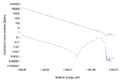 Neutron cross-section of Boron


