Semitendinosus muscle: Difference between revisions
CSV import |
CSV import |
||
| Line 25: | Line 25: | ||
{{Knee anatomy}} | {{Knee anatomy}} | ||
{{stub}} | {{stub}} | ||
== Semitendinosus_muscle == | |||
<gallery> | |||
File:Semitendinosus_muscle.PNG|Semitendinosus muscle | |||
File:Gray432_color.png|Gray's Anatomy illustration of the semitendinosus muscle | |||
File:Gray235.png|Gray's Anatomy illustration of the muscles of the thigh | |||
File:Gray551.png|Gray's Anatomy illustration of the muscles of the leg | |||
File:Gray1239.png|Gray's Anatomy illustration of the posterior view of the thigh | |||
File:Semitendinosus_muscle.jpg|Photograph of the semitendinosus muscle | |||
File:Slide2i.JPG|Histological slide of muscle tissue | |||
File:Slide2j.JPG|Histological slide of muscle tissue | |||
File:Slide2DADE.JPG|Histological slide of muscle tissue | |||
File:Slide2EA.JPG|Histological slide of muscle tissue | |||
File:Slide1BIBI.JPG|Histological slide of muscle tissue | |||
</gallery> | |||
Latest revision as of 21:27, 23 February 2025
Semitendinosus muscle is one of the three hamstring muscles that are located at the back of the thigh. The other two are the semimembranosus muscle and the biceps femoris muscle. The semitendinosus muscle is so named because it has a long tendon of insertion. It originates from the ischial tuberosity and inserts on the medial tibial condyle. The semitendinosus muscle is involved in knee flexion and hip extension.
Anatomy[edit]
The semitendinosus muscle originates from the upper part of the ischial tuberosity, which it shares with the biceps femoris muscle. It is inserted on the upper medial surface of the tibia. The semitendinosus muscle is innervated by the tibial nerve, a branch of the sciatic nerve. The blood supply to the semitendinosus muscle is provided by the inferior gluteal artery and the profunda femoris artery.
Function[edit]
The semitendinosus muscle is involved in knee flexion, hip extension, and internal rotation of the knee. It helps to stabilize the knee and control its movement during walking and running.
Clinical significance[edit]
Injury to the semitendinosus muscle is common in athletes, especially those involved in sports that require running or jumping. The semitendinosus muscle can be strained or torn if it is overstretched or subjected to sudden force. Treatment for semitendinosus muscle injury usually involves rest, ice, compression, and elevation (RICE). In severe cases, surgery may be required.
The semitendinosus muscle is also commonly used in tendon grafts, particularly in anterior cruciate ligament (ACL) reconstruction. The tendon of the semitendinosus muscle is harvested and used to replace the damaged ACL.
See also[edit]
| Muscles of the hip and human leg | ||||||||||||||||||
|---|---|---|---|---|---|---|---|---|---|---|---|---|---|---|---|---|---|---|
|
| Hip anatomy | ||||||||||
|---|---|---|---|---|---|---|---|---|---|---|
|
| Knee Anatomy | ||||||||||
|---|---|---|---|---|---|---|---|---|---|---|
|
 | |
|---|---|
 |
 |
Semitendinosus_muscle[edit]
-
 Semitendinosus muscle
 -
 Gray's Anatomy illustration of the semitendinosus muscle
 -
 Gray's Anatomy illustration of the muscles of the thigh
 -
 Gray's Anatomy illustration of the muscles of the leg
 -
 Gray's Anatomy illustration of the posterior view of the thigh
 -
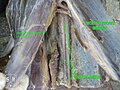 Photograph of the semitendinosus muscle
 -
Histological slide of muscle tissue
-
Histological slide of muscle tissue
-
Histological slide of muscle tissue
-
Histological slide of muscle tissue
-
Histological slide of muscle tissue


