Quadriceps tendon
The Quadriceps Tendon is a strong, fibrous cord that connects the quadriceps muscle to the patella, or kneecap. It is a crucial component of the extensor mechanism of the knee, which allows for the extension and flexion of the leg.
Anatomy[edit]
The quadriceps tendon is formed by the convergence of the four muscles that make up the quadriceps muscle: the vastus lateralis, vastus medialis, vastus intermedius, and the rectus femoris. These muscles merge into a single tendon, which attaches to the top of the patella.
Function[edit]
The primary function of the quadriceps tendon is to facilitate the extension of the knee. When the quadriceps muscles contract, they pull on the quadriceps tendon, which in turn pulls on the patella. This action extends the knee, allowing for movements such as standing up, walking, and running.
Injuries[edit]
Injuries to the quadriceps tendon can occur as a result of acute trauma or chronic overuse. These injuries can range from minor strains to complete tears. Symptoms of a quadriceps tendon injury may include pain, swelling, and difficulty extending the knee. Treatment options can range from conservative measures such as rest and physical therapy to surgical repair in more severe cases.
See Also[edit]
References[edit]

This WikiMD article can only be edited by registered and verified editors. You can log in or register.
-
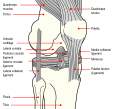 Knee diagram


Medical Disclaimer: WikiMD is for informational purposes only and is not a substitute for professional medical advice. Content may be inaccurate or outdated and should not be used for diagnosis or treatment. Always consult your healthcare provider for medical decisions. Verify information with trusted sources such as CDC.gov and NIH.gov. By using this site, you agree that WikiMD is not liable for any outcomes related to its content. See full disclaimer.
Credits:Most images are courtesy of Wikimedia commons, and templates, categories Wikipedia, licensed under CC BY SA or similar.
Translate page: - East Asian
中文,
日本,
한국어,
South Asian
हिन्दी,
தமிழ்,
తెలుగు,
Urdu,
ಕನ್ನಡ,
Southeast Asian
Indonesian,
Vietnamese,
Thai,
မြန်မာဘာသာ,
বাংলা
European
español,
Deutsch,
français,
Greek,
português do Brasil,
polski,
română,
русский,
Nederlands,
norsk,
svenska,
suomi,
Italian
Middle Eastern & African
عربى,
Turkish,
Persian,
Hebrew,
Afrikaans,
isiZulu,
Kiswahili,
Other
Bulgarian,
Hungarian,
Czech,
Swedish,
മലയാളം,
मराठी,
ਪੰਜਾਬੀ,
ગુજરાતી,
Portuguese,
Ukrainian

